Monday, June 10, 2019

Cutoff to Downhill: 13:35 - 14:53


Running #420, the Upbound Freight, on the Daylight Pass Railroad


October 20 1954: 13:35 – 14:53

The first couple miles east out of Cutoff are a continuation of the same gently winding grade encountered below Cutoff, but then the track starts to steepen, eventually reaching a stiff 2.65%, then soon arcs into the left-hand turn that marks the beginning of the giant S curve that claws its way up the west approach to Daylight Pass.

Leaving the jenny behind in Cutoff has lightened the train a little, but with three loaded cars it still weighs in at just about 284 tons which drags their speed down to around 13 MPH on the steep grade, which means covering this 18 mile segment of track, the longest single segment on the railroad, will take well over an hour. It doesn’t help matters at all that they have to slow when crossing trestle 39.6 which is so close to the steep part of the grade they have little time to build any speed back up after crossing the weakening bridge, but that’s railroading.

The western approach to the pass is not particularly rugged, just steep. And while the scenery in the confines of Wild Woman Canyon is spectacular, the view from the West Pass Grade is far-reaching.

The altitude has caused the trees to dwindle into a few scarce and scraggly specimens as the tracks work their way up into the clear, and increasingly cold, air. Up here the ground is covered with low brush and short, twisted trees, but unlike down in the basin with its sparse and thorny gray-greens, here the alpine flora is a undulating blanket of greens; dusty greens, deep greens, bright greens, the whole spectrum.

Tiny, ground-hugging flowers sometimes cover the greens creating little clouds of purple and dusky yellow. And this time of year the train is rolling through russet patches as the greens of the leaves give seasonal way to the colder nights, showing yellows and reds instead.

The laboring train passes MP 54 with no sight of the track-gang that is supposed to be clearing brush on the downhill side so there will be somewhere to dump snow clear of the tracks this winter. What the sharp eyes of both Tom and Jake do see is the telltale ash and remaining spike of a burned out fusee right at the point where the track-gang obviously stopped cutting brush.

Since the fusee is already burned out the track-gang, who have apparently set their speeder back on the track and bugged out, is more than 10 minutes ahead of them so Tom keeps the train running as fast as the little engine will allow*, but it is strange that the crew has knocked off and headed back to Downhill so early.

*If the fusee had still been burning Tom would have been required to stop. If he could stop before running over the burning fusee he could proceed as soon as the fusee burned out. If he ran over the burning fusee before he could get stopped he would have to wait a full 10 minutes before proceeding. In either case, he would then be operating under the restricted speed rule which means he has to be able to stop in half the distance he can see down the tracks.

Nearing the upper flank of the approach to the pass the tracks duck into a 1238’ long slide-shed spanning a natural chute carved into the flank of the mountain by eons of wind and water. In addition to being prone to slides, this chute also tends to gather wind-driven snow along its leeward side, piling it into a train-stopping drift. When this happens the slide shed creates a tunnel through the drift so the trains can keep on moving. It will come into its own in a few months, sheltering the tracks from slides and the frequent winter winds, but today all it does is amplify the sound of the hardworking engine while trapping its wet smoke under the heavy timbers, forcing the crew to breath as shallowly as they can until open air finds them again at the other end.

From these high slopes, as long as you’re not inside the slide shed, a person can see down the mountain all the way to Daylight huddled there at its base. Beyond that is the bright shimmer of the white gypsum fields towards the western side of the basin and north of that, if you know where to look, the faint black slash of the lava fields. And to the west, all the way over on the far side of the basin, lurks the rugged blue outline of the San Andres range some 70 miles away. If you like long views that dwarf the scars of man into oblivion, riding the rails clinging here to the side of the mountain is the place for you.
 
But near the top of the grade one last left hand curve puts the engine crew’s view behind as the tracks make the final eastward run up into the pass itself.

They run over a couple more burned out fusees as they climb the upper reaches of the grade,* but the last one, just before they reach the long left-hand curve on the final approach to Downhill, is still smoking.


*The speeder crew, or any train crew that thinks they may be over-run by a following train, is required to drop a fresh fusee about every 10 minutes until they can get into the clear.


The little speeder the track-gang is using is even slower than the Freight and they have been catching up to it. Tom glances over at Jake who shrugs. Something isn’t right, probably one of the track-gang got hurt bad enough to need help, but they will have to wait to find out for sure. Right now their job is to get this train into Downhill.


Thursday, June 6, 2019

Structural Crisis Averted - I Hope

You might remember a couple posts ago I was behind The Wife's barn trying to keep it from washing down the hill.


Well she has a shady little garden tucked in against the north side of that barn decorated with various things, including three of these decorative bird cages that she picked up for next to nothing at a resale shop and had me hang from one of the surrounding trees before populating them with another cheep find, some green metal cats.

Well I was back there trying to kill myself by digging a trench when I noticed, through the sweaty fog and floating eye-spots of over-exertion, that one of those cages was populated by more than those stylized metal garden-cats.


In some sort of twisted irony, some Carolina Wrens had built their nest in the bottom of the cage and right now it was filled to bursting with chicks that hadn't fledged yet.

The thing about Caroline Wrens is that they will build nests anywhere. Every year I have to shoo them out of the barn and once I caught one of the little buggers building a nest in a cubby in the open rear door of The Van.

So even though they had chosen the lowest of the three cages hanging in that tree, this wasn't such a bad place for a nest.


Except that disaster was looming.

These cages are not really built to hang out in the weather like that and I guess the added weight of the nest along with retained moisture from all the material the wrens had brought in was on the verge of being too much.


My quick fix was to wrap a couple lengths of para-cord around the cage to hold the floor up. Not pretty, but it was something I could do with the least amount of disturbance to the inhabitants and it only has to last until the occupants have fledged.


Monday, June 3, 2019

Cutoff: 12:37 - 13:35


Running #420, the Upbound Freight, on the Daylight Pass Railroad


October 20 1954: 12:37 – 13:35

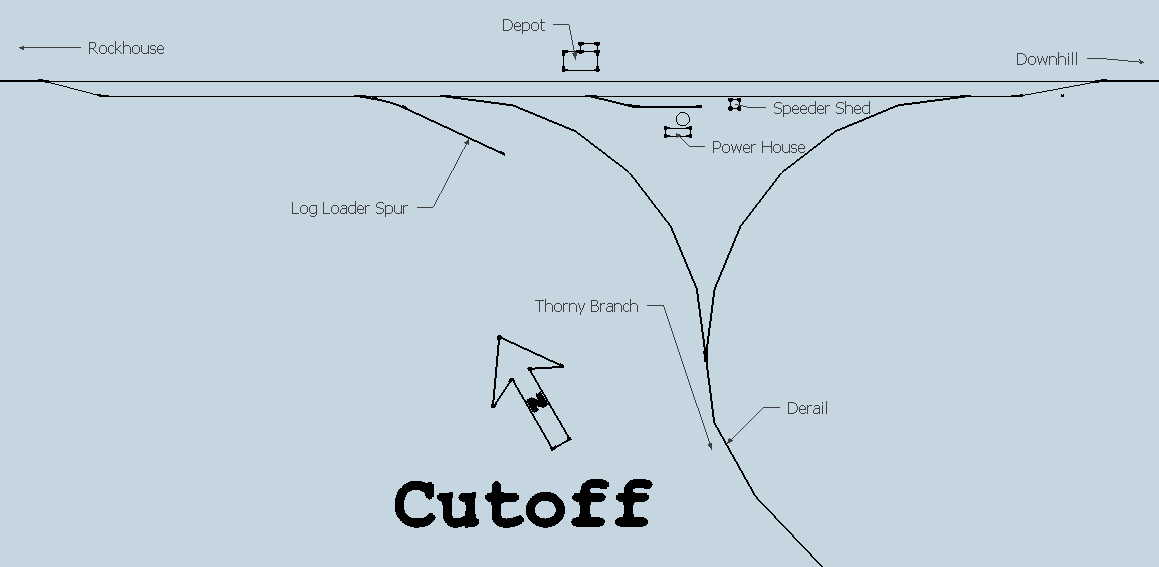
Cutoff* is the smallest and most remote of all the outposts along the DP. Remote enough that here, firmly in the middle of the twentieth century, it still requires a generator to supply electricity because no power lines reach into this isolated part of the valley.

*The question of whether Cutoff was named for its isolation or because it’s the point where the Thorny Branch branch-line cuts off from the main has never been definitively answered, though there are adamant proponents in both camps.

Not counting the Jackson family, which pretty much keep to themselves partway up Gobblers Knob, and the small, seasonal logging crew that sets up camp out in whatever woods they’re working at the time, Cutoff has a permanent population of two and consists of the depot, a generator shed, and a speeder shed.

Originally Edward Bishop envisioned Cutoff growing into a town not much different than Three Creeks. A bustling, growing little center of commerce servicing the mines he expected to start popping up along the flanks of Russian Flats as soon as his railroad opened up the area. A town, not coincidentally, that would be sitting on Lincoln Holdings land. But apparently the vein of ore under Gobblars Knob was an anomaly and once the Thorny Prospect Mine closed down the DP would have abandoned this blip on the mountain were it not for its importance as a control point at the base of the West Pass Grade.

The depot here is the only one on the line with living quarters attached. That’s because the DP has found the most cost-effective way to staff this remote location where labor is hard to come by is to hire a husband-wife team and have them live right there in the depot. To that end an addition was added to the back side of the original building to accommodate a small but cozy kitchen, indoor tub, and bedroom/sitting room. Of course the depot waiting room rarely sees any actual passengers so the occupants can more than double their space by spreading out into it when they want.

Between the remoteness and being ‘on’ 24 hours a day every day, it’s not an assignment suited for just anybody, which has resulted in frequent turnover, but Matt and Anna, a couple that are somewhere in their late 50’s early 60’s,* have held the post down for almost three years now, almost as long as Tom has been back on DP tracks.

*Everyone assumes they are married but nobody bothered to look at their backgrounds very carefully when they applied for the job that very few seemed interested in.


A couple times a month one or the other of them will use their company pass and catch the morning Downbound Express to Daylight. After a stroll through the bustling environs of town and eating a lunch prepared by someone else for a change, they, which ever one of them went down, will return on the evening Upbound with supplies. And for emergencies the DP leaves a speeder sitting in a shed near the generator that they can use to get down to Rockhouse fairly quickly if necessary, not that that’s a lot of help since, other than a few more people, Rockhouse is pretty much as bereft of services as Cutoff, but taking a speeder down Mesa Hill would be suicide and going up to Downhill is too much for the diminutive engine in the old and surplus speeder.

Once in the siding the crew of Extra 1428 East cuts the house-car off then pulls the rest of the train forward, right out the other end of the siding and onto the main. (Despite the length of the siding, because of a design blunder the only way a train more than a single engine in length can get into the west leg of the Y is to pull out onto the main.) Anna, the other half of the Cutoff Station Agent team, is there to throw the west Y switch for them  and Tom backs into the curve.

Anna has already lined the south Y switch and unlocked the de-rail,* so Tom doesn’t have to stop again until the ore jenny has been shoved back beyond the de-rail, onto what used to be the beginning of the Thorny Branch, the DP’s one and only branch-line.

*When closed a de-rail will pick up a wheel and throw it to the outside of the rail, dragging the opposite wheel off the inside of the other rail, putting the car or engine on the ground, protecting the track beyond. When open the de-rail lies harmlessly between the rails so cars can pass.

Back when the railroad was built, even before the track was completed up through the pass into the lucrative mining area of Six Peaks, the construction crews shoved a switch-backing, 7.8 mile branch-line up the eastern flank of Gobler’s Knob to reach the site of the Thorny Prospect Mine. It just so happened that Edward Bishop held the proofed and patented mining claims up there and he leased them to the newly formed Thorny Prospect Mining company for a little percentage of every ton of ore that came out of the ground. Of course he also got paid for every ton his railroad dragged down the mountain to the processor.

When the mine ceased operation in 1946 the Jackson Brothers, owners of a small drift-mine partway up the flank of the Knob, convinced the DP to turn the lower 3.1 miles of the branch line over to them with the stipulation that the brothers would maintain and operate the track on their own. With scrap prices being modest at best, the DP management, which by then meant Edward’s son Charles, decided that the limited revenue they would get from hauling the occasional load of Jackson Brother’s ore down the mountain would, in the long run, be worth more than the scrap value of that last 3 miles of rail, so they agreed.

So instead of having to back up the former branch-line all the way to the Jackson Brother’s tiny mine, all Tom has to do is leave the jenny sitting on the track behind the re-locked de-rail.

Because they are late dropping this car off the brothers are already sitting there just up the track in the little 4 wheel, 7 ton Baldwin they picked up used in Albuquerque and repowered with a John Deer diesel engine of shady origins, (The brothers claim it came from the same Albuquerque dealer the Baldwin did after they found the original gas engine wasn’t up to the job, but around that same time a nearby abandoned McGiffert log-loader’s engine, coincidentally also a John Deer diesel, went missing.)

The brothers are waiting impatiently to drag the jenny the rest of the way up to their mine as soon as possible so they can get it loaded, by hand since their tiny operation doesn’t include a fancy loader, and back down to the derail before tomorrow’s downbound freight.

It only takes a few minutes to pull out of the Y and back down the siding to retrieve the house-car, but now they have to wait on the Ore so, with Ronald staying behind to mind the engine, the rest of the crew drifts on over to the depot where they spend the time standing on the ramp to the freight room chatting with Matt and Anna. The Station Agent are a nice couple that have few opportunities to socialize up here so the crew are content with taking a break.

Well, perhaps Dean is a little less content than the rest.

Being delayed has ruined his plans to sit at the counter in Ryan’s Emporium – Drugs – & Sundries up in Three Creeks and flirt with Isabella Montego between her bouts of serving burgers, fries, and ice-cream, mostly fries because they are the cheapest, to the kids after school lets out.

Now, by the time they get to Three Creeks Isabella will be home serving her widowed father and older brother, both of who work first shift at the power plant, their dinner. Dean knows better than to come calling when Isabella’s father is around. The man has no trust when it comes to Dean, nor should he truth be known.

At first Tom isn’t much of an active participant in the conversation, which he is vaguely aware is centered on the upcoming winter and getting a machinist from the roundhouse to come up and give the generator a good going over before it gets here.

Instead he lets his eye wander to the fenced garden-plot there in the middle of the Y. Matt and Anna, mostly Anna though Matt puts in his time as well, are accomplished gardeners and in summer the plot is bursting at the seams with an array of plants that feed the two well for most of the year.

This time of year there are only a few late-season crops still in the ground. He can see carrots, beets, cabbage, and, even from here, he can see the tops of plump red radishes poking out of the ground. It’s still a little early for them down in the warmer climes of Daylight, but he doubts his own radishes will look anything near as good as Matt and Anna’s.

Until the past couple years he would have never recognized the different plants let alone have some of his own, but now he has his own garden-plot behind the little two-bedroom house he bought in the old section of Daylight when he moved back after – well, after.

He’d never been a gardener before so he doesn’t know where the urge came from, but now he spends much of his downtime out back messing with his plants, which include what the older lady that lives on the other side of the alley calls ornamentals mixed in amongst his veggies just because he likes the way they look.

Being reminded of his garden helps chase away the daemons brought on by the ineptitude of the paperweights down in Daylight, or at least drives those daemons into some remote corner, and with renewed interest he joins the conversation.

Eventually they hear the whine of the Ore coming down the mountain, even though it will still be several minutes before it arrives.

The whine comes from the eight traction motors on the two Alco RS-3’s that make up the Ore’s motive power. The motors, instead of delivering power to the track are now busy turning the rotation of the axles into electricity. This is like downshifting a vehicle, and like downshifting, is holding back the 1000 ton train. The traction motors whine when used as generators and the whine is only added to by the sound of the big fans inside the short-hood struggling to cool down the resistors all that generated electricity are heating up.

The resistance of dynamic braking means that the air brakes can be used much less and, unlike when it was powered with a couple steamers, now the Ore can roll straight through Cutoff without stopping to cool brakes and wheels and reset retainers after the long run down West Pass Grade.

Finally the headlight of the approaching train, with engine 1955 running in the lead with 1956 trailing, pokes though the woods and the group in front of the depot, to a man, or rather to a person, checks their watches as is the ingrained habit of railroaders. The Ore is right on time and the group in front of the depot splits up.

The semaphore is pointing down since there are no orders to hand up so the Ore will be rolling straight through Cutoff. Matt stays put on the depot side of the tracks while Anna steps across the main to the other side. The crew of Extra 1428 also drifts across the main to stand next to their train.

Anna and Matt inspect their respective sides as the Ore rolls by with a raucous, soulless blatt from the airhorns that makes the crew of the steamer cringe.

“I’m not sure I’ll ever get used to that sound,” Otis says.

“Yeah,” Tom agrees. “You can’t play those airhorns like you can the whistles either.” That’s going to suck some of the life out of railroading. He keeps that last thought to himself.

Both Matt and Anna give a highball to the house-car crew when they see nothing more than a little residual smoke from the brakes that helped control the speed of the train as it came down the long, steep slope of the West Pass Grade. From here to Rockhouse the dynamic brakes will be enough to hold the train without using the brakes anymore. At Rockhouse they will stop just long enough to alternate the retarded cars as they prepare for dropping down Mesa Hill.

Shortly after receiving the highball the engineer, who has slowed the train while passing the depot, pulls the selector handle back to the big “B” position which reduces the amount of dynamic braking effort to zero and the whine of traction motors in generator mode drops to a whisper. This allows gravity to do the work of speeding the train up again as it starts down towards Rockhouse.

That’s the crew of Extra 1428’s signal to get ready to roll themselves.

As soon as the Ore clears the depot Anna, who generally handles all the switching at the east end of Cutoff while Matt handles it at the west end, trots lightly and expertly along the ties between the rails and lines the east switch so the Freight (Technically it’s not the Freight anymore but everyone still thinks of it that way.) can take the main.

Thursday, May 30, 2019

An Exercise in Fluid Dynamics


Nope, that nasty old thing isn't a sooty stovepipe, that's our well aged rain gauge.

Often times when it rains here in Central Texas it RAINS. This is our rain-gauge on May 3rd. It was empty on May 1st. Of the 6 inches or so in the gauge, 5 of those fell in about an hour and a half.

As I've mentioned before, nothing about our property is flat, so when it rains like that we don't have to worry about flooding, but we do get some serious runoff.

When things eased up I, as usual, was out inspecting the fresh washouts in our driveway to determine which ones we could live with and which I would have to do something about, when I came across a chunk of pressure-treated 2x8 about a foot long sitting out in the middle of nowhere. At first this was curious since I hadn't been doing any projects with treated lumber recently, but then I looked uphill and the light dawned. That's when things went from curious to alarming.

The black wire is the ground for a mast-mounted am-fm radio antenna, crossing under the barn to tie into the electrical ground-rod.

The Wife has a little barn of her own where she shelters the remaining 'stray' cats, all pretty dang old now, she collected when we lived in town and where she also keeps all her craft supplies. It's one of those "portable" buildings you see being sold along the roadside, at least you see them along the roadsides around here, that we have wired, insulated, paneled and air-conditioned. (The Wife needs lots of air-conditioning from May through to October. . .)

Despite what they call it (Here in Texas "portable" buildings without foundations or concrete slabs are ignored for property-tax purposes, which makes them popular.) her barn is hardly portable, being about the size of a small two-car garage, and it had to be built on-site on top of a gravel pad. Once the pad was prepped, by a contractor that supposedly knew what he was doing, (I shouldn't complain, the barn's been there for over a decade.) the guys showed up with The Wife's barn, or at least the components of The Wife's barn, on a trailer. It took the two men a very long day to get the shell up and it is supported on a whole bunch of concrete pads with bits of treated lumber on top to level out the floor-joists.

That bit of lumber I found hanging out in the middle of nowhere directly downhill from the barn had to be one of those bits.

Sure enough, when I got down on my belly and shown a flashlight under the barn - well - it was bad. . .

The damn thing was giving birth to our own personal Grand Canyon under there and at least one of the support pads had been sitting right in the way.

Holy Crap! One more good rain and the whole damn barn might end up down in the pond!


After a sunny break of a couple days we were due for another week-long round of rains projected to total up to another 5 inches (Normal rainfall for May is 4.82 but we don't always get normal.) so I needed to do something about this situation like right now!

Since the barn was still standing firm despite the loss of some of its support I decided my efforts were best focused on finding a way to prevent any additional gouging out of our own version of the Grand Canyon.

My solution, at least for now, was to divert the runoff to places where it wouldn't be washing the barn down to the neighbour's ranch. (Because I'm pretty sure he doesn't want it.)

I started by digging a trench along the uphill side of the barn. (When you write it down like that it sounds so easy, so offhand, but you try digging an 8 inch deep, 14 inch wide trench in undisturbed,wet, sandy-clay gravel! And do it without dying in the process!)


Then I dropped a couple sheets of left-over polly-carb roofing into the trench (I knew I'd been keeping that stuff around, like for over a decade, for a good reason!) 


And back-filled the trench in three lifts, tamping each one down with a hand-tamper, the only kind I've got. (You know, one of those arm-killing heavy metal plates on the end of a vertical stick that you pick up and smash down, over and over; and over and over; -  and over and over; -  and over - hopefully only hitting your toes a few times in the process.)

The idea, however deluded it is, is that water coming down the hill behind the barn will, instead of flowing right on under it, hit the exposed polly-carb while the buried part keeps it in place, and then divert to either side of the barn before continuing on down towards the pond.


The next morning I dragged a few 60 pound "bricks" (I have some bags of topping mix that I managed to let get wet that I've been keeping around because - well, you never know.) up from where I had them tucked into a corner of the tractor barn.

I suppose I could have used the tractor to haul them up to The Wife's barn (163 steps away and all uphill -- I counted.) but that seemed a little on the decadent side, especially on such a nice sunny day full of birdsong, so I used the hand-truck instead.

Once The Wife found me passed out on the ground and revived me, (Which I'm pretty sure consisted of a few kicks [she says nudges but I don't believe her!] to the ribs while she muttered 'silly old fart.') I threw them down in the hopes of controlling erosion until the trench packs down hard and vegetation grows back and stabilizes it. Then I'll remove the "bricks". At least the trip back to the tractor barn will be downhill!


But I'll tell ya, a project like this is not good for maintaining the flabby-old-man-body image I've been working on so hard for so long.


Monday, May 27, 2019

Rockhouse to Cutoff: 12:18 - 12:37


Running #420, the Upbound Freight, on the Daylight Pass Railroad


October 20 1954: 12:18 – 12:37

In stark contrast to Mesa Hill, the run from Rockhouse to Cutoff is an easy, relatively straight, 4.9 miles of gentle uphill grade up through the lower end of Russian Flats. Tom and Jake are able to pull the 312 ton train, now whittled down to 3 loads and one empty, across the distance at the speed limit and in slightly less than 20 minutes.

At this altitude, once they are moving again, mostly in the shadows thrown by the trees crowding the tracks, there is a definite bite, a sharp crispness, to the air, that has Ronald retreating into the three-sided doghouse on the tender’s deck to escape the worst of the wind, while Jake shrugs back into both his shirt and jacket as that air cools one side of him while the firebox heats the other. Back in the shelter of the house-car Otis tosses an extra stick or two into his stove and checks to make sure there is still coffee in the pot while Dean keeps an eye on the train from the relative comfort of his seat in the bay.

By rights Ronald, who has more seniority than Dean, should be the rear trainman, which technically is also second in command of the train behind Otis, but he usually has no trouble swapping with the other trainman, giving up the warmth and shelter of the house-car for the open air, and solitude, of the tender-deck.

It’s not that he doesn’t like them, the rest of the crew that is. Otis is one of the easiest conductors he’s worked for and Dean, despite being a shameless skirt chaser and avid partier, is always holding up his end of the deal, doing his share of the work, but experience has taught Ronald that socializing, talking, especially talking personal stuff, is not something that is part of him anymore. That’s something he left behind somewhere on a no-name Pacific island where he traded civilized niceties for the stench of the burned out tunnels and bunkers he had to clear in the most savage ways imaginable, sucking the humanity right out of him, and forever changing his view of man’s place in the world.

The fact that he is still alive while so many others aren’t shows just how good he was at the savagery and that frightens him. In the years since he hasn’t been able to claw his way back to the person he was before the war and now figures he probably won’t, but today, in this moment, that isn’t going to keep him from sitting up here keeping watch over his cars and enjoying being alive in such a beautiful, though sometimes harsh, place.

The leaves, those of the hardwoods anyway, are dropping rapidly and swirling in the passage of the train, sparking a sudden memory of Thanksgivings in western Pennsylvania with his aunts and uncles and lots of cousins. It’s a comfortable memory but a memory it will remain because Ronald, swaying and jerking up there in the solitary sanctuary of the doghouse, won’t be sharing this with the rest of the crew. Maybe, someday, with Cloe, but not yet.


The altitude means the trees are slightly smaller along here than down around Big Timber, but it’s still forest and here on the lower half of Russian Flats, between Rockhouse and Cutoff, there used to be a couple of small logging operations that worked the area, but the two log loaders that serviced them were abandoned after the sawmill in Daylight burned and pretty much eliminated the market for logs, though the short spurs that serviced them have been left in place.

Instead of loggers anymore, the crew occasionally gets a glimpse of elk through here, but not today.

As they approach the west siding switch Tom sees that it is still lined for the main and that Matt, half of the station agent here at Cutoff, has just left the depot at a run to line it properly. Tom chastises himself for mindlessly operating as if he was still #420, assuming the switch would, as usual, already be thrown so he can just roll right on through it. This is an assumption that has him moving the train right along.

But the reality is that it isn’t surprising the switch hasn’t already been thrown since they are so far off schedule and switches must be left lined for the through route until needed. But, because this is the longest siding on the railroad, it’s a long ways from depot to switch, so now Tom is going to get there before Matt will make it, so he needs to get the train stopped short of the points.

The steady rhythm of a train easily covering distance is suddenly interrupted when Tom dumps 10 pounds out of the trainline while bailing off the independent. As soon as he gets the pressure in the trainline down to where he wants it he pulls the service brake lever back to hold then shifts his left hand to the throttle which he starts easing off, but not so much the engine stops pulling on the train as they slow. Otherwise, as he’s making this somewhat sudden stop the slack will run in hard enough to give Otis a nasty jolt.

If he doesn’t bail off by holding the independent brake lever down against the spring trying to force it back up, then the application of the service brake results in an equal application of the independent brake and without the engine pulling the slack will run in on him. Since he needs to gradually close the throttle as the train slows, start the bell, possibly add more brake if he hasn’t set them hard enough, (He does end up dumping an additional 2 pounds.) and bail off the independent all at the same time, he could really use three hands at the moment!

Many engineers keep a nut of just the right thickness, or even a carved wooden wedge, in their pocket which they jam between the housing and the independent lever to keep it forced down and bailing off hands-free, but this is against the rules because if the engineer forgets the independent is disabled like this it can be downright dangerous.

It’s inconvenient, juggling the service brake, throttle, and other controls with only his left hand as the right holds the independent lever down, but Tom prefers to play it safe and never wedges the independent. At least not anymore. Not since an incident on the SP 9 years ago scared the crap out of him. (Forgetting his wedged independent brake in a fog of sleep-deprivation, he cut the engine off a string of cars to run a quarter-mile up to a water tank and nearly ended up rolling right through a switch and into the side of an opposing train when he couldn’t apply the brakes.)

The train comes to a stop, more abrupt than Tom would have wished for, with Matt still 20 yards short of making it to the switch.

With the switch lined Tom pulls past Matt and lets the train drift down the longest siding on the railroad.* He brings it to another, much gentler, stop just short of the east Y switch, using the independent this time to gather up the slack so pulling the pin to uncouple the ore jenny from the house-car will be easier.


*This siding is long enough to fit two trains end to end, which is a real help here at the base of the West Pass Grade where trains tend to stack up waiting for their turn at the longest stretch of unbroken single-track on the railroad.


Monday, May 20, 2019

Rockhouse: 11:31 - 12:18


Running #420, the Upbound Freight, on the Daylight Pass Railroad


October 20 1954: 11:31 – 12:18

After the adrenalin high of dragging the train up Mesa Hill the crew is, to varying degrees, exhausted in the aftermath of success, so they work slow and deliberate as they switch Rockhouse, because no matter how fast they work now, there is no way they can make their scheduled meet with the Downbound Ore at Downhill, which means they will have to wait out the meet at Cutoff, which is only 20 minutes away. So there’s no point in rushing around and possibly getting someone hurt.

There are railroad towns, and then there are railroad towns. Both types were created by the railroad for the railroad, but they differ in what happened next.

The former, Towns like Cheyenne, Dodge, Midland-Odessa, managed to survive, continuing to grow and thrive even once the influence of the railroad started to fade.

The latter – well, not so much. Like the former these towns could be found at the terminus, often temporary terminus, of any railroad project, serving as supply and entertainment points for the track-gangs. But unlike the former, once the track moved on the hotels, the brothels, the saloons, the laundries, the general stores, could find no purpose anymore other than as a temporary obstruction to the winds blowing through.

These are the towns described in a late 1800’s Harper’s Magazine article as instant cities that are wicked, wonderful, and short-lived. Towns that were created for a temporary purpose, just like their successful brethren, but could not sustain themselves beyond that.


After the track-gangs moved on these are the stranded towns, some of them still strung out along the original right-of-ways like cheap glass beads spaced out along a frayed and knotted string. Towns like Horace in western Kansas that today boasts a population of slightly less than 100 and is in real danger now of losing its Post Office, pretty much the only business still in existence.

Then there are towns like Coyote, not all that far from Horace, that in its day, sported “canvas saloons, sheet-iron hotels, and sod dwellings surrounded by tin cans and scattered playing cards”, drawing a steady stream of optimistic, and opportunistic, men and women to the muddy Rat Row, as main street was called, all looking for the best of the building lots marked out with stakes poking up through the prairie grass. But despite that Coyote has now long since disappeared, not only from the maps but from the landscape itself.

Rockhouse too was one of those end-of-track towns. A staging point for the work on the mainline up through Russian Flats as well as the branch-line up Gobbler’s Knob. Here is where supplies, drug up from the basin below, were collected and distributed, where the cook-house, laundry, and barracks for the care and feeding of the track-gangs were set up on one side of the tracks and canvas-walled saloons for the watering and fleecing of those same track-gangs, popped up on the other.  Where the engines working the head-of-track were also fed and watered, and where a DP-owned quarry was opened up to shorten the haul of rock and rip-rap needed to support the rails.

But despite there being few, as in pretty much no, other redeeming commercial opportunities in the immediate vicinity, much like Coyote Kansas, being at about the halfway point on the DP’s 65 mile route, Rockhouse didn’t completely fade into obscurity when the track-gangs moved on.

The railroad, in addition to stationing a section-crew here to handle the constant maintenance and repair of the trackage through this middle part of the rail-line, has also kept Rockhouse alive as a watering stop, the only one between Goat Crossing and Three Creeks.  In addition, today Rockhouse where the up and downbound Expresses meet up twice a day so this is where the DP’s only two-sided depot* is located, with the Upbound using the south platform and the Downbound the north.

*The depot in Daylight also has platforms on each side but in its case the platform on the west side belongs to the Southern Pacific and not the Daylight Pass.


While Otis follows Tom (station agent Tom) to the depot to collect their new orders (As expected, the semaphore in front of the depot is horizontal, because they have to pick up new orders since their time table warrant is no longer valid. This is going to keep station agents all up and down the line busy until the schedule can be restored again.) the rest of the crew spot the empty gon out at the quarry by leaving the house-car sitting on the main and backing the empty gon and ore jenny ¾’s of a mile down the trailing-point quarry spur, through the big chain-link gate, around a pretty sharp right-hand curve, and spotting the gon near the portable rock-crusher which has replaced the big, and long worn out, original crusher that is now sitting lopsided in the weeds where years of use eventually beat it into submission.

The quarry was an active place during construction of the railroad east of Rockhouse when it supplied the large rip-rap used to shore up and protect footing and embankments. A few years later the original rock-crusher was carried up from the basin in pieces on the backs of flatcars and straining engines and used to supply the crushed rock for the ballasting project as the rough-laid track was improved in the following years.

Since the completion of the ballasting project in the late 1920’s the quarry has only been used sporadically, mostly supplying the rip-rap and ballast needed for maintaining the railroad. Though there was a spate of increased activity about 4 years back when the Continental Lodge catering to the skiing crowd in Downhill was built. 888
Right now there is a work train parked on the old abandoned Bishop Estate spur* consisting of a gon-load of timbers, a tool-car, and the big steam powered Ledger.

*In the flush years of the 20’s Edward had a large summer-estate built near the edge of High Hill adjacent to the Rockhouse ruins where it could take advantage of the altitude, cool breezes, and spectacular views. He also laid a rail-spur that reached into the grounds of the estate. The spur came complete with a miniature hand-operated turntable so he could take his 1923 Hudson Touring Super-Six, converted for rail travel, right up to the back door then turn it around for the trip back down the mountain. Today the estate is rarely used and Charles Bishop is in talks with a hotelier exploring the idea of a joint venture to turn the 9 bedroom estate into a high-end resort destination. If that comes about then the rail-spur will probably be opened back up, at least until the highway makes it up here to Rockhouse.


Lacking one of those fancy wrecker-cranes the big railroads have hanging around, the DP relies on the big railcar-mounted Ledger to do the heavy lifting, all of it. With the railcar chained down to the tracks the Ledger’s 1.5” cable can haul tremendous loads. Of course it can only pull in the one direction so the accompanying toolcar carries an assortment of slings and pulleys and blocks that the crew, sometimes with a great deal of ingenuity, uses to direct the pull in whatever direction is necessary.


Last spring’s runoff weakened the footings around some of the pilings of trestle 39.6 and the subsequent shifting has damaged some of the bents. Sunday, when they can work undisturbed by other trains from 08:30 till a little after 17:00 when the returning Ore Turn is scheduled, a crew will be replacing damaged timbers on some of the bents and shoring up the footings with the rip-rap that will be loaded into the gon #420 just spotted.

After coming back out of the quarry stub the crew of #420 tags the last empty, the ore jenny they will set out on the Y at Cutoff for the Jackson Bothers Mine, back onto the house-car. Pushing both back through the west switch where they leave the house-car and jenny behind on the main as they run back up past the depot and clear of the east siding switch.

From there they back down the siding and couple up to the first cut of cars they hauled up the hill. Continuing backwards they run out the west end of the siding and pick up the gon and house-car. With their train finally all in one piece again they head back up the siding and Tom eases to a stop with the tender opposite the water-column standing between the tracks just in front of the depot.

Unless the crew wants to use the siphon* this is the only place to water the train for the rest of the upbound journey.  To simplify taking on water here at Rockhouse the spacing between the main and siding is a little wider than typical. This allows room to put a water-column, basically a water-spout not attached directly to the side of a water tank, in between the tracks where the pivoting spout can service engines on either track.

*The siphon is a fitting, usually attached to lower edge of a tender’s tank for easy access, that uses steam from the boiler to pump water out of a tank, creek, pond or most any other source below the level of the tender-tank, and up into the tender. Basically the siphon is the first 2/3rds of an injector. Steam is fed through s small pipe into a tapering cone which increases its velocity. The resulting vacuum draws water up a suction-hose temporarily attached to a protruding nipple, then the water is mixed with the steam in the second stage and forced up a pipe and into the tender. Though this uses up some of the precious steam, it is still a more effective way of getting water into the tender than using a bucket-brigade. (Using buckets to fill the tender at a place too remote or small to warrant a water tower is a process known as jerking water and is the origin of the derogatory phrase ‘jerk-water town’.)

There are two stand-pipes here at Rockhouse, one near each end of the siding. This means that it doesn’t matter which direction a train is going or track it’s on, it can simply pull forward and take on water while its cars are clear of the switch behind.

This arraignment to quickly and efficiently watering trains is important because, even today with less traffic on the line than in earlier years, nine trains a day come through Rockhouse and every day, seven days a week, between 07:17 and 07:22 there are three of them in town at the same time. The two Expresses and the Upbound Ore.

Both standpipes are supplied by a single 30,000 gallon tank that sits near the maintenance warehouse and is fed with a pipe from a year-round creek higher up the mountain.*  The water is sent from tank to the 10” spouts by a large pump tucked under the elevated tank that can push as much as 1500 gallons per minute.

*Originally the tank was fed with an open-topped, overhead flume but that proved prone to icing up so was replaced with a buried pipe instead. You can still see a section of the old flume standing back there in the woods below the dammed section of creek if you know where to find it.


Spotted at the standpipe, Jake, not bothering to don the flannel shirt the heat of the fire he tends compels him to remove whenever they-re not out on the track generating their own breeze, climbs up on the tender where he pulls the large fill-hatch open, letting it crash back onto the stops with a hollow-sounding boom. In the meantime Ronald climbs down and, using a lever similar to that on a switch stand, pivots the heavy standpipe against a slight incline so the spout swings over and hangs above the tender.

The spouts here at Rockhouse tilt up and down against a counter-weighted pulley system just like the ones on more traditional water tanks to accommodate all sizes of tenders, and as Jake finishes swinging it into position over the open hatch he leans on the spout to lower it close to the hatch to minimize splashing.

When he’s got it positioned he gives the OK for Ronald to open the valve at the base of the water-column and pull the heavy switch that starts the pump over there in the heater-shed under the water tank. In a few seconds water is gushing loudly into the 2/3rds empty tender. (Jake can tell what the water level is by counting the exposed rungs of the permanently fixed ladder used by the roundhouse crew to climb in and clean the tank.)

A light train, such as the Express’s before that job was taken over by the RDC’s, could make it up to Three Rivers without taking on additional water, but the heavy trains trying to climb the mountain go through a whole lot of the stuff and must water here at Rockhouse. Downbound trains, which are mostly drifting, which doesn’t use near as much water, don’t bother unless they have been delayed excessively.

When the water is just about to spill over the combing around the hatch Jake gives a shout and Ronald turns the pump off and closes the valve.  Jake steps out of the way of the spout which is pulled back up by counter-weights and pivots away on its own until it is parallel to the tracks and once again out of the way of passing trains. To finish up Jake closes the hatch. This time it drops into place over the full tank with a solid gong sound.  

While all this is going on Tom climbs down and oils and inspects the engine before joining Otis and agent Tom in the depot to check in their new orders.

Actually, it’s two sets of orders.

The first is an order annulling train #420 from Rockhouse to Three Creeks, wiping it from the schedule for today. This order is also sent to all trains that would have shared track with #420 to let them know it won’t be there. For most the crews this is a blue ‘19’ order that is just passed along by the operator, but because of the potentially disastrous impact of it not being properly passed along to the crew of #420, in the case of Otis and Tom it is an orange ‘31’, an order than must be read back to the operator verbatim and then signed for by each of them.* Tom, station agent Tom, then contacts the dispatcher who marks the order as completed.

*Regardless of 19 or 31, orders are written on pads of “flimsies”. Two sheets of double-sided carbon paper are slipped between the first and second and third and fourth pages to create 4 copies, one for the operator, one for the engineer, one for the conductor, and one to be sent back down to the dispatcher to be archived. Rather than a pen, the operator uses a stylus, usually of high-quality steel with a highly polished tip, to write orders. The paper is thin enough that the writing on the back of the first and third sheets can be read through it and in the dark can be held up to a lantern or the open firedoors so the light shines through, making it easy to read.

The second order, just for them, creates a new train called Extra 1428 East, originating in Rockhouse. As an extra, they are to stay out of the way of all scheduled trains. Since they will still be able to make Three Rivers before the Downbound Express is scheduled to leave, (No train is allowed to leave a depot before its scheduled time. Rule 92) this means they only have the Downbound Ore to contend with.

Officially the Downbound Ore is identified as train #311 and the evening Downbound Express as train #109. On the DP all even numbered trains are upbound, which is officially eastbound, and odd numbered trains are downbound, or westbound. The first digit of a train number identifies its class. The Express #109 being a first-class train is superior to all except an upbound first-class (On the DP upbound trains are superior to downbounds of the same class.) and #311, as a third-class train, is superior to their own #420, or rather was since #420 doesn’t exist anymore. As #420 they were superior to extras headed in either direction, but now, as an extra themselves, they are only superior to westbound extras and it’s their job to stay out of the way of everything else.

Jake, still up on top, is enjoying the sun which gently heats the black deck of the tender and wouldn’t mind just staying up here and taking a break, but Otis, checking against the timetable he carries in a back pocket at all times even though he knows it by heart, decides they have time to get up to Cutoff before the Downbound Express is due. Since the Jackson Brothers are probably spitting nails waiting on the empty ore jenny that was supposed to be there hours ago he signals for Tom to get underway now.

Extra 1428 East clears Rockhouse at 12:18, two hours and fifteen minutes behind #420’s schedule.