Monday, July 8, 2019

Dinner With Mom


One of the key features of Mom's new digs is eating. Of course eating is important anywhere, but wow. it sure seems like a disproportionate amount of space, time, and effort go into it here!

While each apartment has a full kitchen, shuttles make regular runs to local grocery stores, and there is a little market right on the property, the rent here also includes a month's worth of meal chits to be used as each sees fit in one of the two sit-down restaurants, the pub, the cafe, the soup and sandwich take-a-way, the - well it all gets kinda confusing.


Anyway, that means that every one of Mom's visitors is treated to a meal out. During my 4 evenings there that meant 2 sit-down dinners and one Sunday Brunch Buffet. (I'm sure it would have been 4 meals, maybe at one of the pubs this time, but we spent one evening at my sister's.)

As you would expect with this age demographic, the restaurants open for dinner at 4. They do serve through about 7 but from what I could see the early feeding is preferred. After all, there is a full schedule of games, crafts, talks, movies, etc. every evening that has to be fit into one's schedule as well. (This place even has a model railroad room!)

The hungry start working their way through the labyrinth of halls and connecting walkways towards one of the eateries and lining up about 3:30 (If you are going to live here you have to learn how to say "hello", the mandatory greeting every time you pass someone, which is a lot since the people here seem to always be out and about.) The host hands out the same kind of buzzers/flashers that places like Chuy's and Red Lobster use when things get hectic, then you go sit in the nearby lounge or browse the adjacent library or drop into the pharmacy just down the hall and wait for your table.

The servers, bussers, food-deliverers, walkers (The people that lead you to your table, often at a turtle's pace appropriate for the demographic and their various bits of mobility hardware) and drink-topper-uppers are all young people, high-schoolers  gaining work experience and earning scholarships funded in part by the residents.

At your table you are handed a freshly printed menu because the ten or so main offerings (Minimum of 25 item on the menu if you count salads, sides, and deserts.) change every day (And are different between the two restaurants as well, each of which has its own chef and kitchen.)  Each meal consists of one of several different salads or fruit-cup, an entree, two sides including vegetables and "starches" as they call them, and a desert. And the food is GOOD. Not at all like institutional fare. (Sorry lunch-lady, but you can suck it!) There's things like citrus-grilled salmon and poached lake trout on the menu, and tasty too, (Maybe you can tell I tend towards fish. . .) though they do cook the farts right out of the steamed broccoli. . .

With the population of a small town (something like 1300 residents) the servers are busy, though it was easy to see the occasional kid with less get-up-and-go than the others. They stand out because they are often standing still, or "chatting" with any server/classmate they can snag, and when they move through the dining-room it is at pace that forces the go-getters to flow around them like they are a rock in a fast moving stream.

Now Mom is a tiny woman these days, a lot tinier than when she was packing me off to grade-school in the mornings, or so it seems anyway. Nowadays I can put my chin on top of her head when we stand close and she's so insubstantial she is in danger of fluttering away in any sort of breeze. I have to be careful not to crush her skinny, frail little self in a clinch, (Mom is a hugger.) but I have to say that she ate me under the table! Which was good to see after the last couple of lean years at her condo when cooking for one everyday was just too much of a chore.

As we were wrapping up dinner one night she ordered some fancy French desert and out of desperation (I didn't know what was on the desert menu, hadn't prepared, and the busy server was standing there listing off the evening's choices while throwing shade (That's kid-slang for giving a nasty look) as only a teenager can, for slowing her down.) I ordered the first thing on the list, warm chocolate cake. Mom leaned forward and said, with the clear voice of experience, "You're going to want a scoop of ice-cream on top of that." "I am?" I replied, thinking that I don't usually eat desert anyway and now she's telling me to double-down? "Believe me, you're going to want a scoop of ice-cream on top of that!" Bowing to Mom's authority because - well, Mom's are always the authority, I turned to the server and said, "Apparently I want a scoop of ice-cream on my cake." There was one more moment of panic when the server asked what kind of ice-cream because I didn't want anymore shade thrown my way, then she was gone with our order. (OK, in reality she was very nice about it, but they are run off their feet keeping all the old people's dentures busy.)

Now I'm sitting there expecting a slice of cake with a scoop of ice-cream on the side but Holy Crap! She brought the whole damn cake with this great blob of ice-cream threatening to slide off onto the floor! Granted, the cake was served in the six inch dish it was baked in, but damn! that was a whole lot of cake and ice-cream!

Then a couple days later during the buffet, after an initial trip to the fruit and salad bar then back to the table to consume that portion (Mom was clearly reluctant to head back to the table with such meager fair in her hand but I was her guest and she knows I'm not comfortable in crowds so she sacrificed, as all mothers do, and went with me.) we wandered, plates in hand, down a serving line groaning under various kinds of eggs, all sorts of sausages and bacons, biscuits, rolls, toasts, cereals, grits, oatmeals, pancakes etc. When we got to the end I had about half the plate Mom was lugging but she wasn't done yet. "You go on back to the table," she instructed, "I'm going to go over there and get my waffle."  (Over there is yet another a serving line where you can pick up little dishes of various ingredients, hand them to the chef, and have him/her make you an omelet to order right there in front of you, as well as grab a massive waffle [each square is big enough to be a child's swimming pool!] hot off the griddle.)

As you would expect, a feature of a community like this is the plethora of walkers, scooters, canes, wheelchairs, and more, (One neighbor of Mom's has a hoverboard with some sort of hand-control parked outside her door and Mom tells me she zips all over the place on that thing!) so many bits of mobility hardware are in use that during dinner there are a couple of young people assigned to moving this extra hardware off to a storage room next door to keep the dining room somewhat accessible. Like checking your coat, only this time it's your wheels.

As you might also imagine, women far outnumber men in a place like this, and what men there are are often not in the best of shape or mobile status, many of them resorting to supplemental hardware to get around. We're talking men for whom gravity has weighed heavy on their eyelids and cheeks while noses and earlobes have continued to grow to assume proportions, men for whom time has insidiously migrated hair from their heads to ears, noses and eyebrows, and for whom the physical effects of a lifetime of hard work, play, and an abundance of food, has left it's twisted, stooped, and knobby effects. Men who are wearing saggy-butt pants over slippers and miss-buttoned shirts doing little to conceal jelly-like man-boobs. (I always double-check my buttons because nobody, not even me, wants to see what's under there!) OK, I might, just maybe, perhaps, be exaggerating just a bit, but you get the picture.

As I looked around the dining room full of the animated but time-worn, it occurred to me - you know, being a youngster with only six and a half decades flopping over my tightly cinched belt - that I have never before in my life been the best looking man in the room.

And I still wasn't.

And no, I don't want to talk about it.


Thursday, July 4, 2019

Wrapping Things Up In Three Creeks: 18:29 – 19:17


Running #420, the Upbound Freight, on the Daylight Pass Railroad


October 20 1954: 18:29 – 19:17

As they drift past the brightly lit Three Rivers depot with its short, shed-covered spur that shelters the Express from weather during its overnight stay, Jake is still at the throttle. Tom is surprised but somewhat pleased that Jake has decided to stay at the controls as they work Three Rivers.

Rather than stop to have Ronald reline the west switch for the siding, Jake, as Tom usually does, takes the main down past the yard tracks where a few lonely looking empty ore jennys loom in the dark. If it was daylight they would be able to see that a few of the once busy yard-tracks now carry a coating of rust on top of the rails.

Normally taking the main past the yard dumps them right onto the reversing loop but tonight somebody didn’t properly line the switch at the end of the power company spur so Jake has to stop while Ronald jumps down and lines it to direct them onto the reversing loop and not send them crashing into the fuel storage tanks down there next to the power plant. The stop is a little abrupt, but it takes experience to get that right. Next time Jake will probably be a little better at it, Tom hopes.

The loop takes them around behind the ore-loader and as they pass under the overhead tracks coming down out of the basin and saying up high and level with the top of the ore-bins to simplify dumping the loads, the little narrow-gauge Shay with its rapidly pumping vertical cylinders clacking away is backing a string of small, empty tip-dump hoppers away from the loader bins and starting the journey back up the basin where the hoppers will be loaded with more of the ore coming down from the mines above. Tom would have slowed, or even stopped, his train until the hoppers above were clear but Jake drives right under them. Tom, and Ronald, make sure they stay under cover in case any stray chunks of ore come crashing down, but again, Tom doesn’t say anything because right now its Jake’s train.

By wrapping the whole train around the loop and coming back out on the main facing the other direction, not only do they save the hostler from having to turn the engine later, they also simplify spotting the boxcar at the Coop Warehouse since now it’s a trailing-point set-out.

When Jake couples back up to the house-car after dropping the box at the Coop he misjudges and hits it a little hard, but he’ll learn with experience, though Otis leans out the side and gives him the stink-eye to nudge that experience along a little faster.

Almost done, with Dean and Ronald throwing switches, both carrying lanterns for signaling now that it is dark, Jake backs down the lead past the service area and nudges the house-car, very carefully, well down the house-car track. There will be another one, from the Upbound Pipeline, sitting on the track by the time they get up in the morning, and that’s the one that will be tagged onto tomorrow’s Downbound Freight.

Their final move as Extra 1428 is to uncouple the house-car, gather their paperwork, (In the case of Tom and Otis, the rest of the crew have no paperwork to worry about.) grab their carryalls, and turn 1428 over to the hostler who will keep her simmering overnight* on one of the tracks in front of the two-bay engine-house, then top up the water and sand in the morning (Since the oil tank has more than enough capacity for round-trips, refueling is normally only done in Goat Crossing to avoid the expense of hauling fuel up the mountain) and leave her sitting on the ready-track waiting for her departure at 04:30 tomorrow as #421, the Downbound Freight.

*In order to reduce stresses it takes a good 12 hours to properly fire up a steam engine with a cold boiler, though that time can be cut down to 6, or even as little as 4, hours at the expense of the long-term reliability of the boiler, so the fire is rarely pulled on a steamer unless it is going to sit idle for several days or needs work that has to be done cold. In that case, once the fire is pulled a hose is attached to the blowdown valve and the hot water in the boiler is moved into insulated tanks just outside the roundhouse. When it comes time to fire up a cold engine the hot water from the insulated tanks is dumped back into the boiler to speed the process.

Tom writes into the comment line on the sign-over sheet his suspicions about the petticoat of 1428 hanging a little low. The shop up here doesn’t have the equipment, nor manpower, to do anything about it overnight, but the report will get down to Goat Crossing on the morning Express before they will so plans can be set in motion for shopping the engine for this relatively minor, other than having to pull the fire, adjustment.

Leaving their carryalls behind on the ground under the watchful eye of Barna, the crew of Extra 1428 East walks across the ready track, past the two large doors on the business end of the engine-house, one open on an empty bay and the other closed, and around to the wood-framed office stuck onto the other side of the stone building.

Inside they take turns signing off the crew sheet, each carefully listing the train number, both of them in today’s case, printing their name, adding the time, and finally signing the official document that will be used to calculate their pay. Tom and Otis also finish scribbling out the last of their separate reports.

Tom on how the engine behaved and any deficiencies or comments for the roundhouse foreman, and a separate one for the crew superintendent listing the time Jake took the right-hand seat and how he performed. Otis finishing up his trip report, though in the comments section he left out the track issues that held them up so long at Downhill because his hand could barely hold onto the pen by now. (Probably should have let someone else wrestle with that chain in Wild Woman Canyon!)

Finished they slide their paperwork into the proper cubbies. From there it will be sent down the hill on the Express, added to at every stop with the paperwork from each depot, and most of it will end up stored with all the rest of the paperwork kept for who knows what reason down in the DP’s head office across the street from the Daylight depot.

It’s 19:17, roughly 15 hours and 20 minutes since they signed on duty this morning, 8 hours of regular pay, 7 hours 20 minutes of overtime, and still 40 minutes to go before they would have outlawed.*

*Federal law sets the maximum hours a crew can be on duty in a single period at 16. If they are still on the road at that point they ‘outlaw’ and a relief crew, often called dogcatchers, must be sent to finish the run. A crew that has outlawed is required to be given 10 hours rest before they can go back on duty. If they have worked less than 16 hours they are allowed to go back on duty after only 8 hours rest. It’s amazing how many crew-sheets across the nation work out to 15 hours & 59 minutes of on-duty time.


Finished with official business the whole crew retrace their steps around the engine-house, pick up their carryalls, and walk the few steps down to the end of the house-car track where a former sleeper-car, a few of its windows showing a welcome glow of lit lamps, has been pretty much permanently parked. The old heavyweight car, it’s 80’ foot length gingerly eased around Wild Woman Loop as it was gently drug up the mountain, replaced the crew-boardinghouse that used to sit a little ways behind the two-bay engine house but was badly damaged in a fire in 1946, just weeks after VJ day.

Before making the trip up the mountain the car was customized with a small lounge at one end and two-up bunks lining the central aisle at the other with a porter’s area in between the two spaces. Because of plumbing and sanitary issues the car’s toilet rooms were eliminated during the customization. Instead a small, and frankly not very well heated, lavatory/shower house was built off the back of the engine-house to complete the crew-accommodations.

With its individually curtained beds, comfortable lounge for shooting the breeze, (No booze or women allowed which is why Dean normally only hangs around long enough to stuff his carryall into a bunk and grab a quick shower before he disappears into town, often not crawling in next to his carryall until shortly before crew-call time approaches!) a roof that doesn’t leak, and the steam-line and electricity fed in from the engine-house for heat and lights, the sleeper-car is actually nicer than the boardinghouse was. Which is good because the crews of the Freight and Pipeline spend 3 nights a week here in Three Creeks.

Having just eaten up in Downhill the crew forgo walking into town to use their meal-chits at the Regent House, instead they, even Dean who must have gotten his fill of wander-lust for the day up in Downhill, settle into the surprisingly plush seats in the lounge where Jake, Dean, and even Tom, though he limits himself to one, can’t resist Barna’s excellent coffee, always fresh, always served in china cups with saucers.

Barna is the grizzled, one-armed ex-hard rock miner that is the porter for the bunkhouse, keeping it clean, the sheets fresh, the beds made up, and producing a seemingly endless supply of fresh coffee.


Barna, who lost his right arm from the elbow down up in one of the mines, forcing him down to town for work, has obviously lived a hard, physical life and is seemingly alone far from home with a limited grasp of English. He is rumored to spend his Sundays (When there are no crews staying in town)in the bottom of a bottle, but he always has a smile on that ugly face of his. Barna is Hungarian and, oddly enough, his name means Son of Comfort, which is exactly what the crew needs right now because in just a little more than 7 hours Barna will rouse them from their bunks with fresh coffee and toast thickly slathered with heavily sugared applesauce dusted with cinnamon so they can climb up on train #421 well before dawn and wrestle it back down the mountain.


Monday, July 1, 2019

Downhill to Three Creeks: 17:51 – 18:29


Running #420, the Upbound Freight, on the Daylight Pass Railroad


October 20 1954: 17:51 – 18:29

With a train consisting of engine, boxcar, and house-car, weighing in at only 275 tons, the trip down the East Pass Grade is simple and without drama – well, almost without drama.

Before they leave Downhill Tom reminds Jake not to call Dean in.

Partly because he is being extra careful and partly because, regardless of what he gets up to, Dean is a member of their crew, Jake pulls extra-long when he whistles off, then is slow to start feeding steam.

Still, even he has to agree it’s pretty funny to see (well, in his case, over in the right-hand seat now, imagine.) Dean come flying out from behind the buildings to the north and hurdle clear over the tracks of the Baily spur with his jacket flying from one frantically pumping hand as he races desperately after his train with the crew unloading the boxcar cheering him on. Even the taciturn Ronald gets into the act, urging Jake to pull a little more throttle as Dean slowly gains on them.

Fortunately for Dean the tracks curve to the left as they head east out of Downhill and he is able to cut the corner, shortening the distance he has to run, but no sooner does he make a desperate, and successful, grab for the handrail on the rear vestibule of the house-car, does he have to drop right back off again to properly re-line the switch for the main after the house-car clears. Of course this means more running to catch back up to the receding train.

According to Otis Dean doesn’t even have the breath to cuss the rest of them out as he finally tumbles into the house-car and collapses on the floor, out the cost of one new Kroner because apparently he lost his hat in the rush in the rush.

Since, once they clear the switch on the east side of Downhill, the 9.5 miles from here to Three Creeks is all downhill Jake lets the engine coast. Tom gently reminds Jake to feed enough steam to prevent the cylinders from sucking air, and along with it dust and other grime, as the weight of the train nudges them down the hill.


As they clear the pass and make a long left-hand turn to the north, rounding  the shoulder of North Peak, which may be on the north side of the pass but is actually the southern-most peak of the basin,  the panorama of the Six Peaks Basin starts opening up before them.

First Milly’s Teat, the northern most peak of the east-facing basin, comes into view, it’s upper reaches just tipped by the last of the twilight, then shortly after that, from about 7 miles away, they can see the surprisingly reassuring lights of Three Creeks nestled there at the lower end of the basin.

Since they are coasting downhill Tom doesn’t have a whole lot to do as the fireman except keep an unobtrusive eye on Jake’s every move over there in the right-hand seat. Once the fire is set up near the top of the grade he barely has to touch it until they roll into Three Creeks.

He does use the injector to fill the sight-glass to the top. Normally he wouldn’t do this because with the engine tipped forward on the downgrade there’s more water in the boiler than the sight-glass shows, but about halfway down the grade he’s going to blow-down the boiler.

When they get to the right spot he does this by opening the blow-down valve located low on the fireman’s side of the boiler. With an almighty roar a stream of 375 degree water at 188 pounds of pressure blasts out of the boiler, most of it flashing into steam though some rains down trackside.

The water from Rockhouse is sweet, the water from Three Creeks isn’t too bad, but the water from Goat Crossing is another story. That water is filled with minerals. Minerals that eventually precipitate out in the harsh environment inside the boiler. Here on the DP the solution is to use the blow-down valve while coasting down the East Pass Grade on upbound trips and down the Big Timber to Appleford grade* on downbound trips to purge the minerals which have concentrated low in the boiler, especially when the engine isn’t working hard and stirring up the water.

*They used to do this on the grade between Appleford and Goat Crossing but because of the noise and mess of a boiler-blow-down it’s best done in a remote spot where it won’t affect people and lately that area is becoming more populated as highway access has allowed developers to sell off “ranchetts” along there.

With his hand on the valve-control Tom watches the sight-glass and when it gets down to the half-glass point he shuts the blow-down valve, abruptly cutting off the roar. With a half-glass of water he doesn’t need to add anymore to the boiler for the rest of the trip down to Three Creeks.

It helps, especially when going down Mesa Hill, that the top of the firebox, the vulnerable crown-sheet, is flat on these Consolidations rather than a barrel or curved crown that sticks up higher inside the boiler as these barrel topped fireboxes are more prone to ‘going dry’ by having no water covering them when running downhill.* If that happens, with boiler pressure pushing on one side and heat chewing at it from the other, the crown-sheet will eventually fail, blowing the engine, and crew, all over the countryside. Railroaders, with the same macabre humor solders, cops, and ambulance crews use to survive the nastier parts of the job, call this a ‘boiler ascension’.

*The bottom of the sight-glass is just above the level of the crown-sheet when the engine is sitting level, but with the engine steeply tilted there’s less water over the crown-sheet than indicated. You definitely never want the glass to go empty when the boiler is under pressure!

Jake controls their speed by giving the brakes a set of 8 pounds, releasing that when they slow on the flatter spots to about 10 MPH.  He is letting the retained boxcar hold them back while the train-line recharges, but clearly Jake is content to run the train a little slower than Tom would, only letting the train pick up speed to about 17 MPH, before setting the brakes again, but it’s Jake’s train so Tom just goes about his job as fireman and says nothing.

That last part, letting the train pick up speed while giving the trainline time to recharge, is where a hesitant, fidgety engineer tends to make too many applications too close together, dangerously depleting the air in the brake system. Tom is pleased to see that Jake has the nerve and patience to let the train-line recharge fully before pulling the next set on the brakes.

If his train handling in other situations is as good as this, if and when he decides to qualify as an engineer Tom is going to be comfortable giving his recommendation. You don’t stand on the left foot-plate for as many years as Jake has without learning something about handling the right hand seat, but not all firemen are cut out to be engineers.  But it looks like Jake is, and with a bit of seat time to fine tune what he’s learned, he will soon be ready to become a hogger. 

Thursday, June 27, 2019

Mom's New Digs


The two or three regular readers I still have may recall that last fall my mom rendered me homeless by selling her condo of 30 plus years in a fifty or older community (fifty five or older when they first moved in) and moving to an independent living community.

Well in May I went up to see her new place in this community.

Out in front of one of the two club-houses
OK, technically she is living in the independent living portion of this community, which is by far the largest part of it, but there is also an assisted living as well as memory care unit on the grounds as well. They advertise that when you move here you never have to leave again. They even have special programs and funds in case you run out of money along the way. (To be fair, there is a stiff up-front buy-in that ensures a resident at least starts off in decent financial shape. That buy-in goes into escrow and either you or your heirs get it back when you leave. )


Speaking of large, this place is big! A walk around the perimeter sidewalk, which skirts several wet-lands and some woods, will cover just about a mile.

In fact the size of the place was one of Mom's concerns before choosing this community.

OK, truth is, Mom didn't have "concerns" --- she went bat-shit crazy during the whole selection, sell, move process. Even though it was 100% her choice to make this change she fretted and gnawed and worried and lost sleep, and an alarming amount of weight, over every little aspect of the process. Which in the end, after all the sleepless nights, all the imagined disasters, and countless phone-calls to talk her down off the ledge, went smoother than even us kids expected.

All is well now and it didn't take all that long for her to make her one bedroom, one bath apartment with laundry and big-ass walk-in closet, her own and get the feel of the place and become comfortable with moving around its many buildings.

To assist with this every new resident is assigned a 'buddy' from a pool of volunteer residents who acts as a guide until you get the hang of the place


To facilitate the moving around the property part, in addition to impeccably maintained sidewalks, even in the winter, all the buildings are connected with walkways so a person can get anywhere on the campus without having to go outside. If you've ever been to Calgary and used the Plus-15 you know what I'm talking about.)

Which is good because part of the deal here is that you get 30 meal chits a month (More on the meal experience in another post) and there are two sit-down restaurants, one in each clubhouse, as well as a number of snack-bars, pubs, and even a miniature grocery with fresh hand-picked produce brought in once a week from a wholesaler. (Oh, and there's also a compact but complete kitchen in your apartment. Well, I say compact but Mom and I decided it's actually about the size of the kitchen she raised us 3 kids in-except we didn't have a dishwasher, other than us kids that is.)

Hell, Mom's bank even has a branch here on the property!

See the new strip of sod? In keeping the sidewalks absolutely snow and ice-free through the winter they remove that strip in the fall so ice doesn't build up against it and salt won't kill the grass, then in the spring they come along and replace it again.
If you do ever need to go out, all the shopping you could wish for is within a couple of miles and you have your choice of either your car sitting in its assigned slot (The covered slots cost extra but there's also an on-site team that will clean your uncovered car of snow and ice for a fee.) or the property's shuttles that make both scheduled runs to popular spots such as grocery, drug, and department stores, as well as acting like a call-up taxi service, (as long as you plan a day or two ahead.)


There are two separate clubhouses, game-rooms, an auditorium with fancy seats, nightly movies, frequent concerts and guest speakers covering a wide variety of subjects. a couple of gyms, an indoor pool, a beauty parlor, craft rooms, including a wood-shop and a whole lot of other stuff, such as on-site home nursing and an interior design studio to help you with decorating during move-in. (Each apartment is completely redone before every move-in with fresh paint and new carpets, and in Mom's case anyway, new appliances, though it took her several tries and at least once trip to the communal laundry to learn how to use that fancy new washing-machine.)

They even have their own TV studio and station on the property and while visiting I watched the annual board meeting which was filmed a few days before I got there. Monday's you can sit down for coffee with the executive director and share thoughts, concerns, whatever.

The schedule of available events is mind boggling and Mom has jumped right in with both feet. In fact she called my brother's wife and told her to tell him to stop trying to call her before 7PM because she is busy!


So, although being made homeless sucks, this was a great move for Mom and neither she nor us kids have any regrets.


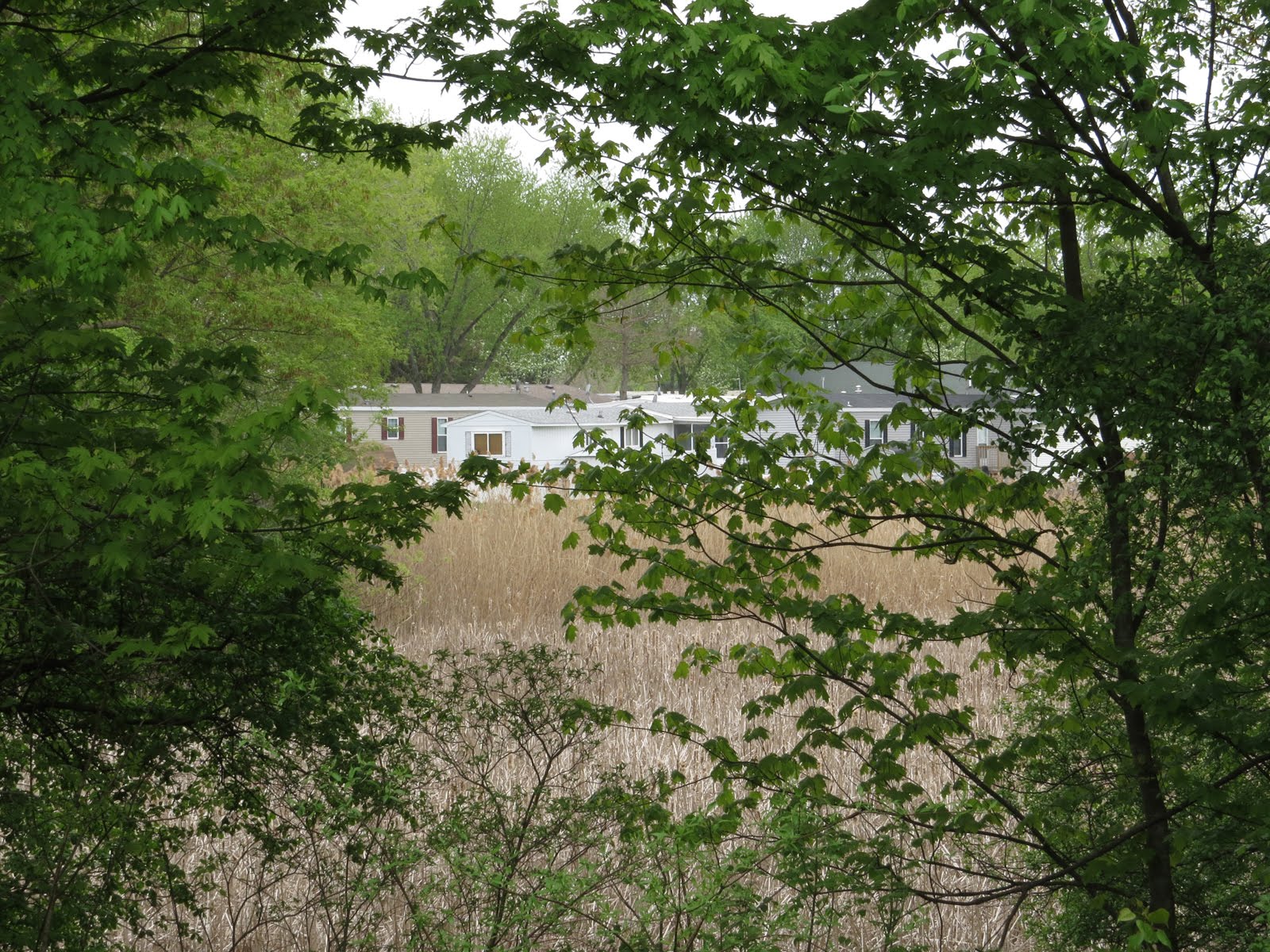
Oh, and you see that over there across the wetlands along the west side of the property? The First Wife and I lived over there in that mobile home park for a year or so during my brief foray back to Michigan in the late 70's. Back then where I'm standing to take this photo was just woods, swamps,  and fields.


Tuesday, June 25, 2019

Now What?!


The easiest way to size a replacement V-belt is to read the number off the back of the original. Of course by the time you feel the need for a replacement the numbers are usually worn off by the idler. . .

An alternative strategy is to check the manual for the part number and try to cross-reference that nonsensical number back to the real world of V-belts. Of course that's assuming you can find the parts manual for a mower over 15 years old. . .

Or, you can just measure the existing belt.

Make a chalk-mark on the outside, set the mark at 0 on a tape measure, and roll the belt down the tape until you get back to the mark, then round down to the nearest inch to account for stretch to get the length. Measure across the outside of the belt and add a bit to account for wear to get the width. (measures 9/16's? Then it was a 5/8ths belt.)

Easy!


Unlessss . . .


Your belt is now just a few shreds of rubber and some clouds of fluff that blew out from under the mower mid-mow.


OK, I figured out what size belt I needed (The blue one is the new one) but to get it wrapped around the pulleys and settled onto the idler, the one with a really heavy spring on it, I had to pull a half-inch diameter, 20 inch long stabilizing pin at the front of the mower deck completely out and let the deck pivot backwards on the three hangers that hold it up off the ground at the desired cutting level. Now I could get this belt routed around all three pulleys.


But to put it all back together the slot in the mower deck, the bit closest to you with the hook in it, needs to line up with a slot on the mower (Kinda visible through the top half of the deck-slot here but you have to look close to figure that out.) Only problem is that to move the two slots into alignment I had to overcome the spring-action of the drive-belt idler, and The Rock I am not! (I briefly tried to strong-arm it, but yeah, no way. . .)


So I parked the mower between a couple of sturdy trees, hooked a strap from one tree to the front of the mower deck, (The red strap on the right and the hook in the previous photo.) attached another strap from the other tree to the mower's chassis, and started ratcheting. Eventually I got enough pull going to get the first set of slots to line up and was able to jam the pin through, but only through the one side.


To get it through the other side I had to move the red strap over to to the other side of the mower deck where, with some more ratcheting, and ratcheting, and ratcheting, I was able to get the final two slots to line up so I could drive the pin the rest of the way through with a drift and a dead-blow.


-----

Because it makes me look like an idiot, I probably won't tell you that I ended up doing this three times.

The first time I had the deck out to measure for a new drive-belt I failed to pay attention to the belt that drives the three blades and when I put everything back together it started slipping so bad the blades weren't cutting (At least that's what I thought the issue was.)

After dropping the deck out from under the mower one more time I inspected the blade belt and it didn't look too bad, so I figured that the idler, which adjusts with a bolt and not a spring for this belt, was just too loose. I got that taken care of by tightening the bolt on the idler, reducing belt-deflection on the longest leg down to a quarter inch, put the deck back on the mower for the second time and the blade slip was even worse!

With the mower shut down and the key in my pocket, I reached under the deck, something I hadn't done yet so far, and found that the two outside blades were just spinning on their shafts.

One more time I dropped the deck, (I'm starting to get pretty good at that. Drive the big pin out, remove the clip and washer from the three hanger bolts, drop the deck to the ground, remove the drive belt, grab one end of the deck and drag it out from under the mower.) got my impact wrench out, tightened the blade-bolts as tight as 120 pounds of air pressure would go, and for the third time hung the deck back under the mower ---again.

A test cut showed that all was working now and I wasn't gong to have to drop that mower-deck again, at least not tomorrow. (I was done for today!) I guess next time I'd be doing myself a favor by checking everything the first time. If only I can remember that until next time. . .


Monday, June 24, 2019

Downhill: 14:53 – 17:51 (Part 2)


Running #420, the Upbound Freight, on the Daylight Pass Railroad


October 20 1954: 14:53 – 17:51

“As far as operating the Alco, in some ways the controls, that are mostly clustered together on this thing called a control stand that sits right were the boiler backhead and firedoors should be, are similar to those of a steamer, but in others they are quite different and take some getting used to.


“For instance, unlike a big Johnson-Bar sticking up from the foot-plate, the reverser (14) sticks out the side of the control stand and only has three positions, forward, neutral, and reverse. It actually looks like nothing more than an overgrown light-switch sticking out there.

“Since there’s no valve cutoff to worry about you control train-speed with only the throttle, (17) also sticking out the side of the control stand, which has 9 positions. All the way forward is idle which keeps the diesel running at about 350 RPM but puts no power to the traction motors. After that there’s Run 1 through Run-8 and you can tell where the lever is by the number showing in a little indicator window (16). The higher the number the faster the diesel runs and the more power the traction motors get.

“And also unlike a steamer, these Alco’s could pull a building off its foundation from a dead stop! You just pull the throttle back as far as you need to, all the way to run-8 if necessary, and in a few seconds the engine revs up and juice starts flowing into these things called traction motors, four of them, one on each axle.”

“Juice?” Jake askes. “You mean like electricity?”

“Yea, electricity and lots of it! With the train at a dead stop you can rev that big 12 cylinder diesel engine all the way up to about 1000 RPM and put all 1600 HP into the generator that drives the traction motors. These things have so much starting power most the time you can start a train with the slack already stretched out.  But you have to make sure the train starts moving right away because stuffing all that electricity through the motors when they aren’t turning is bad for them. That’s called a stall condition, when electricity is flowing but the motors aren’t turning. The guys tell me that if you do that too long the wires in the motors start heating up and they can actually catch fire! But once the motors are turning they can suck the juice right up no problem. So you have to make double-sure the brakes are off before you pull throttle like that, and that you start moving pretty quick.”

“So why risk burning the motors up?” Jake asks. “Why not just start the train easy and not have to worry about burning things up?”

“I asked the same thing. What they said is that putting a little bit of juice into the motors, too little to get them turning, is still a stall condition and can burn the motors up too. In fact the operating manual says the way to start a train with an Alco is to pull as much throttle as you can without pulling drawbars, busting knuckles, or slipping the wheels and get it moving and up to speed as quick as you can. By the way, you can’t tell if the wheels are slipping by the exhaust, since there isn’t any, not like on a steamer anyway, so there’s a warning light (26) to tell you if the wheels are slipping.

To make sure you don’t cook the motors you kinda have to watch something called a load-meter (25) and make sure it comes down out of the red pretty quick.  And you have to remember to notch the throttle back in to keep from going too fast once you do get moving. They tell me these things could do 65 if we had good enough track to keep it from flying off!

“But to complicate things a bit more these engines also have something called transition.”

“A transmission?” Otis asks incredulously.

“No, no, not a transmission, though it’s kind of the same in a way. This is called transition, which means you’re changing how the electricity from the generator flows through the traction motors, something about parallel and series but don’t ask me any details because trying to figure out that electricity stuff was still making my head hurt even after three trips.”

“So, what?” Jake chimed in. “You have a clutch and shifter or something?”

“No, it’s actually simpler than that, though it does bring up a whole new control called the selector lever (13). It’s kinda in the same slot as the throttle but on the back of the control stand instead of the side.

“When this lever is pointing straight back it’s in the off position – you can tell by another indicator window, (15) and no matter what you do with the throttle when the selector is in off, no electricity can get to the traction motors. In fact this is one more step when safeing these engines for the trainmen. You put the throttle in idle, the reverser in neutral, and the selector in off.  

“But anyway, when you start one of these engines from a stop, in either direction, you first put the selector lever one notch to the left, or towards the fireman’s side.  That’s transition 1 and it feeds electricity to the traction motors one way. Then when you have a little speed on, about 17 MPH, you have to move the selector one more notch to the left to position 2, which changes how the electricity runs through the motors. There’s also transition 3 (23 MPH) & 4 (49 MPH) too, but fortunately the Ore never gets going fast enough to need them, and rarely fast enough to need transition 2. But if you do have it in transition 2 you have to remember to pull it back to transition 1 when you slow down below 17 MPH.

“There’s little white marks on the speedometer (4) that tell you what transition you should be in. And speaking of speedometer, I’ll be using that a lot because sitting so close to the front the tracks look like they’re coming at you much faster than they actually are, and, unlike listening to the exhaust chuffs of a steamer, it’s impossible to judge from the sound of the Alco’s diesel just how fast you’re going.

“Why’s that?” Otis was about to ask but Jake beat him to it.

“Well, because the speed the diesel engine is running sorta has nothing to do with the speed the train is moving.”

Tom could see that this confused his fellow crew members.

“OK, for instance, climbing the grade just out of Goat Crossing with a bunch of empties, it might only take run-4 on the throttle to keep moving at 20 MPH, so the diesel is running at about 700 RPM. But when pulling East Pass Grade out of Three Creeks with a string of loads behind you will have to be in run-8 with the diesel spinning at 1000 RPM, but just barely making 8 MPH over the ground. So that’s why the sound of the diesel is no help in judging your speed.”

Otis and Jake sat and tried to wrap their heads around that while Tom got up, gathered their mugs, and went over to the bar for refills.

“So what’s with this dynamic brake stuff?” Otis asked after he returned.

“Oh that’s probably the part I like about the Alco’s best!” Tom replied.

“First off, these engines still have both service and independent brakes just like 1428 out there, but they also have these things called dynamic brakes that somehow use the traction motors to slow the train. Remember that selector lever? The one used to select the transition level? Well if you pull it to the right instead of the left you go into dynamic braking.

“First you idle the throttle then put the selector into off, then you pull it to the right into what’s called the big B. From there you ease the lever just a little bit more towards you. This gives you a little bit of dynamic braking to gather up the slack, then you move the lever further. This adds more braking and you’ll hear the fans in the short hood just in front of you start speeding up. That’s where all the electricity the traction motors are now generating goes, into something called a braking grid, though I’m not exactly sure what that is even though they showed it to me. The grid gets hot and the fans cool it down. They tell me that if you use too much dynamic, – there’s a green and a red zone on the load meter and if you are in the red zone that’s too much  – or the cooling fans fail, you can actually melt that braking grid thing.

“To reduce the amount of dynamic braking and get it back into the green you just pull the selector lever back a little bit.

“And the best part is that as long as you keep the needle in the green zone on the load meter you can use the dynamics all you want without heating up wheels or using up air.

“Of course you can also use the automatic brakes at the same time but you have to remember to bail off the independent when you do or else the combination of dynamic and air brakes can lock-up the wheels on the engine and flatten them.”

“Sounds complicated,” Jake said.

“Well, yes, I suppose it is, especially at first, especially since the slower you go the less dynamic braking is available, but at anything above 10 MPH the dynamics are strong enough that you can come down the easier grades without touching the automatics at all, and even when coming down West Pass or Mesa Hill you only need about half as much automatic brake as you would need on old 1428 out there, except when you slow down for Wild Woman Loop. Then there isn’t much dynamic braking at all and you need the automatics to make up for it. But truth is, once I got used to it, it was really sweet coming down the grades without having to worry so much about how much air I had left.”

“No, not just the brakes. The whole thing,” Jake replied. “Sound like running these new engines is really complicated.”

“At first sure, and I won’t lie to you, I’m not sure three qualifying runs is enough, but then again if you’ve never been on a foot-plate before a steamer is a pretty dang complicated piece of machinery too.

“And on the plus side, the Alco cab is completely closed in, no drafty canvas curtains constantly letting the cold and rain or snow in, and no fire cooking you. And speaking of rain, there’s honest-to-God window wipers on the Alco’s! Four air-powered wipers, each controlled with its own needle-valve, though for some strange reason the main valve that feeds air to the wipers is located under the cab floor and can only be reached from outside.

“And compared to the kidney-scrambling slamming around of the Consolidations, the Alco’s ride like a magic carpet. OK, maybe not that smooth, but a heck of a lot smoother than most steamers I’ve been on. Why, if a guy wanted to, he could sit there and drink coffee from a china cup while the thing is going down the road!”

There is a pause in the conversation as the three railroaders contemplate, with varying degrees of uneasiness, life without steamers.

“Oh yeah,” Tom says, plucking at the front of his coveralls, suddenly aware of the faint stink of oil, both fresh and burned, and sweat wafting up from them. “Another thing about operating the Alco’s is how clean they are. No need for coveralls, not even gloves.”

“Might as well be sittin’ in an office,” Jake grouses.

“Maybe so,” Tom fires back, becoming a little frustrated with Jake’s attitude. “But come February you’re going to be nursing frostbite on your ears, burns on your hands, cussing those drafty curtains and the cold water dripping down your neck,* wishing for a nice snug place away from the cold. Besides, I don’t know any office that rolls on through places like Wild Woman Canyon!”

*With the heavy curtains closed the steam that is constantly leaking into the cab condenses on the inside of the roof and tends to rain down on the occupants.

‘On the other hand,’ Tom thinks to himself while looking pensively out at 1428 sitting there patiently waiting to get moving again and mentally apologizing to her for his disloyalty, ‘I sure am going to miss the steamers. They are as close to a living thing as any machine can be. Right now she’s out there panting and murmuring and gurgling, sucking in air and breathing out her hot breath. She asks only to be fed and watered and cared for just like any other beast of burden, and in return she’ll work her guts out for me.’

With a furtive glance to make sure the others haven’t caught him in these almost poetic but maudlin thoughts, he mentally shakes himself back to the real world of the twentieth century working man.

By now it is getting on towards 5 o’clock, the after-work crowd is starting to filter into Hap’s, and the backless wood benches they are sitting on, even though they are stationary and not pounding down the rails, are getting uncomfortable, so the three men, after buying a slice of gummy looking apple pie to feed Ronald’s sweet-tooth, wander on out the door.

Having missed their window in the schedule because the track gang is holding the track, they still have a lot of time to wait yet before the Downbound Express clears Downhill, even assuming the track is repaired on time, so after dropping a slice of fresh pie off for Ronald all three of them step across the tracks and go into the depot.

“That track-gang happen to come back while we were away?” Otis asks Ed, somewhat hopefully.

“No, and if doze guys don’ show up soon da Express is goin’ ta be ‘eld up and I’ll be here ‘alf da night writing up TO’s ta sort da mess out and reports ta ‘slpain ta da bosses wat ‘appened.”

“I thought you went off shift at 6,” Jake says.

“Normally, but dat Robert (The night shift agent) went down ta T’ree Creek on the morning Express so til the Downbound come back trough wit ‘im on it I’m stuck ‘ere.”

The new depot, built with paying customers in mind, has a good view of the track, is bright, has a decent stove, and the benches, despite being wood, are contoured and comfortable, so the three railroaders decide to wait there for whatever is coming.

They have just barely settled when Ed, from the vantage point of his desk in the bay on the front of the depot that lets him look up and down the track from his seat, calls out that he can see the speeder coming back up the track.

They get back up to see for themselves, a phenomenon closely related to the need to push the elevator button or ring the bell on the desk even though someone else has already done it.

The speeder is running forward so the crew obviously picked it up and turned it around at some point. The trailers, which are now loaded with two short pieces of rail with ragged ends on them are tagging along behind. As it passes the depot one man jumps off and walks in. Tom doesn’t know him by name but recognizes him as the track-gang supervisor.

“OK Ed, you can call down to dispatch and let them know the track is fixed and they can release the Express on schedule. I’ll write it up in my report but it looks to me like someone was taking pot-shots at the rail with some sort of heavy hunting rifle and managed to crack the web with one or two of them. Must have been a while ago since the cracks, at least around the divots the bullets made, are rusty. There was also some depressed ties right underneath that spot so I expect that the rail has been flexing under load for some time and extending the cracks. Today one of those heavy ore jennys probably finally snapped the rail right through. We brought both pieces back and the boys are sticking them in the old depot in case someone from down below wants to inspect them.”

“I wonder ‘ow dat train didn’t end up on da ground.” Ed mussed.

“Well it was near the center of the rail so both pieces were held somewhat in place by tie-plates back away from the break. Which means it wasn’t a bit of rail that hit the house-car, but there were some loose tie-plates just flapping in the breeze under the busted ends of the rail and we found one of them way on down the tracks. Maybe that was what flew up and rang old Griff’s bell.”

While Ed gets on the phone to dispatch and the supervisor heads down to where his gang is wrestling the broken rail off the trailers, Otis pulls out his watch. “Well if it’s on time the Express will be here in in about 35 minutes.* I can heat up the pot (He’s talking about the indispensable coffee pot he keeps on the stove in the house-car) if anyone’s interested.”

*The Express isn’t scheduled to leave Three Rivers for another 15 minutes yet, but at the speeds it reaches, even up grades, it will take less than 20 minutes to reach Downhill.

“Not me,” Jake says. “I shut the blower down earlier so I think I’ll just go turn the fire up a little so we’re ready to go when the time comes.”

“Me either,” Tom kicks in. “I’ve had about all the coffee I need for the day.”*

*As a consequence of the crazy hours, infrequent, and often less than ideal, meals, and endless pots of coffee, old railroaders often end up with dicy stomachs, now that his hours, and many of his meals, are more predictable Tom has been feeling better, but the down side of that is that he now really notices it when he overdoes the coffee. Not that he’s going to cut it out altogether though!

“Alright guys. See you at the other end then,” Otis says to his crew and Ed alike. “Oh, and Tom, if Dean isn’t back by the time we leave do me a favor and skip calling in the flag.”*

*Pulling the 5-longs on the whistle that would signal the rear flagman to return to the train.

“You’re the boss Otis. No signals until I whistle-off. “

Some railroaders are notorious pranksters. Otis isn’t one of them. But he makes no secret of the fact that he doesn’t approve of Dean’s promiscuous, partying ways. If Dean is not back by the time they start rolling, those two blasts as Tom whistles-off will put the fear of God into him since missing your train will have you ‘dancing on the carpet’ as you get called in for an official investigation which will result in brownies,* or, if you already have too many brownies, could get you struck off the board for a while, if not forever.

*Demerits are called brownies on the railroad because in 1885 George Brown, general superintendent of the Fall Brook Railway thought the summary suspensions common back then put undue hardships on the families.  Under his system you were given a number of demerits for an infraction. After one year the demerits expire, but if you collect 90 or more ‘brownies’ at any given time you will be shown the sidewalk, at least for a while. Most railroads have adopted this system or a variant of it.

Not to be confused with ‘brownie points’ which has the opposite meaning and seems to have originated with the Girl Scout Brownies that got badges or points as rewards for good work or deeds, or possibly it came from war-time rationing where people were issued various colored ‘points’ each month, the most coveted being brown points which were used to obtain meat.

“I wonder if that guy is ever going to settle down,” Jake muses.

“The only way that’s going to happen,” Otis comes back. “Is if a woman latches onto him so tight she has to loosen her grip so he can pee.”

There is a brief moment of shock as Tom and Jake process the words that just came out of the mouth of the grandfatherly Otis, before they both burst out laughing. Not only because it is Otis that said it, but because it’s true.

With a sly little grin Otis turns and heads for his end of the train.

“Damn! That was a good one Otis,” Tom calls out when he stops laughing.

“Hey Tom,” Jake says, his seriousness in sharp contrast to the reaction to Otis’ statement. “You think it’ll be alright if I take the right seat down to Three Creeks?”

“Well sure Jake. I’ll take the left side right now and get the fire going.”

“OK then,” Jake says, excited but nervous at the same time. “I’ll do the oiling and set up the retainer on that box car.”

Personally Tom would set the retainer on the house-car instead to get them down the 1% grade into Three Creeks, that would give Otis the smoothest ride, but he understands Jake’s thinking. The boxcar is certainly the heavier of the two and will provide better braking power, so he says nothing that might make Jake second-guess himself.

The sun has set and twilight is deepening when, right on time, the Express, the third to go by them today, drifts up almost silently as it slows for the depot.

Since they still can’t move until the Express finishes it’s 5 minute stop and rolls on out again, Ronald, who went up to line the east switch for their departure once the Express passed, has plenty of time to walk back and climb on the engine where he can get away from the increasing chill and warm himself next to the backhead.

Unfortunately for Dean, the little horn on the Express, that already isn’t all that loud, is muffled even more by the short freight train sitting on the track between it and the north-side buildings.


Thursday, June 20, 2019

Water Usage in The Van


A while back I wrote about making this modification to The Van to make it simpler for me to check my potable and grey water levels by simply opening the false cupboard door and looking directly at the levels in the tanks through the "windows" I cut in the cabinet face.

I have one 10 gallon tank for each, potable and grey, placed side by side under the sink. (With the added bonus of no unprotected plumbing at all outside the shell of The Van to worry about.) With this setup I carry a maximum of about 84 pounds of water. (When the potable tank is full the grey is empty. As I draw water from the potable tank making it lighter, some of it ends up in the grey making that one heavier.)

About now some will be shaking their heads thinking that 10 gallons is a ridiculously small amount of water to have to live on, and when I was young and dumber and susceptible to the lies of "experts" I would have agreed.  Hell, in one of the previous rigs I built for myself I installed a 40 gallon potable tank smugly thinking 'Now I can really go boondocking!'.

Well that turned out to be a bone-headed decision!

Not only did I never even come close to needing all that water, that 40 gallon tank, and it's corresponding grey water tank, cost a lot of money, took up a whole lot of space, and when full weighed in at 330 pounds, costing me even more money for every mile I drove.

"Yeah, but only 10 gallons! You must have to fill up every few days!" is a comment I often hear, but when I tell people how long 10 gallons can last me they don't believe me. I know they don’t, I can see it in their eyes and in that condescending "whatever you say" way in which they terminate the conversation, but it’s true non-the-less.


I recently took this photo showing the level in the potable tank when I got back home from a trip. I left with a full tank, didn't refill at any point along the way, and this is what I came back with. I recon that's about a third of a tank left, but to be conservative let's call it a quarter tank.

It was a 15 day trip but let's also not count the 5 days I spent with Mom and family because I wasn't cooking for myself those days. So we'll ignore them, even though I was still brushing my teeth, hitting the pits, cracks and dangly bits, and took a couple of my sink-showers during those five days. (I took two "real" showers at Mom's because – well, mothers worry.)

Another mitigating factor I also need to point out is that, with the exception of hot tea once in a while, made with water from the tank, I pretty much exclusively drink water, no sodas, no coffee, and I carry 4 gallons of purified rainwater, the same thing I drink at home, for that. In addition the toilet in The Van is a portable unit with its own water supply.

Anyway, given those parameters, that means that in 10 days I went through 7.5 gallons of water for cooking, cleaning up, and personal hygiene.

How the hell is that possible!

Well there's only one of me so cooking uses a minimal amount of water. To wash dishes, which I do once a day, hiding dirty things under the sink-cover in between, I put a drop or two of soap into my sink along with a quarter-inch of cold water followed by another quarter inch of hot water from the kettle (I am an advocate of small sinks in RV's as it doesn't take much water to fill them a half-inch or so, and dishes don't have to be swimming in water to wash them.) and then wash the dishes with an 18X18 micro-fiber towel. The kind that will suck up and hold about half the water in the sink but then hand-wring nearly dry. Then I dump the wash-water, stack the dishes back in the stoppered sink, and rinse with scalding water directly out of the kettle.

By planning the rinse sequence this too only takes a bit of water. Dribble a little water over the larger bits like pot-lids, being careful to keep fingers out of the way to avoid cooking them, while letting the dribbled water run down into the bowl or mug the utensils are stacked in, swish the forks around then dump the bowl/mug into the pot it has been sitting in and swish it around again, unless I used the cast iron skillet which just gets a wipe-down then a polish with a drop of oil, all before drying everything with yet another micro-fiber towel. (The bowl is for the salad and I eat right out of the pot so no plate. OK, don't judge me! I like my food hot and both my cast iron skillet and heavy-bottomed pot hold the heat well.) The used rinse water in the sink, cooled off enough by now to prevent any serious burns, is then utilized for a final wipe-down of the counters and backsplash and finally the sink itself.

As always when using the kettle, if there's any water left in it when I'm done, I leave it there for next time rather than waste it by dumping it out.

To brush my teeth I put between 1/2 and 3/4 of a cup of water (I had to go out and measure this just now) into a glass, actually an old-fashioned tin camp-cup I've had since I was a kid, swing the faucet out of the way, and use what's in the cup for rinsing me, my toothbrush, and the sink.

Baths – well frankly I think baths are just disgusting, even if they were possible when on the road, which they really aren’t. Showers are nice, but while we’re still being frank, I find them over-rated and can get along without just fine. (I'm not even going to get into a discussion about the farcical fallacy of trying to cram a usable shower into a small RV!) Even when they are available, and clean enough to not make me cringe, and not swarmed by a bunch of the noisy, 15-minutes-minimum-of-wasting-water-or-it's-not-a-real-shower, crowd, and not too much of a hike away, (I like to lurk in the further reaches of a campground) I still find them to be a hassle compared to my sink-showers.

What the hell is a sink-shower?

Pretty much the same as washing dishes, except I use a dedicated set of micro-fiber towels, one for washing the other for drying. And instead of dish-soap I use a few drops of a no-rinse body bath.

Same procedure for filling the sink with a half inch or so of water, though I often skip the hot water part of the formula. (A little shock to the system is good once in a while!) Then I drop one of the towels in, let it get soaked through, wring it partway out, and start washing, wringing and re-dipping as I finish each ‘part’.

It helps that I keep my hair zipped off with the shortest foot on the trimmers because it’s a whole lot less hassle that way, so “washing my hair” consists of scrubbing my head with the towel just like the rest of me. (And I haven't owned a brush or comb in decades.)

And this is clearly TMI, but when I get down to – you know – the output end, I use a disposable wipe and toss it, (I hope we all know by now that anything like this marketed as disposable or flush-able should absolutely NOT to be thrown into the toilet!) to keep any sort of potential contamination away from my wash-towel. Though, since they are light, small, and inexpensive, I carry a whole stack of these towels in The Van and use them for everything, dish washing, me washing, van washing, window cleaning, wiping up in the shop, etc., and rotate them out to the laundry bag frequently.

It takes less time for me to complete a sink-shower than it did to write about taking a sink-shower, and when I’m done I’m already home without having worked up a sweat or covered my feet in grit from the hike back.

Anyway, back to the original point of this post, it’s not like I’m really trying to conserve water when I’m out there with The Van, it just comes naturally. (At home I also use a cup for teeth brushing and only turn the shower on when wetting down and rinsing off.) Maybe in large part because as a kid I tent-camped with the family all the time and it was me and my brother’s job to lug military-style jugs (Cheap at the surplus store) of water back to the campsite from the hand-operated water pump, so being careful with our water was just part of what we did, just like never walking through someone else’s campsite and making sure to use our inside voices around the campfire.

So, less than a gallon of water a day? No problem. Really!