Monday, June 27, 2022

Final Tomato Update


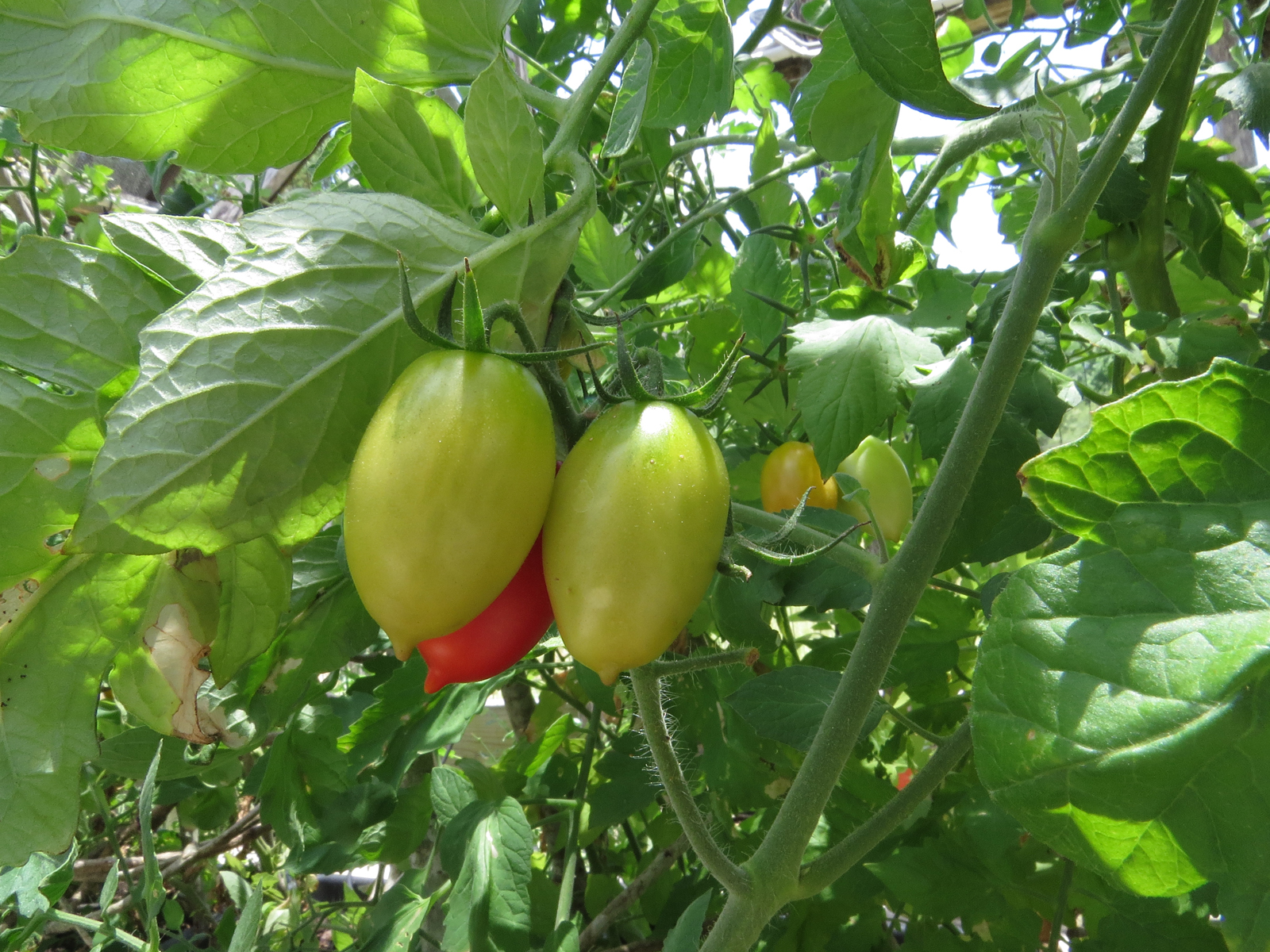
It's June 23rd as I write this and though they have retreated a little from their grandest, all five varieties of tomato are still producing.

Italian Ice

But I'm not surprised - about the retreat that is. Here it is with still a week left to go in June, with the full heat of summer yet to "look forward to" (late July through August) and we have already surpassed last year's total number of 100+ degree days. (According to the thermometer right here beside me it's exactly 99.9 degrees at my computer desk out here in the barn as I'm writing this at 1400. Oops, nope. Just switched to 100! - now 100.2!)

Juliet

In fact so far this month we've had a grand total of two days of sub 100 degree highs.

Since sometime in the last week of May we haven't had a single day that hasn't been above average temperature. Also, so far this month there has been zero, as in 0, rain.


But that hasn't stopped production yet!

And with no friends or family around to give produce away to


we have been eating a lot of pasta-tomato-feta meals!

Boil up a little pasta, and while that's draining toss the tomatoes and feta on a baking sheet, drizzle a little olive oil and slip them in the oven for a few minutes. Just long enough to drive some heat into them. Combine with the pasta and eat till your stomach hurts!

I anticipate this being the final tomato update because I just expect more of the same, or a little less, from the plants for a few more weeks, then they will start to shut down due to stress until we have to caramelize the scant sugars under the broiler to knock down the bitterness in the last of the green tomatoes.

So final conclusions?

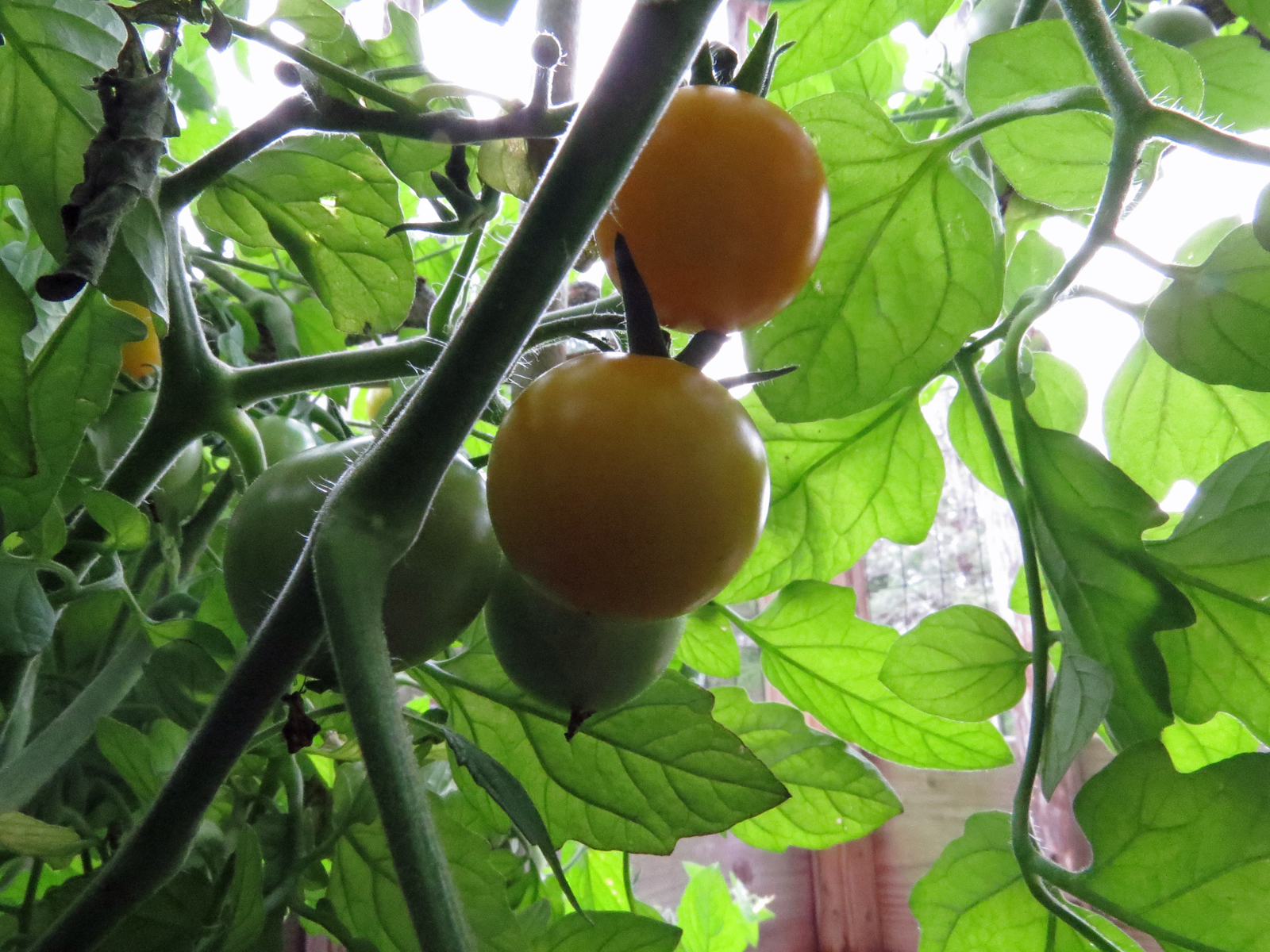
The Golden Nugget and Sungold Cherry produced a similar fruit. The Sungold Cherry's skin is slightly more tender but the Golden Nugget plant held up better to our hot climate and produced more, so next season the Golden Nugget stays while Sungold Cherry hits the showers.

The bright red oblong Juliet got off to a slow start and showed early signs of blossom end rot but once it hit it's stride it has produced well and contrasts, in both flavor and color, nicely with the Golden Nugget/Sungold Cherry so it too has a spot in next season's lineup.

The Balls Beefsteak was alright, producing a lot of larger-than-golf-ball, smaller-than-tennis-ball fruit that also has a good, if robust and sharp.almost lemony, flavor even when green (A few green ones got knocked off the vine and I didn't want to waste them!) but wasn't anything spectacular so probably won't make it off the bench next season.

The Italian Ice was slow off the mark and confusing to those not familiar with it since the fruit went from green, to crisp and strongly flavored greeny-white, to tender and really sweet whitey-gold. It is producing well and we really like the flavor-contrast with the other tomatoes so it will definitely make the team next season as well.

Who will make the draft to fill the gaps next season?

Duno yet.


Monday, June 20, 2022

(Dirty) Dancing in the Workplace


 I don't remember how many years I've had these. They were a Christmas gift from Mom. (I know it was her because apparently none of us in this family quite get the concept of 'Secret' Santa - - -)

Good gloves, and after all these years and a lot of service, well broken in and comfortable.


But nothing lasts forever and there comes a time, 

Yep - Won't be using the nail-brush on that finger for a while!

in this case marked by some rather intricate, prolonged, and colorful - as in mostly blue, and rather strong blue at that - dancing at the worksite, (I didn't even know I knew some of those words!)


when the old must be retired and the new and untried reluctantly sent in off the bench.


Tuesday, June 7, 2022

The Unjustly Maligned Cliche


It's often used as an insult.

                        Personal or otherwise.

It even sounds like a sneer when said out loud.

"What a cliche!"

Almost onomatopoeic, but not quite. (Hey! don't look at me if you can't pronounce that doozy. I can't either. Besides I'm not in charge of making this shit up! Nobody asked me what we should call words like plunk or cackle or flick that imitate the sound they describe!) 

I'm not sure if there's an inclusive term for words that are typically said with an attached emotion. Words like 'sleazy' or 'magnificent'. But come to think of it, 'sparkle' is another one of those attached emotion words that doesn't actually sound like it's definition yet it is often included in lists of onomatopoeic words, so maybe 'cliche' is onomatopoeic.

Regardless of all that crap, which is only important to linguists, the origin of the word - you know, cliche - is slightly fascinating - even if its origins are French.


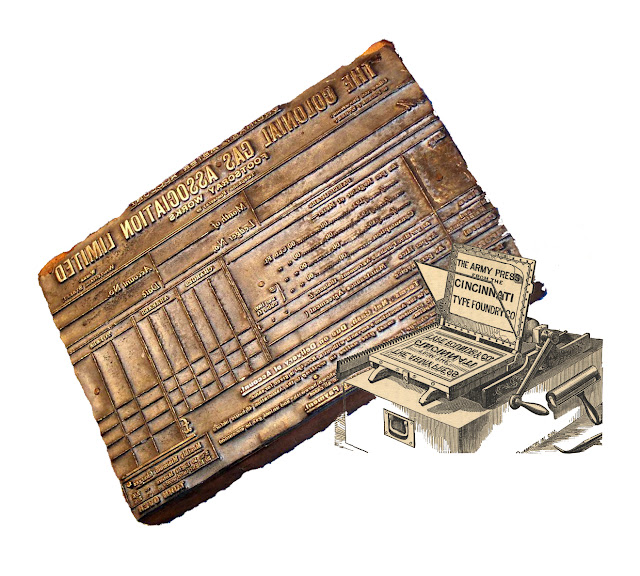
Those big cast iron plates that hold the reversed letters and/or images on printing presses are called stereotypes.

So already we have an object used to make multiple, identical, copies lending its name to the definition of multiple, identical, copies.

Then - and here's where we get to the French bit - the sound a stereotype makes as it slaps down against the paper on the platen is a click - or in French, a cliché. (OK, I make no secret of the fact, after having been forced to work with them for a number of years, that I am not a particular fan of the French culture so I'm not going to pass up the opportunity for such an easy dig: - Leave it to the French to screw up an otherwise perfectly good onomatopoeia!)

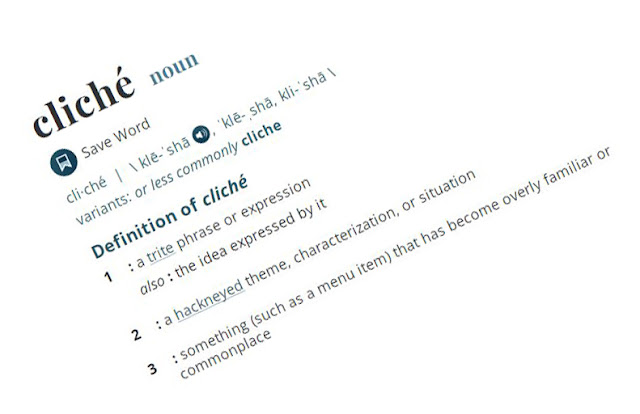
Merriam-Webster, pretty much negatively, defines cliche as a phrase or expression that is: 1) trite, 2) hackneyed, and 3) over used.

What they don't specify is just who decides if a phrase or expression is trite, hackneyed, or over uses. Just who the heck are these word-police?

22 years ago William F Buckley Jr. in attempting to make a point about cliches, was quoted in National Review as saying "Non-amateur writers avoid industriously the word Orwellian".

First off, I don't know who he was trying to impress with his hackneyed reversal (See what I did there?) of the positions of  'avoid' and 'industriously' since, unlike Spanish and other romance languages, in the English language (and Buckley would be the first to tell you he was American through and through) the adjective, in this case 'industriously' is most commonly placed before the verb 'avoid'. 

Secondly, his pretentiousness is showing.

For someone who's stock-in-trade was words, both written and spoken, his dismissal of the effectiveness of the cliche is baffling.

Orwell was another wordsmith that dissed cliches, (Can you see the irony here!) writing in his Rules of Writing to 'never use a metaphor, simile, or other figure of speech which you are used to seeing in print'.

Well have you ever tried reading either of these men? It's painful! A real slog where you can never get any momentum going because you are constantly having to stop and decipher just what the heck they are saying.

Language is, first and foremost, a tool for communicating, for sharing information.  And shorthand of any sort, be it the classical, squiggly form, or that used in today's electronic communications, (LOL. WTF) is an efficient way of communicating. And cliche's are the shorthand of words.


For instance "heart stopping fear" is considered a cliche by those nebulous word-police because it is "over used" (my air-quotes.) But most everyone, sometimes from a very early age, has a personal acquaintance with the visceral effects of heart stopping fear and knows exactly what the writer is describing. If we eliminate that three-word shorthand from our vocabulary it will take several sentences to replace it with something that probably still wont have the same emotional impact because it took so long to get there.

And, since I've already touched on it, almost every English-speaker, at least of my generation, knows exactly what is being expressed in that single word 'Orwellian'. Yet it will take Buckley's 'avoiding industriously' non-amateur writer, such as George Orwell himself, half a book to express the same concept. (He used the other half of the book to detail how to fight back against such a dystopian situation.)

When I Googled images with 'weather presenter' the first 80 hits were female. Don't know what that means but it was interesting.

Now I'm not saying there aren't some cliche's out there that need to be retired - badly.

For instance, "If you don't like the weather here in <insert your location> just wait 5 minutes!", usually said with a heavy dollop of perverse pride.

Oh man! Can we just make this spindled, mangled, and abused cliche go away already?!!!

With the exception of a few isolated places, like maybe Southern California, the weather changes quickly all over the world, but wherever I have been in that world I hear this annoying, useless banality repeated over and over again, and every time as if this was the only place in the world that happened.

So this is one cliche that's on my don't-do-it list. I won't use it and I don't want to hear it - ever!

But there are so many other, useful cliches out there that deserve the respect they don't often get. 'Mad as a hornet'  is so much more evocative and elegant than 'really really mad'. 'A dead ringer' is so much more efficient than 'she looked and acted so much like that other person I couldn't tell them apart'. And, ironically, 'A stitch in time saves nine' takes so much less time to make the point  than 'if you slow down and do the job properly the first time you won't have to come back and redo it again later'.


Gerard de Nerval said "The first man that compared a woman to a rose was a poet, the second an imbecile."

He was wrong.

That second man was an unpretentiously effective communicator. 


Monday, May 23, 2022

May Tomato Update

OK, starting with a recap:

The seedlings were planted March 25

and this was the state of things April 28

And here's where we are on May 20

I'm having to train some of the plants up onto the crossbar above because they've topped out the tomato cages I built.

Still shy of "full harvest" the results are a bit mixed right now.

As it was at the previous update, the beefsteak (Yep, miss-spelled in the photo but spelling was never my strong suit - "It's a damn poor mind that can think of only one way to spell a word." - Andrew Jackson - and I don't feel like going back now to correct it.) is still lagging behind the others

but it is setting fruit so we'll see how it goes.

Golden Nugget produced a half-dozen early on but seems to have paused production for the time being, though some of the remaining fruit looks to be about ready. (as the name implies it ripens to gold not red)

What did ripen had a moderately robust skin (Acceptable to The Wife who prefers a mild skin and definitely doesn't go for strongly robust skin) and a slightly tangy tomatoey flavor that was fine though I was hoping for something a little stronger - you know, on the tomatoey side of things.

The Sungold also produced one or two ripe fruit early on. These had a very mild skin and about the same level of tomatoeyness as the Golden Nuggets.

Now things seem to be paused here as well. Maybe because our temps have been about 10 degrees above average for three weeks now.

The Sungold isn't showing as many green fruit as the Golden Nugget

but there are plenty of blossoms that could indicate a more bountiful future.

The Juliet is being very prolific, both in plant-size as well as number of fruit set, but a lot of the fruit is suffering from blossom-end rot. Typically this is due to a deficiency of calcium, perhaps exacerbated by the overall prodigious growth.

Since the plant is growing in exactly the same soil (Side dressed with a small handful of Microlife 6-2-4, which is an organic fertilizer full of micro-nutrients and microbes, every three weeks) and conditions as the others which are showing no sign of the problem, rather than fight it I'm inclined to just write this variety off as not suitable for our location so we won't be trying this one again.


 Though it is setting some fruit that aren't showing signs of the rot, so I'm culling the bad fruit at first sign of rot in the hopes that will leave more calcium available to the other fruits.

In fact, this morning I discovered I was getting a little help in the culling department from this guy.

It's a pretty healthy Hornworm and I know I'm supposed to pick it off and squash it, but you're talking about a household that uses live traps and a bug-cup not poisons and a slipper, so I just relocated it a couple of hundred yards to the native underbrush surrounding our place. It won't thrive as well but at least it has a chance to complete its life-cycle. (With those very strong legs with a pretty strong grip, it's easier to just chase it out to the end of a branch then snip the branch off rather than try to pull the poor thing free without damaging its soft body.)

The Italian Ice is robust and setting a lot of fruit.

The issue with this non-reddening variety is telling when it is ripe. It's supposed to turn from green to white but in the plant world white usually has a distinct green tint so I've been trying one of the less-green ones now and then. So far they haven't been bad, but are very meaty with a strong acidic bite. (the description says sugary sweet so I don't think we're there yet.)


When I first planted the seedlings I had the irrigation scheduled for 20 minutes twice a day based on the finger test, (Jam my finger down to the bottom of the tub to see if there's any sign of damp down there.) which is better than the over-flow test, (wait until water is flowing out the bottom of the tubs) which tends to leach nutrients out of the soil, not to mention producing watery and split tomatoes. 

Now the plants are much bigger and obviously require more water.

On top of that we have been "blessed" this May with three weeks of summer-like temps and absolutely no rain. Combine that with the usual feisty spring winds and the water requirements are now up to an astounding 2 hours twice a day. Which, if I was using regular lawns sprinklers would be ridiculously wasteful, but with the small soaker hoses dispensing water drop by drop it's a different story.

In fact the five 3 foot lengths of soaker hose are so stingy that when the valve on the timer closes it takes almost a full hour for the pressure in the irrigation line to drop to zero - which you find out real quick if you crack a fitting open too soon!

In a few days the temps are supposed to drop back down to seasonal for a week or so. We'll see how things go, both on the watering and production fronts.


Monday, May 16, 2022

The Wonder Toggle - Never Fight Your Guy-Lines Again!


Ahhh yes! The guy-line tensioning toggle.

Anyone who's ever camped, or put up a canopy, or erected a badminton net in the back yard, has wrestled with encountered one of these. Or more likely, more than one kind of these because they come in a bunch of different shapes and sizes,


each of which works a little differently than the other.

But they all share some common traits.


They'er all persnickety little things to deal with.

They all add bulk to your gear while lightening your wallet.

Each fits only a specific size of line.

And they all come out of the stuff-sack snarled up as if they're in the middle of a '60's orgy - - Every time!


But what if I told you there's a Wonder-Toggle out there that works on any size and type of line,

Can adjust a guy to any length and tension in seconds.

Can be completely removed even faster.

Doubles the power of a 'traditional' toggle so even Grandma can adjust the tension anywhere from snug to Holy Cow I Could Play A Tune On That!.

Won't loosen or fall apart when shaken by the blusteryest of winds.

Unlike 'traditional' toggles allows you to pass the line around an anchor point such as a tree or tall pole without removing the toggle first.

Adds exactly zero weight or bulk to your gear.

And is free?


See it here?

This Wonder-Toggle I'm talking about?

Right there on this line, all ready to go into action?

No?


How about now?

Actually it's more properly called a trucker's hitch and while it is a wonder, it's nothing new. In fact it's been around since before trucks, which makes this continued infatuation with all these various new-fangled and 'ingenious' toggles all the more baffling.


The Wonder-Toggle might look complicated but without being in any particular rush, once the standing end is anchored and the guy wrapped around the second anchor-point, be that a post, stake, or tree, it takes me about 10 seconds to throw the hitch, tension it just right, and snug it down.

Admittedly there are a number of different ways to tie this hitch and several additional variations, mostly aimed at making it even stronger or more robust such as when securing heavy loads on - well - trucks, but what follows is the way I learned to throw the hitch many years ago and still use today.

This will probably seem complicated at first, but so do the diagrams of even the simplest knots in instruction books trying to teach you how to tie them. I promise, if you grind through this instructional a few times it will become easy. (Of course I may or may not have had my fingers crossed just now - - -)

In my experience, once you get it down, a 10 second trucker's hitch will become second nature and you can finally ditch those pesky toggles.


But before I get started, a couple of terms to help keep things straight.

The initial anchor-point is the end more or less permanently attached.

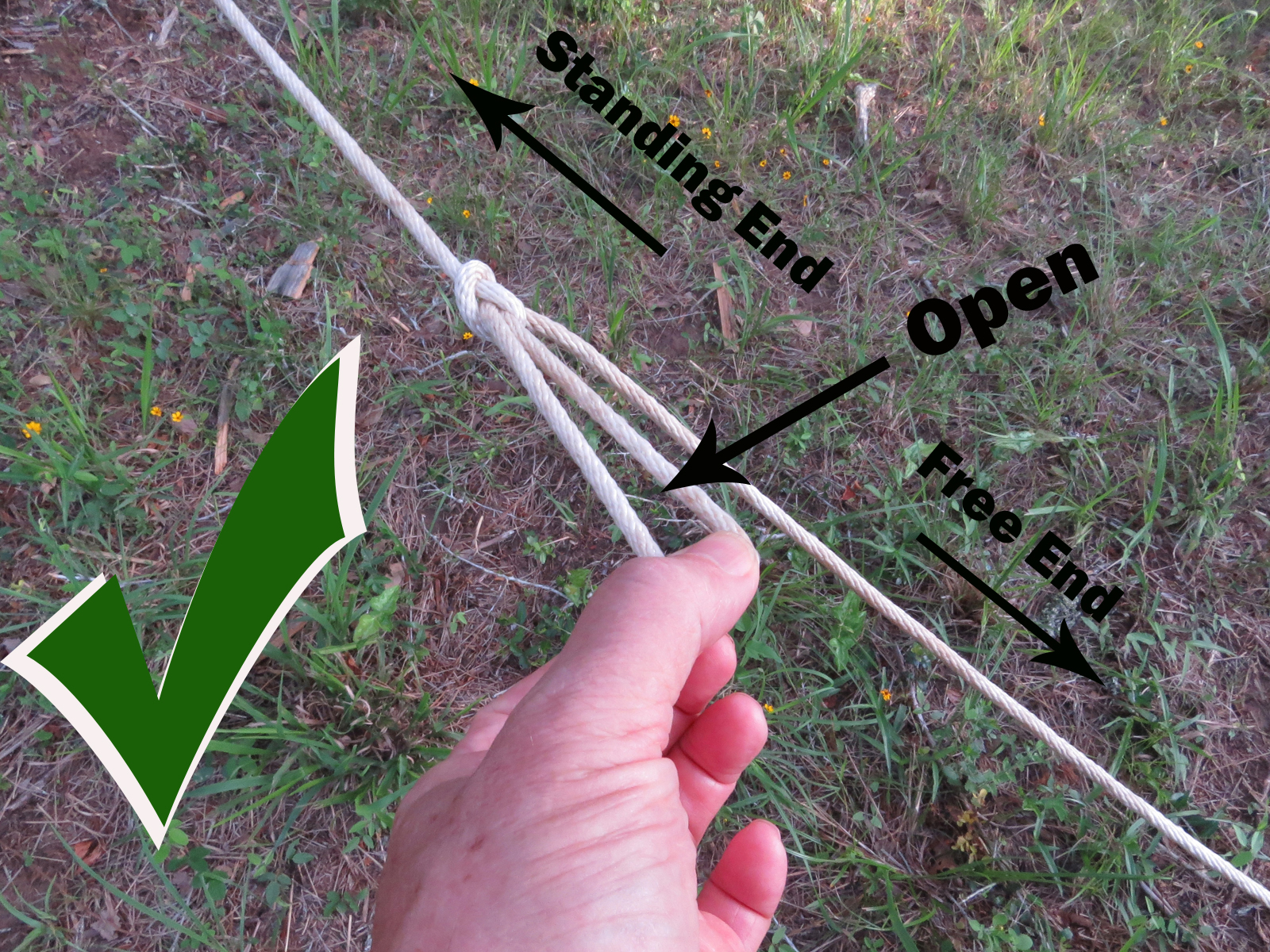
The standing end of the line is the one closest to the initial anchor-point.

The secondary anchor-point is - well - it's not that hard to figure out which one that is!

The free end of the line is the one closest to the secondary anchor-point.

The dividing line between the standing end and the free end is where-ever you happen to be - well - standing. In the case above everything to the left of my hand is the standing end and everything to the right is the free end.

The loose end is - you guessed it - the loose end of the free end.

And a bight is just a quick and fancy way of saying a bend or kink in the line.


So, back to the Wonder-Toggle.

The first thing, if it's not already done, is to secure the line to the initial anchor-point. That's the end that will stay put as you work on the rest of the hitch.

In the case of a tent or canopy the initial anchor-point is usually attached to said tent or canopy.


In the case of a ridge-line or clothes-line either one of the two supports you've chosen will do for securing the initial anchor-point.

How you secure the initial anchor-point is not important as long as it stays put. I prefer to use a bowline because it is simple, stays in place, and never jambs so is easy to untie, but a slip-knot, a clove-hitch, an overhand knot, will all do nicely under the right circumstances.


Now that the initial anchor-point is secured take the free end of the line over to the secondary anchor-point, which could be a stake in the ground for a tent or another tall support for a ridge-line.

While standing in front of this point and facing it with your dominate shoulder (right if you are right-handed, left if - well - you know) pointing back to the initial anchor-point - in my case, as a left-hander, the tree the initial anchor-point is secured to is off to the left of this photo - pass the free end behind the secondary anchor-point, (That behind bit is kind of important for consistent results!)


then bring the line around in front of the secondary anchor-point so it's heading back towards the initial anchor-point.

Hold the free end there loosely with your non-dominate hand.

Now here's the slightly tricky part, but only tricky the first couple of times you do it, after that it will seem normal.


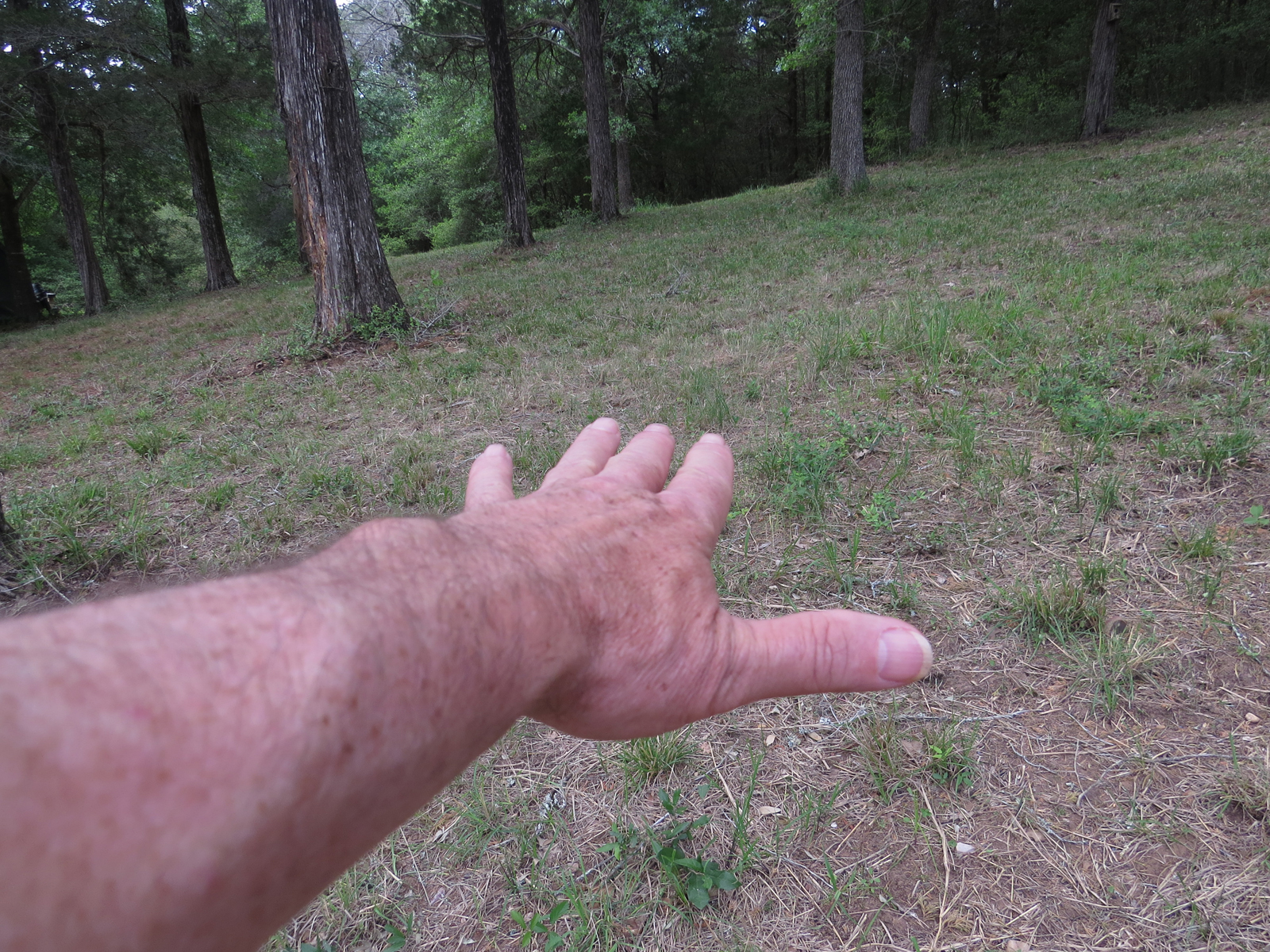
Hold your dominate hand out in front of you with your palm down and thumb out (Your thumb will be pointing back towards your non-dominate hand at this point.)

Keeping your fingers straight and thumb out, roll or twist your arm 90 degrees so your thumb points down and your palm is facing the initial anchor-point.


Continue to roll (or twist - whichever terminology works for you) your hand another 90 degrees in the same direction so your thumb is now pointing at the initial anchor-point and your arm is twisted up like the string on one of those button-spinners your grandma used to make for you. You know, that kid's toy where the sharp edge of a button is spinning impossibly fast just a couple inches from your eyes as you do your damnedest to break the string it's spinning on!

Keeping your thumb out of the way, wrap the fingertips of your upside-down hand around the line from below.

And apologies. Statistically most of you are right handed and these are all photos of a left-hander throwing this hitch, so you right-handers will have to reverse the images in your head.


Now, keeping hold of the line with your fingertips, un-twist your arm


keeping your thumb out of the way as you do 


until your hand is palm-up and your thumb is pointing back at the initial anchor-point. 

You can uncurl your fingertips now!

All that effort, which in real-time takes no more than a second and a half - if you're moving slow - creates a simple loop in the line, but it creates the loop exactly the right way every time.

Rather ingeniously, if I do say so myself, I label this 'Loop 1'.

Here, and for the next few photos, in an attempt at clarity I've tinted the standing end of the line, the one attached to the initial anchor point, blue and the free end, the end wrapped around the secondary anchor point, yellow.

Again, as a left-hander, here my left thumb is pointing back towards the initial anchor-point, the free end of the line is heading the other way and has been passed around behind the second anchor-point and the loose end of the line is in my non-dominate hand out of frame to the right. (Remember, you are holding the loose end of the line loosely with your non-dominate hand so there is enough slack in the line to form Loop 1 without choking your fingers.)


At this point you finally bring your thumb back into action by slipping it under the standing end part of Loop 1


and pinching the free end part of the loop between thumb and a couple of fingers


so you can pull a bight back through Loop 1.

Without letting go give this new loop, which I call Loop 2, (Oh man! How do I come up with these genius ideas!?) a tug away from the initial anchor-point to collapse Loop 1 and set Loop 2. 


If you did everything right Loop 2 will remain open as you pull it away from the initial anchor-point.


If instead, Loop 2 pinches down on your fingers as you tug it away from the initial anchor-point you were probably standing on the wrong side of the line (i,e, dominate shoulder facing away from the initial anchor-point instead of towards it) when you made Loop 1 with your upside-down hand.

This is no good. Try again!


Now that the hard part of this hitch is done it's time to bring your non-dominate hand, the one holding the loose end of the line, back into action by feeding that loose end up through Loop 2.


Still using your non-dominate hand give the loose end a tug away from the initial anchor-point to tension the guy-line. Notice that Loop 2 is now acting as a pulley, amplifying the power of your tug.


When the tension is right use your dominate hand to pinch the free end of the line tight against the very tip of Loop 2 to temporarily hold it in place for the next couple of steps.

The first of which is to make sure the loose part of the free end is draped over top of the taut part as in the photo above to create yet another loop. - Yeah, OK, let's call it Loop 3 - but this is getting kinda boring.


Here I've substituted a clamp for my thumb and finger because I needed a third hand for the camera. Normally my dominate hand would still be doing the pinching and I would be using my non-dominant hand to finish off the hitch by feeding a bight of the loose part of the free end under the taut part and back up through Loop 3, just like tying half of a shoelace knot.

This creates yet another loop, Loop 4, but I promise, that's the last one!


As you do with your shoelace knot, grab the bight of Loop 4 and give it a jerk, this time towards the initial anchor-point, to collapse Loop 3 and snug the hitch down. Again, normally I would be doing this with my non-dominate hand while my dominate hand kept the 'pinch' secure until this final part of the hitch was snug, but - well, camera and all - -


And that's it!

You can let go of everything now and and your tensioned guy-line will stay right there.

Just remember, because of the 'pulley' action of Loop 2 you can use this trucker's hitch to apply a whole lot of force to the guy-line and while guitar-string tight is what you want for a ridge-line or clothes-line, that's not always what you want when guying out a tent or canopy. In addition to excess tension over- stressing whatever the initial anchor-point is attached to, you really do want a little bit of give in tent and canopy guy-lines so that when the wind hits everything gives a little and spreads the load out over multiple components decreasing the odds of a single-component failure.

OK, this has gone on for a while but to finish up real quick, here's the 3 second process for breaking down a guy tied off with a Wonder-Toggle - - I mean a trucker's hitch.


Like with your shoelaces, grab that loose end and pull until Loop 4 pops free, taking Loop 3 with it.

At this point you can either tighten or loosen the guy by adjusting the tension, re-pinching, and throwing Loops 3 then 4 back into place.

But if you are breaking things down rather than re-adjusting,

then pull the free end completely out of Loop 2,


grab hold of the line on both sides of Loops 1 and 2 and pull them out of the line too.

Your wonder-toggle is now completely gone.

Because there's no hard and bulky toggle left to tangle things up or abrade the stuffed, rolled, or folded canopy or tent I generally leave the initial anchor-points of my guy-lines attached and and just pack them up along with the tent or canopy so they're ready for next time. 


Because I can make Loops 1 and 2 anywhere along the guy-line I want it's easy to compensate for conditions.

For instance, the nearest guy here goes all the way down to a stake in the ground using up a lot of line, but the far guy is tied off to a corner of the greenhouse making it much shorter. (That bit dangling to the ground over there is just the extra length of the loose end) I compensated for this by putting Loops 1 and 2 up closer to where the initial anchor-point is tied off to the canopy.

I already pointed out that the trucker's hitch can be used on pretty much any sized line. For visibility purposes I used an old bit of  3/16 inch diameter cotton clothes-line for most of these photos, but that high-viz line that's been continuously bracing my canopy through the spring winds for a couple of months now is only 2mm in diameter.

By the way, since this hitch stays in place through all sorts of conditions I haven't had to adjust these guys since I put them up.

So happy Wonder-Toggling ???!

                Happy Trucker Hitching ????????

                                Nope. That doesn't sound right either!

                                         Oh hell - - - whatever - - -