Monday, May 14, 2018

Tricky Nature Trail


Being mid-afternoon, I chose the worst possible time of day for photography short of straight up noon,


but I had arrived at my campsite at 1400, it takes all of 3 minutes to convert The Van from road to camp mode, (5 if I also set out the folding chair and table) and the half-mile Twin Falls Nature trail hanging off the southern side of the Pedernales Falls State Park campground was calling my name.

It’s a big campground and by the time I added in getting to and from my campsite on the northern edge, it turned into a mile and a half trip, but if I couldn’t handle that in the afternoon sun tomorrow was going to be a killer!


This trail, short as it is, can be deceiving.

First there’s the whole “Nature Trail” thing. Right or wrong, whenever I see Nature tacked onto a trail it conjures up visions of a short, graveled, or even paved, stroll, and the beginning of this trail does nothing to contradict that vision.


But it’s not long before this baby-stroller-ready path is dropping over the limestone cliffs forming a bluff above the river and ducking under low-hanging trees. (if you follow the trail on the right edge of the photo you can see it heads towards an ‘arch’ which is a toppled tree that has been there for at least a decade. It’s just low enough to make it painful on old knees to maneuver self and pack under it but the tetrain precludes going around.)


The second trick this trail has under its sleeve is actually managing to stay on it.


This isn’t an out-and-back trail but rather an open loop that very discreetly comes back out on the campground road between a couple of the well-spaced campsite. Unless you know where it is, this end of the trail is difficult to find so naturally most people start at the signed trailhead and walk it clockwise.

After dropping down the bluff then traversing along it for a bit you come to the overlook, which is a set of steps dropping down to a wooden observation platform. The problem is that when people climb back up, rather than strike out up-bluff they have a tendency to look for the easier route and continue traversing westward along the bluff. So many boots have gone this way that it has created a fake trail.

Right now it’s not so bad because someone has drug some cut brush across the fake trail but more than once over the years I’ve re-directed people from the fake trail back to the actual trail, which at this point is soon climbing up through a steep crack in the limestone. If you stay on the fake trail long enough it peters out and dumps you off in an area of thick brush that is difficult to get through.


At the best of times the overlook is a long ways above the featured falls themselves. In this photo one of the twins is below the arrow and the other is behind the vegetation to the right.


And right now, with low water-levels all over the area, the “falls” might be slightly disappointing.

3016

But it’s still a pleasant little hike-et.


And at one spot I catch sight of Wolf Mountain, where I’ll be messing around on a longer bike/hike in a few days.


Thursday, May 10, 2018

No Room At The Inn; Now I Know Why


I was wondering why I had so much trouble snagging a reservation at Pedernales State Park. At first I put it down to spring break, then Easter, but the two weeks following Easter??


I finally settled for a long-range Sunday-through-Thursday reservation and once I got there understood the issue.

At least half, though it seems like more than half, of the campsites are closed down, but not because of any work on the sites themselves,


rather the issue is lack of shitters!

One of the two bathroom buildings in the campground, probably dating from the early 70’s when the park opened, is gone and in the process of being replaced by this upgraded version.


The new building sure is purty,


but the original still functioned and I didn’t think it was all that bad.

Then again, they didn’t ask me. . .


Monday, May 7, 2018

By The Numbers


In The Van I live on solar power, and since my 12-volt compressor fridge is by far the single largest user of that power, squeezing the best possible ‘mileage’ out of it has a big impact on the overall livability.


But, like most fridges, RV or not, the so-called thermostat control is just a knob with meaningless numbers around it. (I’ve yet to see food safety guidelines that say “Keep Refrigerated To At Least Setting 3”!) I suppose by now there are some high-end fridges out there with app-controls that can be used to set specific temperatures, and one-day those might migrate to RV’s, but in the meantime it’s pretty much a guessing game.

I suppose I can stick my hand inside and fondle the shredded cheese to check the temperature but that’s highly prone to miss-interpretation. On a hot day the cheese might feel nicely chilled, even if it’s not. And on a cold day it may feel too warm, even if it’s not.  In this case about the only sure fired indicators are those too-late warnings such as frozen lettuce or slimy sliced turkey.

And besides ruined food, a too-cold fridge is sucking down power like a kid that’s found an unguarded jug of Kool-Aid!

OK an aside here: Notice that I keep saying fridge and don’t refer to the freezer at all. That’s because, though my fridge technically has a freezer section it’s a bit of a joke since there is no thermal separation between freezer section and fridge. This means that, in practice, if I get the freezer section down to around 30 degrees, the delicates such as lettuce and other vegetables down there in the fridge section are frozen, and it’s no fun eating frozen lettuce! And if I get the freezer cold enough to be a real freezer, down to 10 degrees or less, you know, ice-cream and ice-cubes ready, then everything in the fridge, except maybe the vodka, is frozen too. So I use my unit as a two-compartment fridge. Things I want extra cold, such as meats and fruit-cups (mummm, nothing like a frosty fruit-cup after a long hike!) go in the upper (freezer) section and everything else in the lower (fridge) section.


Of course the only way this works out consistently is if I know the actual temperature inside there, and in my case I use these wireless sending units. One in the upper section and one in the lower.

By the way, my fridge is not a frost-free unit and I learned the hard way that these sending units need to be protected from the condensation coming off the refrigerant coils if they are going to survive long-term.


The receiver sits outside the fridge and though it’s still a manual process of checking the receiver unit and tweaking the fridge-knob, it’s much more accurate than the ol’ hand-in-the-fridge method.

And by the way, there is no single setting of the knob that corresponds to the proper temperature so this is not a set-once-and-forget prospect, because the temp maintained by any one setting is affected by ambient temperatures. The warmer the days the higher I need to turn the knob to maintain my target temp.

In the interests of conserving power (Which is kind of where this post started) I shoot for keeping the lower section between 45 and 50 degrees which, as you can see, keeps the temperature in upper section cold enough to safely refrigerate things like meat and fish.


And proper temperature control has a big effect on my power consumption. If I try to keep the lower section in the 35 to 40 degree range, during the overnight hours (No incoming power from the solar panel) the fridge will suck 22 to 25 amp-hours of power out of the batteries. By keeping just the upper section that cold and letting the lower section run warmer, but still within food-safety guidelines for many products, I average more like 13 amp-hours consumed overnight.

Big difference!


Which means that the holy-grail for everybody that lives off solar, full batteries, is achieved well before noon on sunny days and usually by late afternoon on less than sunny days. 


I’ve tried out several wireless thermometers over the years and have found this Acurite model to be the most rugged and reliable. 

Though designed as a fridge-freezer thermometer I use a second one in The Van as an indoor/outdoor thermometer. One of the sending units is inside The Van and the other is wrapped in a heavy-duty sandwich bag and zip-tied to a wire-harness under the left-rear corner of The Van where it’s as far as I can get it from drive-train and exhaust components but still in the shade.

Fun fact, at least I thought it was interesting, that low temp of 44 occurred the morning of my Spicewood Springs hike and the high that day was 77 for a temperature gain of 33. A day of matched  pairs.


Thursday, May 3, 2018

Fall or Slide?


Time for one last short hike this morning before the Friday glut kicks me out of Colorado Bend State Park. Being a mere two and half hours from that overblown ego that is Austin on most spring weekends the rangers have to close the park in the afternoon because there’s nowhere else to cram even one more car.

Any time a city makes one of those ‘best places’ lists it’s all over, the city is ruined, and Austin has been making ‘best places’ lists for at least a decade now, which explains the horrendous traffic and severe housing shortage.


But’s that’s later, right now, on this Friday morning, the question is Gorman Falls or Tie Slide?


At three miles round trip the trails are roughly the same length, and they are both down-then-back-up trails, but I’ve done Gorman Falls, there in the bottom right, before (It’s kind of the obligatory hike in these parts.) so I’m going to hang a left here just out of the trailhead parking and do Tie Slide this morning.


And just in case I’ve forgotten, here’s another of the Mountain Lion warning.

And apparently there’s no hope for me.

While the last two ‘general safety tips’ don’t apply to me, I’m often breaking the second tip, after all, dawn and dusk are when the best hiking is to be found. And, of course, I’m always breaking the #1 safety tip, the one that’s first on any list of hiking safety tips. So if this blog stops short one day it just might be that my rebel and reckless disregard of this tip has finally caught up with me!


Initially the trail wanders easily across flats populated with the remnants, or more correctly, replacements, of the resource that first brought Europeans to the area to log, first for lumber and then when the big trees ran out, for wood to be turned into charcoal.

Coming down off the flats the trail flirts with Tie Slide Creek for a while. The name hints at the recent history of this place but unfortunately the nearest, and only, interpretive signs that goes into a little of that history are at the other end of the park, just outside the visitor center, (In this park the visitor center is at the far end of the park and not up by the entrance.) and my highly un-scientific observations indicate that very few even know they are there let alone read them. . .

Tie Slide Creek soon slips under the northern boundary fence and the trail turns east towards the Colorado River.


And just in case you are having trouble following the trail, here’s a few cairns to help. . .


I have no idea who Rusty is, but at the easternmost end of the trail he has a roost.  A roost he’s apparently willing to share. At least he didn’t show up to run me off while I was there.


In addition to a distant view of Messenger Mountain off to the northeast, (I can speculate but sure would like to know for sure the story behind that name) and of  a bit of closed-to-the-public State Park land there directly across the river,


the Roost offers great views up


and down the river. It's a nice place to just lean (against the Roost's railing) and be for a while.

But eventually I hear people on the trail behind me and know it’s time to go.

This isn't the best hike in the park, but then again, to paraphrase a saying from my youth (Yep, waayyyy back then.) any hike, great or mediocre, is better than a stick in the eye.


Monday, April 30, 2018

Going From One To Two


I started hiking at an early age, camping and the outdoors being a big part of our family life. Family hikes and Boy Scout backpacking trips (and then military forced marches!) set the stage and I’ve spend a lot of time, and miles, hiking ever since, mostly on my own.

Through all this I never once gave thought to using a hiking stick. What the hell, I was too young to be using a cane! Then around the time I hit my early 30’s I nearly fell off a cliff while hiking in Alaska. That taught me two things. All that scrabbling and kicking of rocks loose is a good way to call a hungry eagle in real close when he comes to check out what sort of dinner just fell off the cliff, and that just maybe using a hiking stick isn’t such a bad idea after all. In fact I cut myself a stick right then and there and haven’t been without one since.

Well after three decades of being a one-sticker, last April to be exact, I scared the bejesus out of myself up on the Eyebrow, a section of the Dog Canyon Recreation Trail (Though I’m not at all convinced there’s much recreation about that trail!) that creeps along a ledge a couple hundred feet in the air. I followed that up in October, still as a one-sticker, by going ass-over-teakettle while trying to climb down a slippery chute into Illinois’ Little Grand Canyon.

I may be a few stamps short of full postage, but even I could see it was time to think about graduating to two sticks.

Original Brunton on the left and my new-ish pair of Foxelli’s on the right

You’d think something like that would be easy, but somehow I managed to make it difficult. First off I tried finding a twin to the stick I’ve been using for years, but it turns out that Brunton no longer offers hiking sticks at all.

OK, not an insurmountable issue, I mean Cabellas, Bass Pro, Academy, hell even Walmart, all sell hiking sticks, so I’ll just check around and find a pair I like. Except that apparently everybody in the world wants neon day-glow gear nowadays, and I’m just not a neon day-glow kind of guy. I don’t feel the need to announce to the world where I am, in fact I’d rather the world not know where I am.

Eventually I resorted to on-line shopping and found this pair of Foxelli sticks that weren’t too objectionable, though they would be even better without all the graphics. . .


What I couldn’t find was a halfway decent stick using the twist-lock mechanism of the Brunton, so I somewhat skeptically settled for lever-lock mechanisms even though I was concerned about their bulkiness and how prone they might be to getting pried open accidently.

Neither concern was valid. I have since done enough bushwhacking through thick crap with the Foxelli’s to know that the lever-locks are not any more prone to hanging up than the Brunton’s twist-lock was and I have yet to have one of the lever-locks get inadvertently pried open.


The tension of each lever-lock can be adjusted with a small knurled nob. With a little experimenting it was easy to find the sweet-spot where they were tight enough to resist slipping under a great deal of weight while at the same time not requiring a sacrifice of finger-tip blood to pry them open again.


And to facilitate getting the three-part sticks back to you own personal hiking length with a minimum of fuss, the shafts have length-markings on them.


The Foxelli’s come with a carry-bag, which I personally haven’t found a use for, as well as an assortment of tips. From left to right you get rock/asphalt tips, mud/sand baskets, and snow baskets. 

If I’m ever doing any prolonged hiking in mud or sand (possible) or deep snow (Unlikely!) the baskets thread securely onto the sticks. As for the rock/asphalt tips, they are friction fit and look a bit cumbersome to me. If I ever do use them I’m going to have the hassle of making sure the ‘rocker’ of the tips line up with the hand-grips. (And, having never used them, I’m still not sure which is front and back on these tips.)


The actual tip of the sticks themselves is this toothed tungsten rod.

If they remind you of those trash picker-upper-sticks you see last-night’s drunks using to clean up the park in the morning before they’re released to go home – or back to the bar – you’re right. They do have a tendency to collect leaves.

I’ll admit that these tips grip well and are really difficult to get to slip, but they are too noisy on anything other than soft ground for my taste.


The Brunton, on the left, came with a hard rubber screw-on tip but it wasn’t long before it unscrewed on me somewhere. The threaded aluminum rod-end was never designed to be banged repeatedly into the ground, pavement, and rocks, so I found a replacement crutch-tip at a pharmacy and epoxied it into place.

I have no idea how many miles have been put on this tip, other than a whole lot-a-lot-a, but it has held up to the abuse pretty well.

The Foxelli’s, on the right, come with what are called transportation tips, I suppose to protect duffle-bags and fellow travelers from those tungsten prods. As I don’t like the tick tick tick of the tungsten tips I’ve been using the transportation tips for hiking. I have a feeling they are not going to hold up as well as my crutch-tips, and then I guess I’ll give the rock/asphalt tips a shot. But if those don’t work out for me I can always head back to the pharmacy and pick up a couple more replacement crutch-tips.


The Brunton has a foam grip that has held up remarkably well, still unscarred and looking almost new even after all the miles it has on it.

I’m not so sure the cork grips of the Foxelli’s are going to hold up as well. I’ve only done a modest amount of hiking with them and already I am seeing signs of wear.


Because the Brunton grip is round there is no need for the wrist-strap to be adjustable, wherever your hand falls on the grip works just fine. But the Foxelli’s elaborately shaped grips mean there’s only one ‘right’ spot for your hand so the wrist-strap is adjustable. That way you can get your hand there into the right spot.

If you go back to the first photo of this post it’s pretty clear that the Brunton, properly adjusted for my height, is taller than Foxelli’s, but if you look closer you will see that all three wrist-straps are hanging at the same height, meaning my arm is at the same angle when using either type of stick.

Initially I was worried that the extra bit of strap needed to allow for this adjustment on the Foxelli's but dangling there under my hand was going to be bulky and always in the way, but it hasn’t worked out that way. Unless it twists and folds over, which is very rarely, I don't notice it at all.


Still, I’d rather have the round grip than the shaped grip, which I think is completely unnecessary. The shaped grip is supposed to help keep the stick from slipping through your hand when pushing on it, but instead of transferring the ‘push’ from arm to stick by gripping tightly with the small muscles of your fingers, (forearms) the proper way to hike is to loosely hold to stick with your hand using just enough pressure to keep it under control, which doesn't take much more than the relaxed hand you see in the photo, and let the weight of the ‘push’ transfer from arm to stick via the wrist-strap so you are primarily using the larger muscles of your shoulder and upper-arm.

So far I’m putting up with the shaped grips, but if I get tired of that I’ll shave them down to round and wrap them with a little grip-tape. Which is also what I’ll do if and when the cork wears out.


Foxelli’s marketing blub claims that those stepped foam grips below the cork are there to give you another place to hang onto when climbing in rocks or other wildly uneven terrain. That might work out for others, but I can’t see how you would ever get your hand down there if you’re wearing the wrist-strap properly and if you take your hand out of the strap then you risk dropping the stick, perhaps irretrievably.

The pair of carbon-fiber Foxelli sticks are only slightly heavier than the single aluminum-shafted Brunton, but I’ve still been giving some thought to lightening the Foxelli’s even more by cutting away most of that extra bit of useless grip.


The Brunton stowed, collapsed and upside down, inside the side door of The Van, tucked in between the back of the cabinet and the door-frame, but that wasn’t going to work for the Foxelli’s so I added a couple hooks and a small bungee so I can stow the sticks, without having to collapse them, inside the right-rear door along with my Eazy-Up, camp chair, and kayak. (The backpack is inside the left-rear door.)


Another concern I had with going to two sticks was that they would be in the way when I strapped two rather than just one to the top-tube of the Quad-B, but that hasn’t been an issue. Though they look pretty wide sitting there on either side of the top-tube, they haven’t proven to be in the way. I guess, like Wonder Woman, my thighs don’t meet at the top. . .

I also figured that there would be a steep learning curve when making the transition from single-sticker to a two sticker. I am decidedly left handed and always used the single-stick in my dominant hand. I expected that having a stick in my right hand would be clumsy and awkward for a while. I figured wrong.  In less than a mile of tramping the trails around the property I was no longer having to think about the stick in my right hand.

I’ve found that when it comes to hiking with two sticks there are a couple of natural rhythms depending on the conditions.

When ‘stolling’ on easy, levelish terrain, each stick gets casually moved and re-planted every 1.5 to two strides.

On steeper or rockier terrain there’s a firm stick-plant for each stride; left stick to right foot, right stick to left foot.

For really steep up-hills, especially with a bum leg like I had for a while, both sticks get planted together for that extra push, somewhat like a skier pushing across the flats.

There are a few extra two-stick moves I quickly mastered too. Such as balancing both light-weight sticks horizontally, almost effortlessly, in my relaxed left hand when walking on a road or paved section of trail where sticks are superfluous, or kicking the bottom of the left stick back with my foot so I can reach down and pull the trail-map out of my left-hand cargo pocket without having to free myself from the wrist-strap, or letting the right stick dangle from my wrist while I’m handling the camera.

I noticed the other day, when wobbling on a precarious perch, and again when I was wadding across a flowing river on slick rocks, that I was reaching out and planting the sticks automatically, without having to think it through. They are already a natural extension of me and I should have gone to two sticks long ago. I’m glad that practicality finally overcame ego.


Thursday, April 26, 2018

Plan A 2.0: AKA Will I Never Learn?


OK, after my brutal ‘bike encounter’ yesterday I did eventually manage to drag myself up out of my chair, though it was hours later, and painful. I’m pretty sure my original intent was to do something about dinner, but some masochistic streak buried not-quite-deep-enough inside me saw me picking the Quad-B up off the ground where, in an earlier fit of spite, I left her when the wind blew her over. Then, instead of doing something sensible like crawling into The Van and preparing my dinner salad, I found myself mounting the Quad-B instead.


The two of us, once more joined foot to pedal and saddle to butt, limped our weary way down along the river where we could watch the sunset away from the other campers.


It was quiet enough that this girl tip-toed her way along the opposite bank apparently unaware of my presence,


and this guy, his kind usually much more shy than this, didn’t seem to mind sharing a little quiet-time with me in the last of the rays.


That quiet little ride must have mended things between the Quad-B and me because the next morning found me loading her up for another attempt at Plan A.

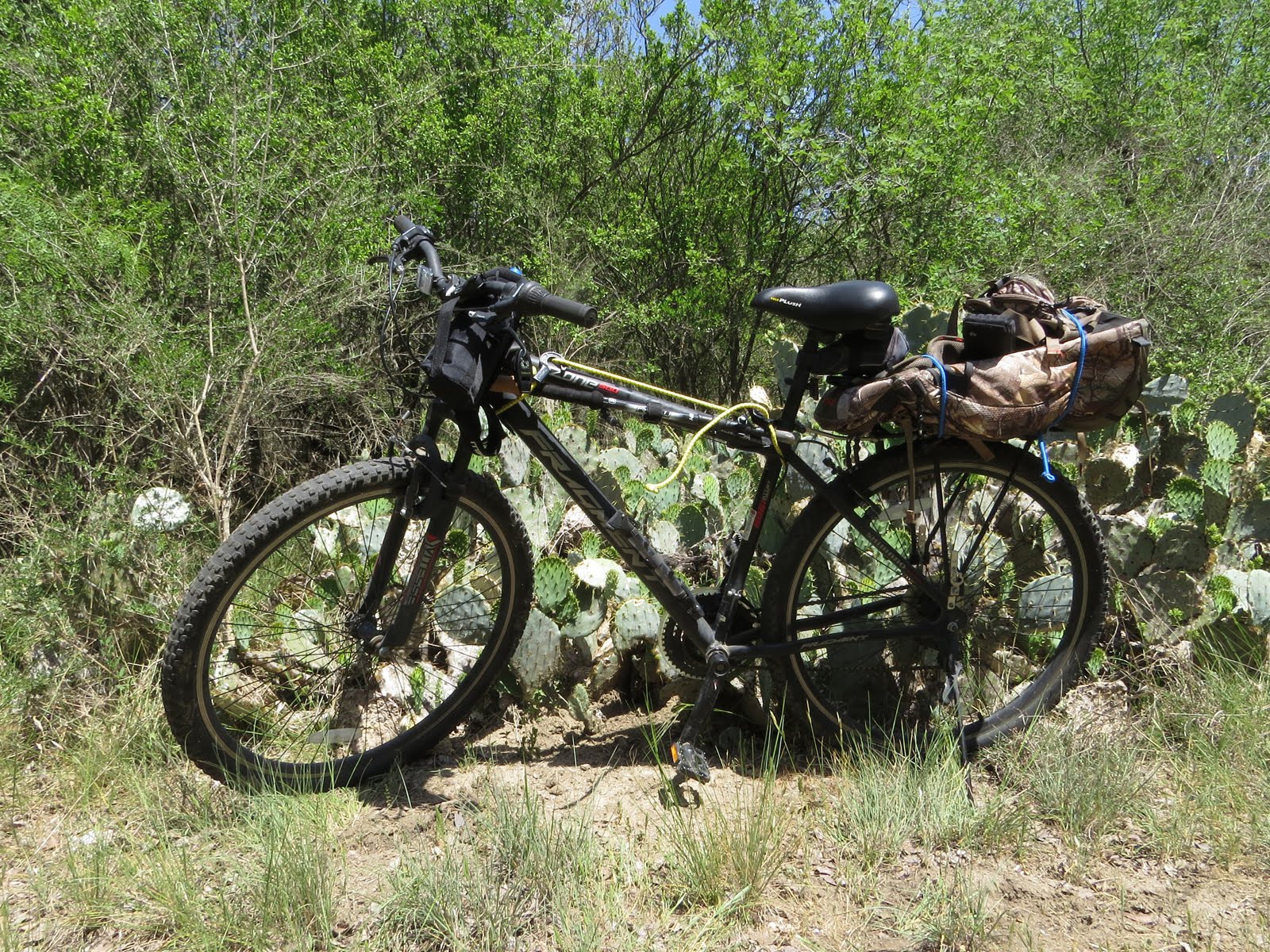
Pack strapped to the rear carrier, water-bottle/camera carrier on the handlebar, straw hat dangling down my back by its chin-strap, Tractor Supply ball-cap on my head with bike helmet over that, (For some reason most bike helmets don’t have a proper bill to shade your eyes) and most importantly, hiking sticks bungeed to the bike’s crossbar. (I double-checked that last point just to make sure this time!)

OK, let’s try this again!

That 3-mile-plus ride/walk up the River Trail wasn’t any easier this morning, but since I knew what to expect this time it somehow wasn’t as bad as yesterday.


This time I had all my gear with me, like I was supposed to yesterday but didn't, and when I got to the trailhead of the Gorman Springs Trail I was able to morph from trail-rider to hiker.

To get here it’s either the 3.4 miles up the River Trail or a mile and a half down the Gorman Falls Trail, both of which are bikeable, (Hey! If I can do it after that fiasco yesterday pretty much anyone can!) but since the Springs Trail is not bikeable a handy bike-rack has been provided.

Oh, and see that little white paper posted there just below the bird-house? That’s recommending you not let your little children run on ahead because there’s mountain lions in the area. . .


The Gorman Springs Trail meanders up the pleasant little valley/canyon formed by Gorman Creek which,


thanks to the strong spring at its headwaters, has a pretty decent flow for its relatively short length. (About a half mile from spring to trailhead then another quarter mile to Gorman Falls where it drops 65 feet into the Colorado River.)


The trail crosses the creek twice but at normal water-flows both crossings are dry-feet as long as you can stay on the sometimes slippery rocks, which, if you remembered to bring your two hiking sticks along, is easy.


The lower end of the watershed is a picturesque, pocket-sized valley,


that quickly starts morphing into the kind of limestone lined canyon which is more common for the area.


But other than a few riffles, there’s nothing ‘wild’ about Gorman Creek. Even when it goes over the falls (a different hike) it’s very measured and orderly about it.


The headwaters, where the trail ends, are a rock-lined pool into which the spring flows


and this is a good spot to shed gear and relax for a while.


I tried to include the toe of my boot so this photo would ‘read’ better, but I don’t think I was very successful. This is shot looking straight down along a foot-pipe that has been dropped into the pool right where the spring is bubbling up.


The other end of the foot-pipe is attached to this horizontal piston pump driven by an electric motor via a (missing) belt. The piston is tucked down there just below the electric motor and driven by the geared crank encased in a protective housing to the right.


Confusingly, the motor seems to be set up for a couple V-belts while the large drive wheel (a small piece of which is visible at the bottom of the photo) looks like it takes, or once took, a flat belt.


The discharge pipe, barely visible beyond the pair of 90 degree elbows where it arches up through the center of the photo, snakes its way up and over the edge of the canyon-rim above.  The Gorman homestead was up there somewhere but I suspect this pump hasn’t been used since at least the mid 80’s when the state bought the land.


If you're patient enough to sit still along the deeper parts of the creek you just might get a glimpse of the purest strain of Guadeloupe Bass left in the State.  I’m not sure if this is juvenile or breeding coloration, but the Guadeloupe Bass is generally greenish.


Later, as I was working my way back down the creek towards where I left the Quad-B a large bird noisily flapped its way out of the tree there in the background on the left and flew across towards that ledge just left of center. The noise initially made me think vulture, but as I briefly saw it in flight I thought Turkey?!

Turkeys don’t usually roost in the middle of the day, preferring to be on the ground foraging instead.


But I parked myself in an inconspicuous spot and settled in to wait for a while just to see what might happen.

Eventually, fooled into thinking he was alone again, this guy leisurely sauntered into view, though when he realized I was still there on the valley floor he did a double-take, turned, and head-bobbed back out of view as fast as his feet would move.


Not long after the turkey encounter I once again mounted up on the Quad-B and prepared to retrace my route back down the River Trail, pointed to there by the big red arrow on the right, battling up and down the various obstacles between here and and the campground, including heaving the Quad-B across that gap in the ledge over the mouth of Gorman Cave.

But  I had barely got my feet on the pedals when I was faced with my first challenge.

If you look close at the circled bit of trail, really close because the grey contour lines are kinda hard to spot, you’ll notice that that last little bit, the tail-end or the beginning, depending on which way you're going, of the River Trail is a bit steep.

In fact this is the lower end of the old Gorman Road where it switch-backed down the final plunge  off the bluffs to the river. That last drop is about equivalent to a 5 or 6 story building and now is a rutted, hard-packed chute of dirt and rock that is only vaguely related to a road; and it is really steep! (No photos because I was too busy surviving, both going up and down.)

Now here is where I broke my rule, the one that says if I would have to walk the Quad-B up then I also need to walk it down.

I don’t know why I broke my own rule. Maybe it was because I had just now got my butt on the saddle and was too lazy to get back off again, or maybe it was just because I’m a man and men do stupid crap. After all, it’s kind of our thing!

Remember the man’s prayer said at the beginning of every meeting of Red Green’s Possum Lodge? “I am a man: But I can change: If I have to: I guess” Well we have to say it every week because we actually never change. . .

Whatever the explanation for ignoring my own rule, I crept up to the edge of this downhill, grabbed for the brakes, and went over, desperately trying to pick out a line to avoid the worst of the ruts and biggest of the rocks while at the same time struggling to remember to keep my eyes open so I could look where I wanted the tires to go.

The motto of that same Possum Lodge is, ‘Quando Omni Flunkus Moritati’ – when all else fails, play dead – but there were a few times on that long slide down where I figured if I screwed up I wouldn’t have to ‘play’ dead at all!

But I made it unscathed.

Well – sort of.

You see, shortly after making it to the bottom in one piece (which I had to check a couple times before I believed it) I passed a family, mom, dad, two young children, and a terrier-sized dog, hiking the other way and I’m pretty sure they were well within earshot as I screamed the whole way down.

That was embarrassing. . .