Monday, August 11, 2014

North Country Redux: Trains, trains and more trains

July 22 2014

OK, if you're not into trains you might want to think about skipping this rather long post (All 38 photos worth!) because that's all it is.

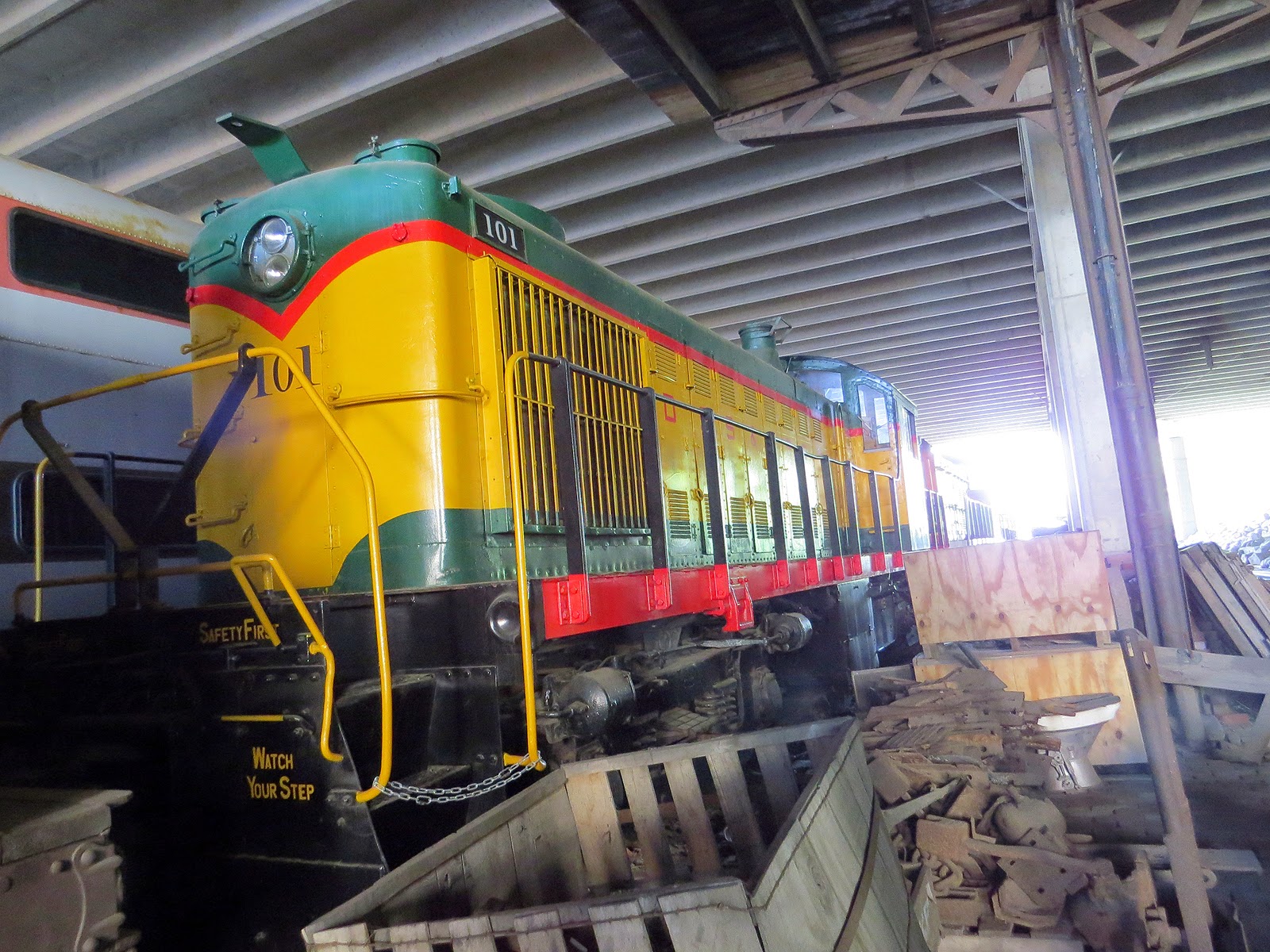
If you are into trains, this is a sampling, and only a sampling, of what is available at the Lake Superior Railroad Museum.

Photography was a bit difficult because much of the museum is housed under a sky-lighted passenger platform and it was a bright, sunny day. This created bright spots of light dropping down into the less bright interior (Didn't really want to call it a dark interior, but in relative terms it was!) of the platform area as well as some extreme back-lighting situations. The rest of the museum is outside on the approach tracks but also shaded heavily by 5th Avenue and a parking garage which have both now claimed the sky-rights over the tracks.


This is the depot from the Michigan Street side. The tracks are two more levels below Michigan Street and from the back side the depot is 4 stories tall.

Duluth is a steep city. In the vicinity of the depot the city is 9 short blocks wide. The first block is down near lake level and the 9th block is nearly 600' above that for an average rise of 65' per block! I wonder how that compares to San Francisco??

Since I35 now runs by between the depot and the harbor, with the main lanes in a ditch and the 5th Avenue ramps up in the air, you can't really get a shot of the backside of the depot anymore without a helicopter, and dang it, I forgot to bring mine!

As passenger traffic dwindled to nothing in the '50's this beautiful building was nearly lost to the wrecking ball!


Here, in addition to an express car, which we'll get back to later, you can get a glimpse of the arched, sky-lighted roof over the passenger platforms that complicates photography. This is a stub-end terminal where the trains can only approach from one end because all the tracks dead-end at the other. The advantage of this type of terminal is that passengers can get from one platform to the next by going around the ends of the tracks without having to use catwalks over the trains or tunnels below them. (Crossing the tracks themselves is highly discouraged because cleaning people-gunk off the windshield and out of the running gear is a really messy job!) The disadvantage is that it requires more switching of trains than is necessary at through-terminals.

As a witness to the extreme weather here in Duluth, the far end of the platform area is walled off with really tall doors that can be opened to let the trains in then closed to keep the winter out.


Of course, that kind of weather requires some serious snow-removal equipment.


And all track, regardless of the climate, needs maintenance. Note the funky little adjustable 'paddles' on the corners of this gas-powered doodlebug. (Used by maintenance crews to get around.) I guess they're there to sweep pennies off the track before they can derail the thing!


This 1957 station wagon was bought brand new and converted to a high-railer. (A vehicle that can run on both road and rail.) It was in use as an inspection car until the late '70's.


But there were still wrecks to be dealt with.


While the actual work of moving trains down the track could be hard and dirty


For a while there being a passenger was a pretty cushy deal. There is one entire car dedicated to displays of the various versions of the proprietary patterned china and flatware used in passenger service during those days by the various railroads. And the cars themselves were works of art and craftsmanship.


But not everyone's ride was quite so elegant!


Such as those that toiled on their feet for the whole trip (Except when they were sitting on the pot that is!), sorting mail in the express car as the train tore down the tracks,


often not bothering to stop at some of the smaller stations. In that case outgoing mail would be snagged on the fly by raising these arms and hooking a bag the station agent had hung track-side on a rack. Incoming mail was unceremoniously tossed out the door as they went by.


But the primary purpose of railroads in northern Minnesota was the movement of ore


and timber.


The massive timber of the old-growth forest is gone now, but ore is still moved from the mines to the ports in long trains where it is loaded into freighters that take it on down the lakes to plants where it will be processed and maybe end up as the fender on your car.


Over the years the equipment used for this has evolved from small and simple


to large and complicated


and everything in between; and the work on the steel rails continues on today.

Just out past the end of the museum tracks, there between the caboose and the switcher,


an engine, arriving from the engine-house where it has been serviced and cleaned,

is switched through the yard-throat


on it's way to head up today's North Shore Scenic train. Passengers are already eagerly gathering at the terminal waiting to board for the three or four hour trip up to Two Harbors and back.


This little depot, plopped down inside the big depot, houses a model railroad that is particularly well done considering it's a public display model.


It was all behind glass to keep our grubby little hands off the merchandise which made photography a challenge, there being no way to eliminate reflections with a simple point-and-shoot camera and a straw hat, but the detail in some of the scenes is incredible. Note the exposed boiler tubes in the half-dismantled steamer at this scrapyard.


And can't you just see yourself walking down these streets, maybe catching the bus after a little shopping!


Or maybe you work down here in the machine shop and live in town perched there above the rail yards.


Or perhaps your day as lighthouse keeper is punctuated by passing freight trains as you contemplate having to get up there and paint the tower where the iron window frames have stained the otherwise  crisp white spire.

I have seen mixed reviews for The Depot museums, some saying it's not worth the $12 entrance fee. Me? Well I was disappointed that the restored sleeper car was locked up so all you could do was look in from the platform end, and some displays didn't have information plaques to go with them whereas I stumbled on a few plaques tucked into corners and half buried under debris that didn't seem to have a corresponding display, but all in all I come down on the side of those that recommend the museum complex as well worth a visit.

Thursday, August 7, 2014

North Country Redux: Immigrants and woodcarvings


July 22 2014

After a very pleasant start to the day yesterday paddling the Tahquamenon River it began to heat up in earnest and by the time I got to Ashland Wisconsin it was downright - well - hot.

One again Karma was working for me and I managed to snag one of the two or three left-over sites in the Ashland city campground right there on the lake-shore which kept me from having to retreat a few miles to the Bad River Reservation Casino for a night of dry camping, which was a very good thing considering.
One of the 600' self-unloaders was way out there on the horizon near Ashland
Ashland is on the southern shore of Lake Superior but, despite reports of the lake surface temperatures being abnormally cold this year, the wind must have been wrong or something because  the air temps were well into the 90's, along with the relative humidity. Some in the campground were saying it was the first real summer-like day of the year and were reveling in it, but it forced me to reluctantly resort to the air-conditioner for the first time on the trip. (I've been harboring the notion of being able to remove that noisy 100 lb. behemoth from the roof and replacing it with a second vent fan but I suspect that if I keep ending up on these summer trips that's not going to happen. . .)

I probably should have climbed up there and hosed the mud-dauber nests off of the fan blades before I left home. At least that's what I hope has the thing so unbalanced it's shaking the whole van!

Storms blew through in the wee-hours last night and cleared some of the heat out, along with a few awnings and other lightweight camp stuff, but the forecast was calling for high temps again today. Not that it mattered all that much to me since I wasn't staying. Instead I hit the road again, timing my arrival in Duluth for the 9:30 opening of the Lake Superior Railroad Museum.

I tried getting here last year but the parking situation thwarted my plans. This year, armed with directions from Carol in the marketing department, I was able to park my oversize vehicle and turn up at the admissions desk just as they opened. (Most available parking is inside parking garages and I'm too tall for those!)

If you have an oversize vehicle and want to visit the museum: From I35 north or southbound, exit at 5th Avenue; at the light at the top of the exit ramp turn northwest towards downtown Duluth, away from the harbor and towards the hills; one street over is W. Michigan, turn right; the next street is 4th Avenue, watch for it because it's a modest street that could be mistaken for an alley, turn right; at the bottom of a short down-hill 4th T's at another alley-like street, from the T make a very short jog right then left into a parking lot tucked under the 5th Avenue exit ramp. If you are towing and miss the first entrance to the parking lot make sure you don't miss the second because the narrow street you are on dead-ends into the side of the museum a half-block in front of you. Assuming you've made the proper turns, this puts you in a lot marked as being for riders of the Scenic Train only and says nothing about oversize vehicle parking, but that's where Carol told me to go and nobody complained.
  
In addition to the train museum, the depot, saved from the wrecking ball back in the 50’s, also houses several other museums and exhibits.

One that was a surprise to me is called the immigrant’s waiting room. This is the room where immigrants arriving to work the woods and mines of the area first ended up as they came off the trains.

Along with the usual information plaques the room is full of stuff. Stuff like dresses and trunks and kitchenware and other things immigrants brought with them to their new life, but the real attraction for me, one which no one else seemed to even notice, was a flat-screen mounted at eye level just to the side of the door.

A film about the immigrant experience at Ellis Island was looping on that screen and I stood there and watched it; twice.
  
The film is done from the perspective of the immigrants, with firsthand accounts and readings of some of their writings. It starts by explaining the drivers behind immigrating in the first place, showing the economic and political conditions of their home countries. Conditions so desperate that they drove large percentages of the population to abandon all they knew and strike out for the vague promise of something better with the few possessions they could carry. It's one thing to hear about this stuff in history class or read about it, but to hear it from the mouths of people that lived it was - well - powerful, and just might make you want to rethink current immigration policies. 


From their homelands the film followed the immigrants through the process of getting cleared at Ellis Island. We’re talking about people desperate beyond most of our comprehension, people who had no prospects back home, who viewed police (I think this was a common translation for any official.) as someone who could, in the words of more than one immigrant, 'cut our heads off and leave us lie in the street to be cleaned up by the dogs'.

The film conveys their mix of hope for the future, fear that they will be rejected and sent back where they came from, confusion brought about by the language barrier and the complicated, multi-step process, and the gut-wrenching separation of families into males and females with their children for much of that process. A process where they had to overcome their most basic fears and submit to the ‘police’ at each station.


The film ended with the bewilderment of being released into the streets of the city and dawning comprehension that they had made it to their new country, and must now make it in their new country, building an entirely new life from scratch in a place they don’t know, don’t understand and haven’t yet learned the language.

My grandparents immigrated in the early 1900’s and I have to imagine they had a little bit of the same experience. At one point, while I was rooted there in front of that screen, a little boy fled to his mother’s leg and asked her what was wrong with that man, because I was standing there with tears streaming down my face.

Not cool to make me scare little kids like that, not cool at all!!  (Oh crap, just standing here writing this has me doing it again. If I hadn’t lost it long ago someone should just come along and take away my man-card right now!)


As a counter point to that very dramatic exhibit, is the whimsical look at the extensive woodcarvings of Herman Melheim. Herman, a Norwegian immigrant, built the 'little log cabin on Moose Horn Rd, on the way to Wooden Frog Park near Lake Kabetogama' and then started carving furniture. Things got a little out of hand and soon everything, and I mean everything, in the cabin was hand-carved by Herman!


The Depot houses several different museums and exhibits, including, in addition to those already mentioned, the Veteran's Memorial hall, the Forest History Gallery and the North Shore Scenic Railroad terminal, but my main purpose in getting here was for the Lake Superior Railroad Museum.


But in the interests of not subjecting you to a bunch of railroad crap you may or may not be interested in, I have decided to give that part of the museum it's own separate post.


Monday, August 4, 2014

North Country Redux: Living on the wild side!

July 21 2014


This is me setting out on Lake Superior in my kayak shortly after sunrise. Yep, that’s right, I'm tackling the very same Lake Superior that has over 500 shipwrecks to its name!

The nearest land out there over the bow is the uninhabited Canadian island of Ill Parisienne, 17 miles away. If I miss that it's Batchawana Bay, 32 miles away near the mid point of the Trans-Canada Highway, longest national highway in the world.


OK, admit it. For just a moment there I sounded like a bad-ass adventurer (Or a dumb-ass tourist!), but the truth is I only paddled out into the lake far enough to get the bits of shoreline you see here out of the photo; and, unlike any self-respecting bad-ass adventurer, I was wearing my lifejacket the whole time.


Adventure photo in the bag, I turned around and retreated with relief to the mouth of the Tahquamenon River. My real plan this morning was to paddle up the river for a bit of peace and quiet before packing up and leaving the area to start the long journey westward.
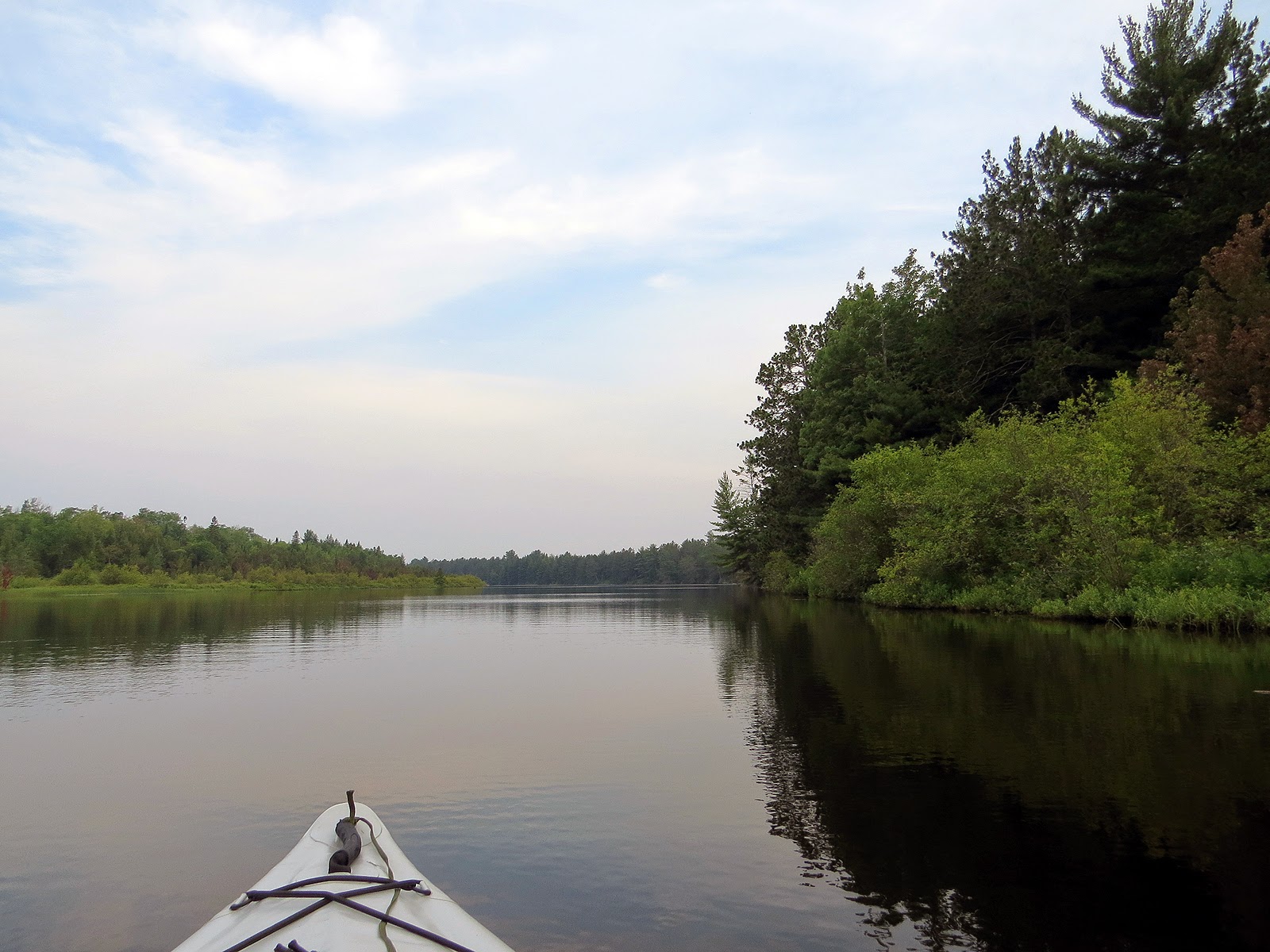
 You can paddle upriver here because there's not a whole lot of elevation change in the eastern half of the Upper Peninsula so the Tahquamenon is a lazy river, making it's way towards the lake slowly. Of course that also means you have to paddle back downriver too if you ever want to get there, wherever there is.

One of a pair of Sandhill Cranes nervously guarding a nest. I left them alone and let the zoom get me in close.


Back in the day there used to be some 15 logging companies up in the 850 square miles of woods drained by the river. In the winter loggers would cut trees and stack them on the banks then in the spring, when the river was swollen by snow-melt, the logs were dumped in and floated out of the back-country.


Because the river is so slow it would take up to a month or so for the logs to make it all the way to the lake. During that time men would patrol the river from sun-up to sun-down for $4 a day breaking up any log-jams, by hand wielded pike and peavey most of the time, by dynamite when they had to, and then prodding the behemoths on their way. Booms would be set up at the river-mouth to capture the logs where they were sorted by the marks ‘branded’ into the ends with specially shaped hammers, each company having their own unique shape or brand.


Some would then be lashed up into large rafts and towed to ports on the lake, but others didn't travel much farther. Just south of the river mouth there used to be a saw mill and the town that grew up around it. That’s all gone now, as far as I could tell completely gone, but there’s still a few stray big-ol' old-growth logs hanging around, such as the one lurking on the bottom at the present-day boat-launch at the river's mouth.