Thursday, September 22, 2016

Golden Spike Tower; The Humps


The theory behind hump yards is fairly simple.

Take a string of railroad cars and push it up a hill, letting the cars roll down the other side

This string of cars is being pushed up the hill from left to right. The two cars just left of center have just gone over the hump and are starting their roll down the other side. That gently arcing track above the two cars is sometimes called the sluffing track and is used to set aside any cars that shouldn't go over the hump for one reason or another.


Gravity and switches will guide the free-rolling cars onto the proper track. Here there are two different sets of cars rolling down the hill  heading for the classification tracks. The cars are sorted (classified)  onto tracks with other cars all going the same place.


The hump is on the left, the 'bowl' in the middle, and the sorted strings of cars are pulled out of the bowl and on to their destinations from the right end. The classification tracks are call the bowl because both ends are curved upwards. The hump end is obvious because there needs to be enough of a hill to keep the cars rolling. The other end is more subtle but still has enough of an upward incline to prevent any rogue cars from just rolling on through and escaping


 Except it's not quite that simple.

Take another look at the photo above. See how the sorted cars are all bunched up to the right end of the bowl? If they stop rolling too soon then there won't be enough room left on the sorting, or classification track to fit them all in, but you certainly don't want cars crashing into each other so hard something breaks, like maybe the freight, nor do you want cars stopping short of each other and not coupling together properly.


So first you have to weigh each car as it approaches the top of the hump


Then, based on the weight of the car, it's number of axles and speed (More sensors) and how far down the track it needs to go, retarders will grip the wheels just enough to make sure the car is slowed down to the right speed for momentum to finish the job.

Of course none of this is worth a hill of beans (Or should I say hill of rail-cars) if the cars don't all end up on the proper tracks down in the bowl, so on the way up the hill each car is scanned to find out where it's supposed to go, then computer controlled switches are lined up to move that car onto the proper track.

All of which might sound like a whole lot of things that can go wrong, but it sure beats the alternative of having an engineer, conductor and brakeman on the ground hand-switching each car one at a time while working off of a paper printout.


In fact, hump yards work so well  that Bailey Yard has two of them. The eastbound hump is there on the left and the westbound hump is over to the top right. (Confusingly, in Bailey Yard, the West yard is for eastbound traffic and the East yard for westbound. . .)

For some reason both east and west humps have the cars being pushed up and over the hill from left to right, (west to east) which means the sorted westbound cars have to be pulled out of the east (right) end of the bowl then reversed to push them onto the west departure tracks along the very top of the photo above. Now the cars themselves don't mind, but that does mean the road engines can't just reach into the bowl and take off with their train. (The eastbound cars are already headed in the right direction when pulled from the bowl.) Not the way I would have designed it but I'm just an observer and somebody down there must know what they're doing.


 Though Bailey Yard is a 24 hour operation, when I first got up there in the Tower the eastbound hump was sitting idle, but there was activity over there on the more distant westbound hump.


UP engine 3005 and slug 3006 were shoving a cut of tank cars up and over the westbound hump.

A slug has no power plant of it's own, just traction motors that take their power from the engine. This setup isn't much good for moving long heavy trains down the road fast, not enough horse-power, but it is a good way of getting plenty of traction at slow speeds.

The cars you can just see the roofs of beyond the engine are sitting in the westbound departure yard waiting to be sent on their way.


This tank car has just gone over the hump after being scanned and weighed.


It was the first of three tank cars all going the same place and here is the last car of the string heading down the hill.


Here they are nearing the bottom of the hill. From here the cars will be guided onto the proper track where they will be combined with other cars all heading to the same general destination, then sent on their way.

The cars between me and the humped tank cars are sitting in the westbound receiving yard. Some of them may go over the hump but the autoracks, with their yellow sides and white roofs, will probably just be pulled on through (towards the left) and added to a departing westbound train since you're not supposed to hump loaded autoracks (Kind of messes up the new paint!) and I would think most westbound racks would be loaded.


Here's where those extra couple of stories originally planned for the Golden Spike Tower would have come in handy. The yard is so big that even standing 8 stories above it isn't high enough to see everything well.


The eastbound bowl (top third of the photo.) is closer to the tower than the westbound bowl, even so it's still kind of hard to see into the bowl. But still, this photo gives a hint of the shear number of rail cars Bailey Yard handles at any one time.

As I showed in the previous post, the string of engines in the middle of the photo are getting sorted out before being assigned to various trains.


While I was trying to watch everything that was happening all over the yard, three engines snuck over the eastbound hump. They are there in the top center of the photo, next to the SUV coming down the hill after dropping off a crew at the hump tower.


 And it wasn't long before they were shoving a string of cars over the hump and rolling them in ones, twos, and three's down through the retarders and switches.


Next time I'll wrap up my visit to the Golden Spike Tower. 


Monday, September 19, 2016

Golden Spike Tower; The Engines

OK, last post I gave an overview of Bailey Yard. Over the next few I'll get into a little more detail because - well - I am a train freak enthusiast.

Of course you can't have a railroad without engines, and you can't have a rail yard without engine facilities.

At small yards this might consist of nothing more than a tanker truck pulled up alongside the engine to top up the fuel and oil tanks, but this is not a small yard!!

Here at Bailey Yard they have the Hinkle Locomotive Service and Repair Facility.


The four run-through tracks, up there in the longer section of the building, can take up to 12 locomotives at a time for everything from scheduled maintenance to changing out components.


For really serious repairs, including changing entire power plants, there are a half-dozen other bays.


Along side the main building are six service tracks where engines take on fuel, oil, and sand as well as have the toilets emptied and the floors swept.


Each service track can handle six engines at a time and up to 90 engines are processed every day.


But that's not the only service tracks at the yard. The eight tracks in the Google Earth image above are in another part of the yard and service east-bound through trains, mostly coal and other bulk freight, which keep the same engines for the entire journey and only stop long enough to top up.


Once the engines are repaired and serviced, they are set out until their next assignment


But before they're set out, they have to be sorted so the right engines end up on the right trains.


And this guy was working his ass off


shuffling engines from track to track


as he worked to get them all sorted out and in the right order.


Next time we'll take a look at the hump yards.

Yep, plural, as in there are two of them!


Thursday, September 15, 2016

Golden Spike Tower; The Setup


Unless you're a Nebraskan, or a railroad junky, you may never have heard of North Platte. (And I have no idea what ever happened to South Platte, or even just plain Platte, so don't ask. . .)

First off, this town of 25,000 is in Nebraska and more people live within the city limits of Houston than live in all of Nebraska. On top of that North Platte isn't a state capital or presidential birthplace you would have memorized as a kid, (Do they still do that??) but what North Platte does have is the world's largest rail yard.


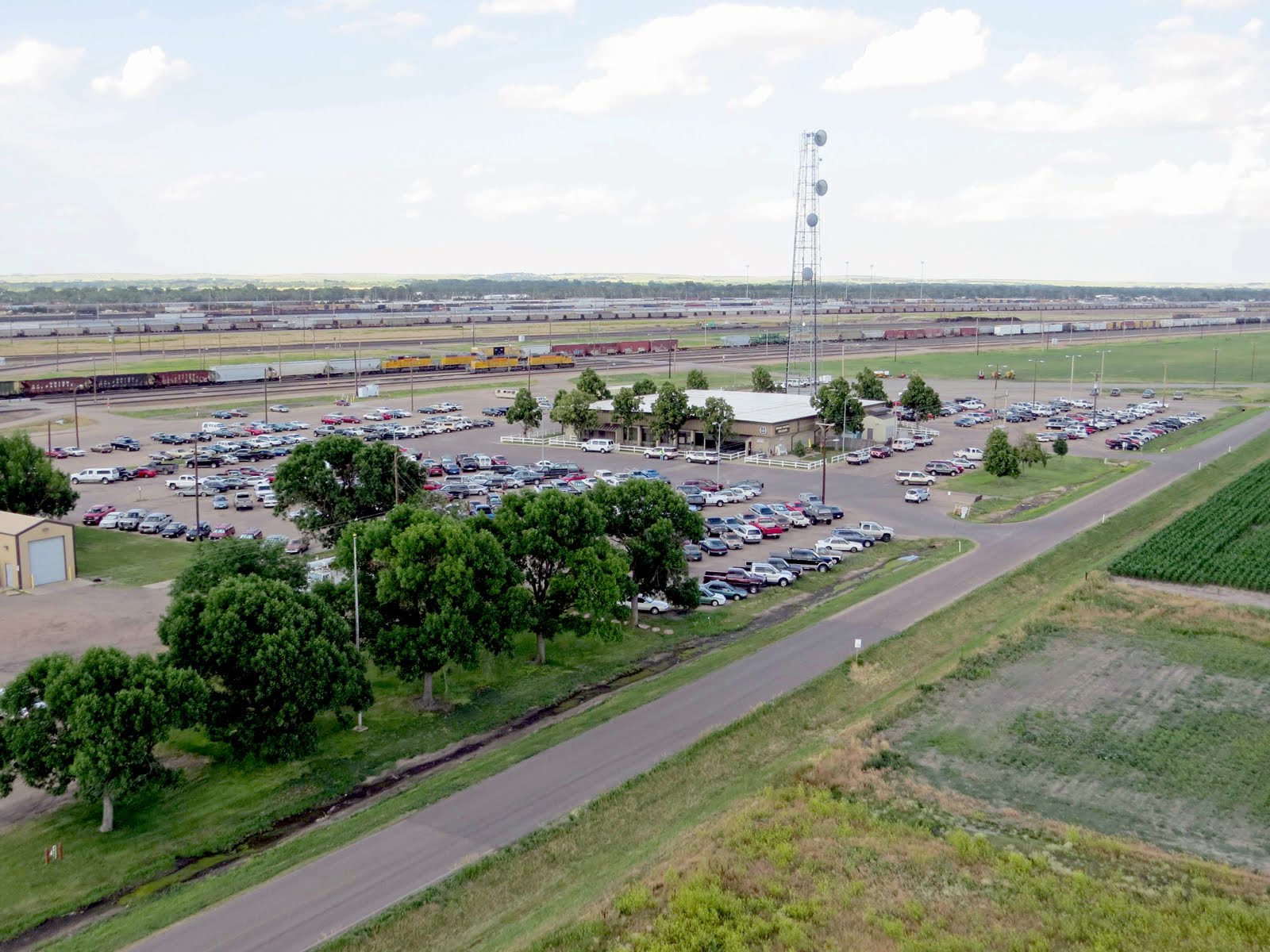
This Union Pacific's Bailey Yard covers over 2800 acres, is 8 miles long and over 200 tracks wide, and overlooking the whole thing is the Golden Spike Tower.


The tower had some rocky beginnings but opened in 2008, nine years after, and several stories shorter than, its conception. (Any taller and new building codes would have required a second stairwell which there just isn't room for.)


Actually getting to the tower, there at the end of the red arrow, seemed a little awkward, but then again I was running short on time and just wanted to be there.

The whole western side of North Platte is split in two by the eastern end of the rail yard and there are no 'main' roads on the south side of the yard, where the tower sits. The most common directions have you turning onto West A St. off of Buffalo Bill Avenue. West A St. starts out as a 30 MPH residential street and eventually turns into a 30 MPH country road slowly slogging through planted fields.

You can see the tower from the turn but it will seem like forever before you can make the right turn onto East Tower road (Not named for the Golden Spike Tower which is relatively new, but rather for the East Route Tower controlling eastbound departures from the rail yard.) but people don't seem to have any problems dropping in spur-of-the-moment. While I was there two different carloads of people just passing through on Interstate 80 saw the tower and stopped in to take a look.


 On the ground floor of the tower is a bit of a museum/gift-shop and a small theater with a 5 or 10 minute video about the rail yard.


Out the back door is an arc of flags representing the states Union Pacific services, 23 in all.


Of course there's Nebraska


But Texas has the highest number of track miles


And Montana the least

But I don't have time to hang around down here on the ground. The front doors to the tower close in an hour and I expect there's more than an hour's worth of looking to do from the two observation decks above me.

7 floors up there's the open-air observation deck that looks out to the north and west and one floor above that is an enclosed observation deck with a 360 degree view


and some information plaques.


 Including this stylized map of the yard which I personally found difficult to interpret because it's not to scale. The width of the yard is greatly exaggerated and I found it challenging when trying to associate what I was seeing on the ground with the map.

Fortunately there was a tower volunteer up there as well.

Usually I find retiree-volunteers that ask too many personal questions and can't seem to stop talking, annoying, (I have visions of them storing up words while living in a lonely room with nothing but a TV for companionship.) but in this case his knowledge of the yard was quite helpful.

Just northeast of the tower is the yard's command central, a busy place that operates around the clock, and over the next few posts I'll show some of those operations.

But since this will be all in still photos you will have to use your imagination to supply the zing of steel wheels against rail, the grumble of engines, the smell of diesel, the crash of couplers and the crisp bleat or lonely wail of air horns.


Monday, September 12, 2016

Harold Warp Pioneer Village; Wrapping It Up


OK, after four other posts I'm still here at the 20 acre Pioneer Village.

I've toured the massive Main Building, the dozen or so buildings around the square, and the Home and Shops Building, but there's still 8 or so very large buildings to go!!


And don't forget all the stuff set out there in the spaces around those buildings.


These buildings, the ones located towards the back of the property, are loaded with cars, tractors, farm implements and more. And I mean there's a lot of stuff in here! On top of that most every item on display has a little info plaque along with it to slow you down even more!


And one floor per building wasn't enough. Every one of these buildings has a second floor


which is also stuffed with - well -other stuff, besides cars or trucks. In the photo above you can see a display of snow-blowers tucked in along the aisleway.

As is the case with all the displays in these buildings, the snow-blowers are arraigned in the order of their development, so by starting at the 'old' end, you can stroll your way forward in time.


And to further clarify this 'timeline' style of display which promotes the museum's mission statement of Showing Man's Progress Since 1830 cars have been separated out by manufacture


so each one gets their own individual 'stroll through history.'


 But if cars, and the stuff that goes along with them, aren't your thing


There's tractors too!

(I'm not sure if the sign refers to people or the tractors themselves. Apparently most everything in the museum is in operating condition.)

 Hey! Our tractor marks it's territory just like this one!

Had to include this one for my JD nut enthusiast nephew.

Ordinary tractors not enough??  There's a separate building for farm implements


and steam-tractors, which need it, a separate building, because they are huge!! (This photo was taken from eye level.)

This 1917 Aultman Taylor develops 30 hp on the drawbar and 60 hp on the belt. With a 'field' speed of 2.25 MPH and a road speed of 4.5 MPH, it took two and a half days to drive this tractor under it's own steam, literally, the 50 miles from the Kemp farm to the museum in the spring of 1955.


But if none of that is interesting to you, there's also snowmobiles


Lots of snowmobiles. (Since my brother and nephews are big into racing vintage snowmobiles these are only a couple of the many shots I took.)


Maybe your interest is motorcycles?


Bicycles?

No?


How 'bout the development of home appliances?


There's even a whole display case devoted to the evolution of the can opener!  No really!! And it was pretty interesting too.

I have a whole lot more photos of this place, and the urge to post them, but in the interest of moving on, as promised, this will be the last post from here at the Harold Warp Pioneer Village.

Besides right now it's a few minutes after 4PM, I'm still 100 miles from The Golden Spike tower, which closes at 7PM so I really need to get going!

Oh, wait! one last thing.


This oddity is a home-built motorhome. In 1939 the owner of a trucking firm bought the truck new. Eleven years later he sold the company but kept the truck for himself. 


That placard there on the rear details the trips he and his wife took in it from 1953 through 1976, about 100,000 miles worth of trips.

But you see that nice, warm and inviting entry, complete with separate screen door, leading in off the back porch?

Well, have you seen those funniest videos of people walking into sliding doors or floor-to-ceiling glass??

That was me; and it hurt!!!  That opening is covered in plexiglass and I never saw it, not even after I bounced off it. . .

But seriously, if you ever find yourself out in south central Nebraska, check you map for Minden and stop at Pioneer Village.  Just make sure you have plenty of time.