OK, "surviving the night" might be laying it on a little thick.
This is not about emergency sleeping arrangements if caught out unexpectedly, something I've already touched briefly on in past posts. This is about my 'normal' sleep system for everyday use.
And why do I keep talking about "my sleep-system"?
Why get so fancy about it? Why not just call it a sleeping bag?
Because, despite the amount of thought and time we put into choosing one, a sleeping bag alone is only one component of a proper sleep-system.
But I'll start with the sleeping bag anyway.
When I was growing up (Actually I'm pretty sure I'm still growing up! But you know what I mean.) you were pretty much on you own when it came to picking the proper sleeping bag for the conditions. There were no standards and each manufacture could say whatever they wanted about their products with no Yelp or Amazon reviews to dispute them.
Obviously this was not ideal - at all - but even so, it wasn't until 2005 that the EN, covering 24 European countries and New Zealand, established a sleeping bag standard and it took even longer, until 2017, before international standards (ISO) were established, giving the rest of us global consumers a fighting chance at getting it right.
But only if we understand the standard.
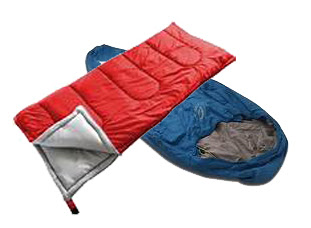
The color choices and wrinkles don't make it easy to read, but this particular sleeping bag's official, verified ISO standard's comfort range is 35F to 40F.
Generally speaking men sleep about 5 degrees hotter than women so in this case a man might find this bag comfortable - which is defined in the standards as in a 'relaxed posture' and 'not feeling cold' - at temps down to 35F while a woman might find 40F to be the limit.
But to complicate things, we are all different. For instance, contrary to gender rules I sleep significantly colder than The Wife - which explains why I'm huddled under two blankets during air-conditioner season while she has kicked her sheet off and is sweating.
In reality, when using the bag in the photo above, at 45F I can feel coolness where it is resting close against me, for instance on the tops of my thighs when laying on my back. And at 40F I'm ready to look for a little more protection.
Unfortunately, even beyond our personal micro-climatic differences, our gullibility has a tendency to lead us down brick roads that often turn out to lean more towards shit-brown than golden-yellow.
It's human nature, and marketers know all about human nature, that when we see advertising that claims a battery will last "Up To X hours", we ignore the manufacture's legally indemnifying "Up To" and focus only on the "X hours", at the same time also managing to completely ignore the implied "under best conditions that you will rarely see" clause. And in the case of sleeping bags, when we see "Rated Down To" that's what we tend to fixate on.
But the IOS standards actually define three separate ranges for sleeping bags, one of which is not comfortable and another of which is downright miserable. So, against all our inclinations, conscious and subconscious, we should be looking at the highest range, the comfort range, and completely ignoring the rest.
Some manufactures, such as Winner Outfitters, the bag in the first two photos, try to protect us from ourselves (OK, in reality they are probably more interested in protecting their credibility and corporate reputation but it all comes down to the same thing.) and splash only the comfort range, in this case both the "typical male" and "typical female" ranges, in large print, while others, such as those that built one of my other sleeping bags, not only print out the whole shebang, but in this case the marketing department has actually bent the standard it in such a way that implies more performance than is really there.
In this case that middle, so-called "Male Comfort" range actually corresponds more closely to the ISO's "Transitional" range, which is defined as "curled up, fighting the cold but not yet shivering". (Extreme is basically defined as "You're going to be damn cold, might suffer some frostbite, but probably - maybe - won't die.")
So knowing this, and myself, when evaluating a sleeping-bag I look at the highest number in the highest range of the ISO results and ignore the rest.
But I'm not out of the woods yet. (Not sure if that pun was intended or not - - -)
To achieve those certified performance levels I still need to understand how those numbers were derived, and if I don't - well I'm kinda screwed!.
Whenever I see a reviewer complaining about the way the inner lining of a sleeping-bag feels against their skin I know they're doing it wrong! That's not how a sleeping-bag is designed to work.
ISO ranking of a sleeping-bag is actually a rather involved process that uses self-heating manikins that simulate a human's internal heat generating properties, the same manikins they use for testing a variety of survival gear. The surface of these manikins is then plastered all over with thermal sensors and and the manikin stuffed into the sleeping bag under evaluation. More thermal sensors are mounted on the bag's outside. Then the whole shebang is loaded into a carefully controlled cold-chamber for several hours of observation and data-logging.
That seems pretty straightforward but what I might have missed if I wasn't looking for it, is that, per the testing protocol, (Fortunately for us both ISO and EN use pretty-much the same standards and testing protocols) these manikins are first dressed in a typical base layer and then the manikin-stuffed-sleeping-bag is placed on a basic foam pad before the door to the cold room is closed.
If I neglect either of these details my experience will definitely not be on par with the claims.
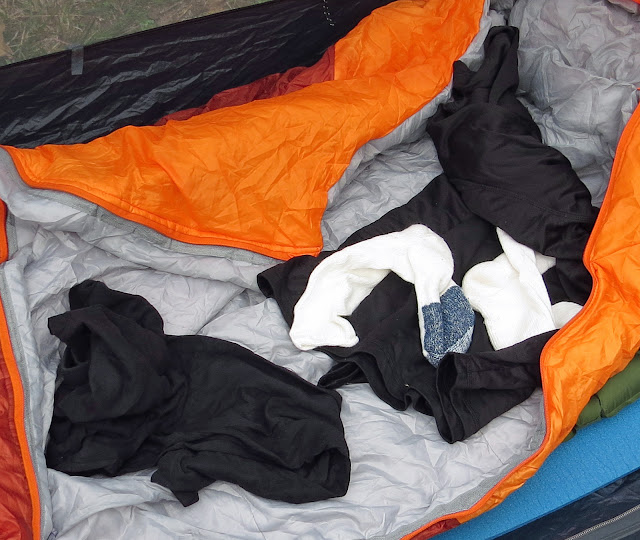
Even if you normally sleep naked, if you think about it, wearing a base layer inside your sleeping bag not only matches the standards and allows the system to perform to expectations, but it makes a lot of sense.
It's a lot easier to wash your night-grunge off a load of base-layer than off a sleeping bag. Even if your sleeping bag is technically machine washable it will last longer and keep performing better if you keep it out of the clutches of that agitator!
To ensure I have a reasonably fresh and dry base-layer to sleep in I have a set dedicated for night-use.
Now base-layers, styles and materials, is a post of its own so I'm going to pretty much gloss over the complex subject here except to say, for budget reasons, and because I don't live in a northern climate where I can get a great deal of use out of them, I use a run of the mill, off the shelf, thermal top and bottoms. Usually polyester with maybe a touch of spandex or rayon and never ever any cotton since its cold-weather performance is suspect at best and life-threatening at worst!
Oh, and I do insist on proper wool socks. (I feel a tirade on the properties of wool verses cotton coming on, but I'll try to restrain myself here. Although - - maybe that's a topic for yet another post?)
When it comes to sizing base-layers, despite the science of close-contact and wicking; which is what a base-layer is really all about and not the "insulation factor" marketers have tried to pound into our brains; because of my dislike of wearing tight clothes I set aside any residual vanity time, age, and that cruel mirror hasn't already beaten out of me and buy XL or even XXL if available.
And speaking of circulation being cut off by too-tight base-layers, (OK, so maybe I wasn't actually speaking about that but I think it was implied!) the need to maintain full circulation is especially true for socks! Like hands, feet don't actually generate any significant heat of their own, instead they rely on either the circulation of warm blood or thermal conductance through direct contact with another heat-source. And unlike my hands, I can no longer tuck my feet into my armpits for that thermal conductance when they get cold! So tight, blood-flow constricting socks, whether around the foot itself or around the ankle are not a good choice. (Let's hear it for old-fashioned knit rag-wool socks!)
For simplicity I keep this dedicated set of base-layer tucked right inside the sleeping-bag all the time.
Remember a few paragraphs ago when I mentioned that the testing of sleeping-bags is done on top of a foam pad?
Well that's not for the comfort of the manikins, though I'm sure it doesn't hurt. They do that because this pad, or something similar is critical to a proper sleep-system.
Again, staying warm is all about insulation, and insulation is all about trapped air.
Well I'm not a weightless cartoon-princess, and when I lay down on my sleeping-bag I crush most of the air out from the part of the bag underneath me, so now I need to replace that critical insulation with something that won't allow the air to squeeze out so easy.
It's kind of a side bonus that such a 'something' can also be used to cushion my delicate body from the hard ground!
There are a number of options here, and I've tried several of them. This is the multi-part sleeping-pad system I've currently settled on.
It starts with this Sleepingo air-mattress which is advertised to be 2" thick when inflated. In reality I think it's slightly less than that at 'normal' inflation pressures, but not enough to quibble about.
It works reasonably well, both as insulation and as padding, and takes less than two minutes to inflate by mouth.
OK, technically I'm not supposed to inflate things like this by mouth because it introduces moisture into the interior which, over time, could promote the growth of nasties, but who carries an air-pump around in their backpack??! Besides, the nasties are, presumably, trapped inside and can only get out when I deflate the thing.
To keep the nasties from becoming too much of an issue I just lay the partially inflated mattress out on some black plastic on a sunny day. I figure this helps cook them into dead nasties.
Deflating and packing the air-mattress is pretty easy.
I stick my finger into the large inflation-valve and pull the little one-way flapper thingy part-way out, at which point most the air inside rushes out in a sigh. (So if you hadn't brushed your teeth before inflating the night before - turn your head away!)
Then I fold the mattress into thirds lengthwise, lay it out flat with the still-open valve on the bottom,
and start rolling from the other end, herding any remaining air out the valve.
Once I have it rolled up I close the valve, both so that that little one-way flapper thingy doesn't get a permanent kink in it and stop working, and so that the valve assembly lays flat as I slide the mattress into the carry-sack.
OK, you may have noticed in the previous photos that there is yet another component to my sleeping-pad setup.
The thing about air-mattresses, including those fancy open-cell-foam-filled self-inflating jobs, (I have one of those too but it packs so large I've never carried it on a backpacking trip, though it does make a useful folding-chair-insulating pad on chilly evenings.) is that if they spring a leak they are useless, both as insulation and comfort. And I don't kid myself, at some point as I'm messing around in camp and flopping myself down to sleep on a variety of terrains, a bit of pokey debris is going to ride in on my butt or jab up right through the tent-floor, and a leak will ensue!
Yes, leaks can be patched, and you've seen from a previous post that I do carry a bit of patch-material with me. But, have you ever tried to locate a pinhole leak on a freezing cold night in the dark confines of a one-man tent - then find your patch material - then have to locate the leak all over again because you lost track of it while digging through your pack for said patch material?? Oh! And while all this is going on that pokey bit that caused the leak in the first place has gone on a Norman Bates stabbing spree, complete with screechy, staccato, stabby music, so you're screwed anyway!
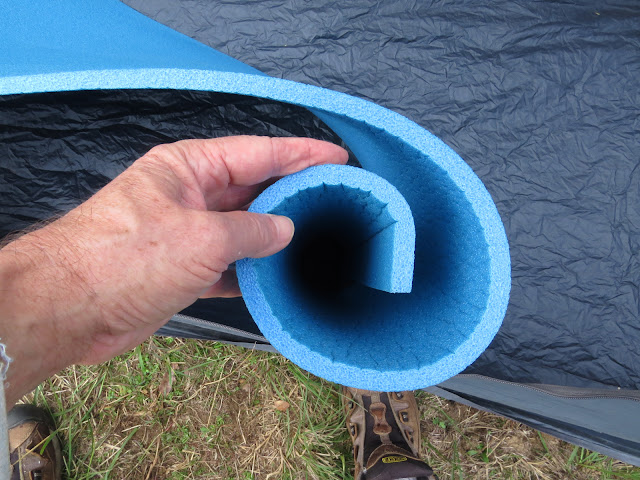
My solution is to have something that can't spring a leak between air-mattress and ground or tent-floor. Something like this 7/16 inch thick closed-cell foam pad.
By placing this pad down first and the air-mattress on top of it I accomplish several things.
- The foam provides additional protection from pokey things under the tent
- It adds additional comfort because now instead of my hip and shoulder bones bottoming out on the hard, cold ground when I turn onto my side, the pad, which is really difficult to compress all that way to flat, provides some cushion for these pressure-points.
- The closed-cell foam pretty much doubles the insulation value of my sleeping pad system.
- And if I do suffer a puncture (Well - I mean the air-mattress. If I suffer a puncture I bleed - - -) the pad is there to offer me additional support and some insulation while I ride out the failure.
The downside to this type of closed-cell foam pad is that it doesn't like to lay out flat without weight on top of it, won't behave when rolled without an additional strap to keep things under control, and packs kinda big.
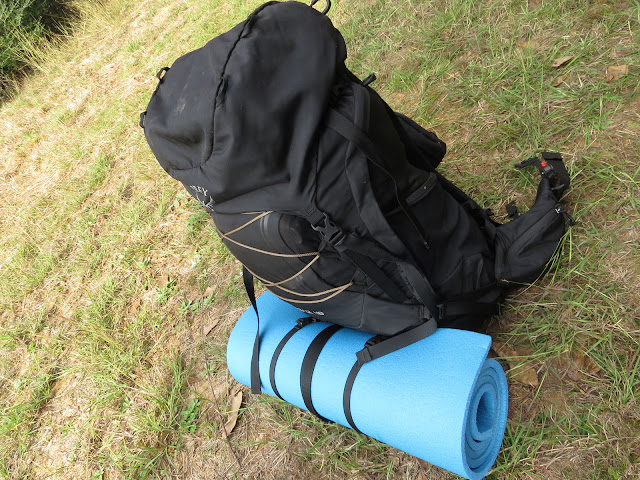
But because it is so light I don't notice the bulk when carrying it in the straps designed for those new-fangled accordion- fold waffle-style pads.
Speaking of which, since they offer all the same protective and insulation properties as my roll-up pad with the promise of even more comfort, and pack up easier (I have to wrestle my pad into a pretty tight roll so it fits within the limits of the straps on the pack.) maybe one of these days I'll get one of them and try it out.
But for now, moving on to the last item in my sleep-system, which is purely about comfort.
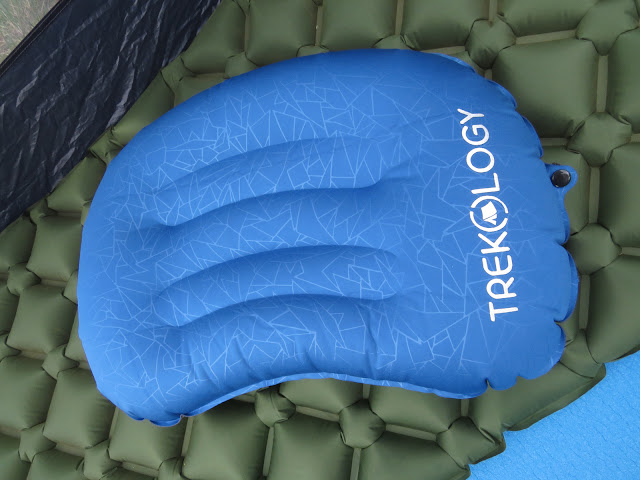
My pillow.
OK, I know this seems like an indulgence. After all, a jacket crammed into a stuff sack, a wadded up pack, even some shirt-wrapped boots, can, and all have been, used as a pillow and have the advantage of being carried along with me anyway.
But the snowflake truth is that my pillow is more comfortable than all those alternatives. And it really doesn't take up that much room.
In fact I have two of these pillows and use one in The Van as well, having ditched that big bulky, traditional pillow. (actually, for the past several years that big bulky traditional pillow has been taking up valuable space in one of the cupboards in our living quarters because it hasn't worn out so I can't bring myself to throw it away just yet.)
The bottom-side of this inflatable pillow is covered with tiny little rubber-like nubbins which keeps the diminutive yet perfectly adequate pillow firmly in place for my beauty slumber. (Not the pillow's fault the beauty part doesn't work!)
For technical issues having to do with thermal conductivity that I've decided not to bore you with right now, in cool to cold weather this pillow should not be used with your head directly on it but always with the sleeping bag between head and pillow.
For stay-in-place redundancy this pillow also has an elastic strap on the back-side designed to be looped over the sleeping pad. I don't use it for that but do use it for keeping tabs on the tiny little stuff-sack overnight. It's amazing how well those little suckers can hide!
On thing I absolutely do not want to do to my sleeping bag(s), even though it makes for a neat and compact solution, is store them in their stuff-sack.
As pointed out earlier, staying warm is all about trapped air, and trapped air is all about loft. By confining a sleeping bag to its stuff-sack for extended periods of time I am slowly ruining that loft as the fluffy material inside my sleeping bag, synthetic or natural, that provides its loft becomes permanently less fluffy.
Draping the bag over a hanger is better than leaving it in the stuff-sack but there will be a line of crushage where it folds over the hanger.
Some sleeping-bags come with loops on one end or the other that they can be suspended from by a hanger in a tall closet, assuming you have one, which is a pretty good solution.
But I have the ideal solution for bag-storage. Since I ditched traditional bedding in The Van years ago in favor of sleeping bags, all I have to do is leave my sleeping-bags laid out where I use them on my bed. This way the stuffing stays nice and fluffy and evenly distributed. And the bag is right there ready to use every night.
Because my bed is wider than I need for sleeping, I can keep both my mummy-bag as well as my light-weight rectangular summer-bag on the bed together. There's plenty of room for the one I'm not using to be pushed out of the way against the wall.
Which is handy since, if in the middle of the night things get a little too cool for my mummy-bag all I have to do is pull the summer-bag over the top like a blanket.
Which leads me, perhaps a little inelegantly as a segue, but leads me non-the-less, to the rectangular bag verses mummy bag question.
My first few sleeping-bags were rectangular. Maybe because there just weren't any affordable mummy-bags when I was a kid. These are familiar, an old standard if you will, but they have their failings and my hands-down favorite for cool to cold weather sleeping is the true mummy-bag. (Not those short versions that, rather than using a full 'hood', close up around your neck in a misguided effort to save a few ounces of weight!)
Not only is there less of it to pack, carry, and warm up from the inside with nothing but my body heat, but there's nothing quite like the feeling of sliding feet-first into a mummy-bag after stripping down in an icy tent or cold van to change into my nighttime base layer, and feeling the instant warmth envelop me when I snug my head into the hood. (We lose a significant amount of heat from our heads so I keep it covered!)
On especially cold nights I've been known to tighten the cords until the hood comes down over my eyes and the bag is snugged up to my bottom lip. But I never cover my mouth and nose because breathing all that moist air into my bag will quickly turn it into a soggy, clammy refrigerator!
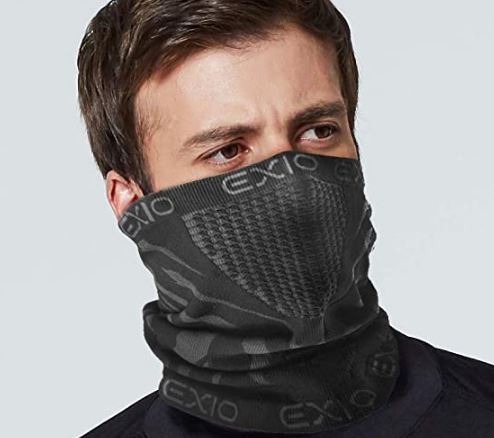 |
| (Don't get excited ladies, or gentlemen - not really me!) |
If it's so cold that my nose is a problem it's time to pack up and head closer to the equator!
But if that isn't practical I have one of these which is designed to be pulled up over the nose and breathed through, though I mainly use it to keep my neck protected from icy - OK, and even somewhat cool - winds during the day.
Some mummy-bags are advertised as having extra girth so there's room to roll around inside like a cue-ball in the bottom of a bowling ball bag. Frankly I don't get it. Mummy-bags should be worn like an outer layer of pajamas, not flopped around inside like you were under silk sheets on a king-bed in an overheated penthouse suite at The Ritz! All that extra sleeping bag just means that every time I shift position inside its luxurious roomyness my body heat has to warm up new territory all over again.
Besides, if I roll anywhere I need the hood-part of the bag to roll with me, and that's easier if the whole bag just rolls with me.
Where mummy-bags don't shine is hot-weather sleeping. Most mummy bags have side-zippers that only open up the top half to two-thirds of the bag so aren't especially good at ventilation, leaving the legs and feet cocooned in a sweat-box . This leaves the choice of either self-basting inside the bag or just laying on top of it. Which is fine for a night or two of back-country tent camping but, as you've already seen, I have a traditional, light-weight - and really inexpensive I might add - rectangular bag as well.
Being flannel with cheap, bulky stuffing, it doesn't squish down well at all so it isn't a good backpacking bag, but since it can be opened up completely and tossed off as much as necessary it makes a comfortable alternative for warm to hot nights in The Van, and I already alluded to how I also use it as a blanket over my mummy bag on especially cold nights.
OK, So that's about it.
The only thing I haven't covered is packing the sleep-system for a backpacking trip, but that's another post.
Oh - and someday, if I get really careless with the wallet I might indulge in the holy-grail of a real down bag that will pack ridiculousness small, yet still keep me warm down to oh-crap-it's-cold! But for now what I have seems to be working just fine for me.