Thursday, September 8, 2016

Harold Warp Pioneer Village; Homes and Shops Building


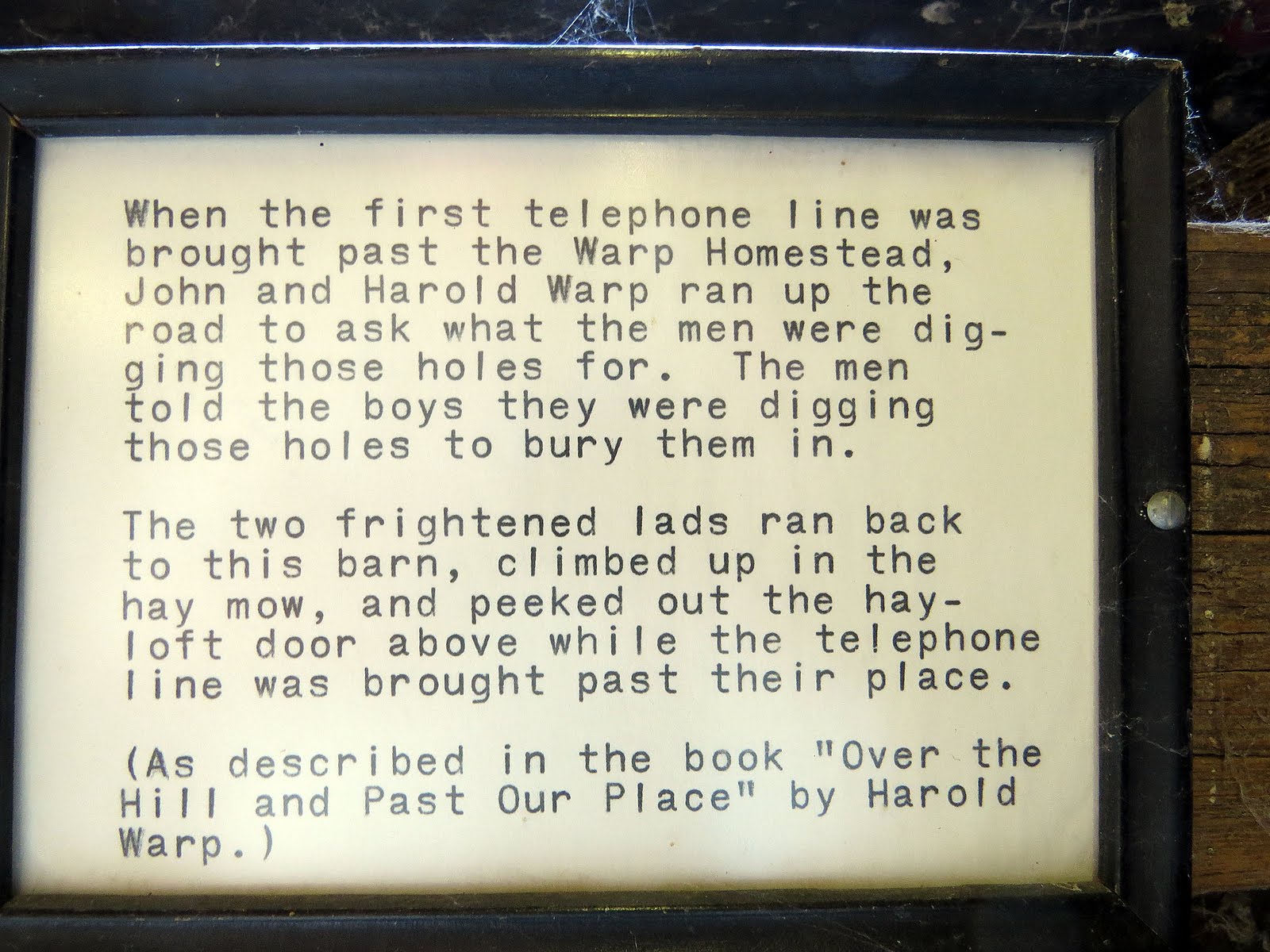
When you walk towards the back of Pioneer Village's 20 acres and leave the environs of the square, which is really round-ish, one of the buildings to be found back there is the Homes and Shops Building, or the Shop and Homes Building, depending on whether you're reading the brochure/web site, or the sign posted on the building. . .

 
It's a two-story warehouse sized building and man is it cool inside!!

Not as in chilly, since I don't think there's air-conditioning in any of the buildings, but as in - well - cool.

(Being the middle of summer I didn't think to check on the heat situation, but given the climate and the nature of some of the exhibits they have I suspect that at least some of the buildings are heated.)

Though it doesn't describe everything in here, the basic premise of this building is picking up whole rooms from the past and dropping them in here, intact.


Some of those rooms are shops that made a variety of every-day items, In fact many of them still make everyday items because crafts-people still man them.

 And I have - had - an Uncle that would have gone nuts over the extensive HAM radio display on the second floor. Unfortunately the display is at the front of the building where some windows are and in my haste, (There's just so much to see!) I didn't realize the couple of photos I took were back-lit so bad as to be unusable. (You'd think I'd know better. . .)


Almost lost on a wall covered in a bewildering array of musical instruments was a wooden clarinet that may very well have been cousin to the one I played all through Junior High. (Don'cha love it when your stuff turns up in museums?? Makes it kind of hard to forget your age. . .)

$16 for the set is catalog price, not a flea-market markdown!

There were several such 'walls' in this building. Walls showing the progression of  radios, of high-fi's and stereos, of furniture,

baby-buggies, vacuum tubes, computers, TV's, and more.


See that IBM System 3 back there? I used to be paid to fix those things.


As well as the card punches data entry operators used to sit at all day, every day, (Some of them were a little nuts!) and the high speed readers (in the background) that fed those punched cards into the computer.


 The cards, by the thousands, were used to load both programs (Apps to you millennials) and data into the computers and if you dropped a deck - well - it was going to take a looonnng time for you to sort them all back out again. And don't bend one in the process! Or you'll have to call me in to fix the machine.


Just inside the main door is nearly an entire TV studio from the 50's with cameras and control station that Harold picked up when KOLN of Lincoln, Nebraska updated it's equipment.


It was fun to check out the TV schedule for the week. I wonder how many of us remember when I Love Lucy and Dragnet were prime-time shows. For that matter, I wonder how many of us remember when TV stations used to sign off for the night with the national anthem played over the image of a fluttering flag.


Much of the first floor is devoted to 'rooms'.

The rooms, including this apothecary, (Holy crap!! Look at all those drugs! Remember that this is from before the days of training, licensing and monitoring of pharmacists!) are enclosed behind plexiglass. Unlike the general store on the square, here the plexiglass is floor to ceiling so there's no need for alarms to chase off those forgetful photographers, but the reflections do make for difficult photography.

That arrow in the bottom left is a reflection from the floor and not  part of step-by-step instructions on how to sweep those jars off the shelf. . .


When the Exchange National Bank building was opened in Minden in 1884, Doc Hapeman moved into an office upstairs. During the 63 years (!) he practiced out of this office he delivered over 3000 babies and learned (?!!) how to successfully perform appendectomies. During his years of practice it was discovered that mosquitoes carried malaria, that vaccines could ward off many prevalent diseases and antibiotics were developed that could combat deadly infections.

After several years of sitting empty, Harold Warp got his hands on the entire contents of the office and eventually moved it here.

!!!!!!!!!


This horrific looking device


was part of Ruth Cox's beauty shop that she ran from 1935 to 1976 in Topeka.


But it's not all fun and games, or torture in the name of beauty, in here.

There is a test!

This is one of three boards peppered with items "any pioneer child would recognize.  Do you??"

Free giveaway, that thing in the top left corner is not a crude doll, it's a bed-wrench, used to tighten the ropes strung under the mattress.

But I've saved what I found most interesting for last.

Today, if you discount the 'media room' found in some houses, the kitchen is the heart of the house, and it always has been. In this building are a series of rooms set up as kitchens from different era's


 Starting with this 1830's kitchen.

The info plaque for this one is large and the protective plastic cover made photography difficult (Yeah, that's right, it was the plastic and had nothing to do with the photographer. . .) so in this case I've typed it out below. If you blow the photo up you can follow along with much of the descriptive text. (Or you can just ignore the whole thing because by now you're bored with all this rambling. . .)


Back in 1830, the kitchen was one end of a one room sod house or log cabin commonly built on the Midwestern prairies. Not by choice, but by necessity, the kitchen served practically every purpose from dining, heating, and sitting to laundry, bath and parlor. The opposite end of the room was reserved for sleeping quarters.

A flint lock gun with powder horn and shot horn rest on the fireplace chimney; copper kettle, iron tea kettle and iron cooking posts in front of the fireplace; copper bed warmer, tongs to put hot coals in the bed warmer, fire lighter and waffle iron.

Over the fireplace opening is a big wood beam for a mantle on which sits a work basket, hand carved 17th century cheese press, hand scythe, cookie iron, wooden butter bowl, ladle and paddle, bellows, one-piece hand-made flat iron, meal grinder, cot coals iron and a grease lamp.

To clean the fireplace, there is a broom made from bluestem grass. A carrying yoke that was placed over the shoulders of the pioneer housewife had two bucket attached that carried water or other heavy objects is also on display in the 1830’s kitchen.

The hand-hewn table and benches add a touch of pioneer ingenuity. On the table are a copper (Betty) lamp, grease lamp and snuffer, hand carved ladle and forks. Hand carved wooden butter dish, wooden bowls and plate, and a milk jug.

Complementing this kitchen are a homemade loom and a floor rug woven on the loom; a spinning wheel; a zither; stomper-type wooden churn; homemade wooden cradle; homemade wooden clock with wood weights and works,; wooden bucket and a dipper; wooden wash bowl and homemade soap, and a handmade stool from the crotch of a tree.


This has got to give anyone my age a warm-fuzzy!!


1980 kitchen

Aaahhhhh! What were we thinking???

On that note, and because by now, if you're still hanging in there, my welcome has probably worn out and I must be stinking (Three day old fish and guests and all. . .)

Next time I'm going to try to wrap up my visit to the Harold Warp Pioneer Village,

                               but no promises. . .


Tuesday, September 6, 2016

KOA's: Use Them Or Not??


OK OK, I know that to some KOA's are the amusing little stepchild of campgrounds, that old standby when you need to come up with a laugh; the fart joke of campgrounds; and I used to count myself among those.

 I think a lot of that was a learned behavior. It just so happened that KOA got it's start when I was a kid, so KOA's had a lot of visibility in the early days of private campgrounds, at a time when our family's camping was frequent and heavily 'wilderness experience' focused. Also, with 3 small kids and all that goes along with that, our parents probably found the forest campgrounds more affordable in those days, so I was rarely exposed to private camping, and especially not KOA's! (Dad! Dad!- - No. - - But they have a playgrounnnnndddd! - - We can't afford that kind of foolishness, now sit back and get your feet off your sister's side of the car!)

Even as I got older, for no particular reason other than prior association, my nose used to crinkle up in the precursor to a sneer at the thought of stopping at the distinct winged A-frame, but I was young and dumb then. I'm still a bit on the dumb side now and then; but I am older now!

Granted, as far as the camping experience goes, generally KOA's are not in the same class as most public campgrounds, usually far closer to major roads and noise than scenery and hiking, (But not always!) but admit it, for a simple, hassle-free overnight stay, especially when you could also use a laundry facility, a decent shower, shore-power for the AC, or need a convenient base-camp while exploring a more urban area, they really come in handy.

For years, many years, as in my membership goes back to the late 80's, I was a die-hard, loyal Good Sam-er, but then I noticed that I was finding fewer and fewer Good-Sam affiliate campgrounds when I wanted a simple, quick and easy one-nighter. (For longer stays public campgrounds are my first choice.) I was finding KOA's instead.

After too many undiscounted nights in KOA's all over the country I finally broke down and paid for a Value Kard, then immediately followed that up by loading the KOA app onto my phone. (All the while feeling very disloyal to the Good-Sam card in my pocket, hoping that the little guy didn't figure out what I was doing and lose his goofy smile.)

Boy, I wish I'd done that long ago!


Now, when I do want some amenities, and I'm starting to think ahead, usually sometime around mid-day, all I have to do is punch up the app, take a look around at the KOA's in the area,


check out any that look interesting, as in about the right place along my projected route, and with a simple tap on the Book Now button I can reserve and pay for a site using my info already loaded into the app.

If I'm going to be a late arrival that's just another few taps, then when I do get there the paperwork and my site assignment will be waiting for me in the box outside the door.

And remember, I've already paid so an early departure, before the office opens, is no problem.

It takes just a few minutes and and a handful of taps, then I don't have to spend the rest of the day wondering where, and if, I'm going to find a spot for the night.

(Making reservations and worrying about finding spots never used to be part of my road-trips, but that was before the population of camping road-trippers got so out of hand!)

I've found KOA prices to usually be competitive with comparable private campgrounds, sometimes even with nearby public campgrounds, plus, as a card holder I get a 10% discount and each stay earns me rewards points for even more discounts, and since they're all part of the same network I pretty much know what I'm going to find without having to squint at the fine print to interpret the three-tiered, ten-point rating system some campground guides use.

True, each KOA is privately owned, but once a year corporate inspects each one with something like a 600 point checklist so I can safely expect a certain level of consistency across the network.

At the end of a long day of touring this consistency of standard is better than getting caught out by something like the non-KOA Biggs RV Park at Budget Host Motel near Trinidad CO where, for the cost of a resort stay, the 'campground' was a few power posts in a steep, dusty, isolated field behind the motel and if you wanted the bathroom or shower, boldly listed as part of the amenities, the front desk would give you temporary custody of a key to a currently empty room. (I gave it a shot, but after about an hour of listneing to trucks braking for the DOT station and staring at a broken down old trailer blocking my view of the scraggly hill while contemplating walking up to the pimply faced kid at the reception desk to get a permission slip to use the bathroom, I went and got my money back, minus $5 to cover the electricity I might have used up in that hour, and drove over the hill to the Raton KOA which is where I finally paid for my first year's worth of Value Kard.)

So, though I don't wear my kard like a badge on my lapel, I am a kard carrying KOA'er.

Actually you don't need to carry a kard at all anymore, you just punch up the app on your phone and show them your member number, or the people in the familiar yellow T-shirt can just pull it up on their computer using your name.


Yep, KOA.  The yellow sign is hiding there behind the tree to the left of the large rig. This shows one of the advantages of driving a compact rig. I can tuck into sites others can't, like this one which is nothing more than a small gravel pad sitting all alone out in the grass.

It's not that my travel budget allows for a private campground every night, but I can squeeze one in here and there without the sheriff dragging me off to the workhouse. So now I use  the heck out of KOA's and see no reason to stop.

(By the way, I am not affiliated with or compensated by KOA in any way other than as a regular customer.)


Monday, September 5, 2016

Harold Warp Pioneer Village; The Outside


OK, so if you follow the little arrows painted on the floor long enough, you come out the back of the Main Building, a complete museum experience in its own right, and into a circularish 'square'.

Arraigned around the square are a number of historical buildings, including the one-room schoolhouse that started this whole thing.

When Harold heard the schoolhouse, which he had attended, was to be sold and moved or demolished, he bought it and thus started Pioneer Village.


First thing I noticed on stepping out into the sunshine was that, like the Main Building, most everything, and I mean everything, is labeled.


But fair warning, even though there are something like a dozen buildings arranged around the square, over time that wasn't near enough to hold everything and there are 8 or so additional buildings behind the square.

  And I'm talking huge buildings hundreds of feet long, most with two floors. But more on those later, for now I'll stick to the square.


This is the very building where Harold's father filed for his homestead in 1876.

He made a dug-out for himself and his oxen in the side of a hill and spent 5 years 'proving up' by living on the land and making improvements before receiving title to it.  During those 5 years he built a sod house,


met a girl from another homestead. And in the winter of 1880 they drove a lumber wagon 20 miles to the nearest sod church and got married.


Like some of the smaller items on exhibit, many of the buildings around the square are part of Harold's personal history.


But not all.

I'm pretty sure there were no grain elevators like the ones peeking over the fence here when this place, known at the Old Elm Creek Stockade Homestead, was built in 1869.  At the time this building was moved to the museum the homestead was in the hands of the 4th generation of Keeneys.


 But as more and more people moved into the area, not all of them were farmers and homesteaders. As self-reliant as they were, farmers also needed things they couldn't produce themselves, so the merchants soon followed.


This store is stocked, literally to the rafters, with goods of the period.

What you can't see here, because I was composing the shots to eliminate it, is a plexiglass barrier between me and the goods. Every few feet is a sign warning that reaching over the barrier will trigger an alarm.

Well they ain't lying!! As some damn fool visitor, simply trying for a better angle on a photo discovered.

(Fortunately, at the time I was the only one there in the building to witness my own damn-foolery.)


And when people start moving in, the railroad usually wasn't far behind.


 When this depot was moved to the museum and restored, they found 7 different floors laid one over the other. Clearly this was a busy place as the original floor only lasted 3 years!


 It wasn't all work and no play.


But living on the edge was a lot of work and little play.


Yep, still more to come so stand by.


Thursday, September 1, 2016

Harold Warp Pioneer Village; The Main Building


When Harold Warp named this place Pioneer Village, he wasn't so much thinking of the Little-House-on-the-Prairie kind of pioneer, though they are certainly included in the exhibits, but rather he used pioneer in the sense of innovator.

This Ford sitting in front of the main entrance is used to ferry guests from the tiny Minden airport to the hotel/museum complex.


And as you walk up to the main doors you get just a little hint that cars are part of the experience here, but they are only a part of the experience.
 
When you walk in the door to Pioneer Village, go on past the gift shop (Time enough for that later! Or not.) until you hit a wall, turn left and on the left is a ticket window. It's manned by the gift shop clerk so you might have to wait a moment while she rings up a customer.

With ticket in hand turn 180 degrees and walk through the turnstile into what's called the main building.

View from the turnstile


The place is packed to the gills and can be a bit overwhelming, but, just like the RV Hall of Fame, arrows have been painted on the floor to help guide you along. But did I mention this place can be a little overwhelming???

Oh, I did??

 
Oh yeah, so I did, but - well - this place can be a little overwhelming!

So much so I hadn't made it down the first jam-packed aisle before realizing that I had buried myself behind the camera and was clicking and moving without taking the time to see and absorb. After a short pause, during which I gave myself a stern talking too, I went back to the beginning and tried again, this time experiencing and not just recording.


Most of the major exhibits have little placards that go well beyond just labeling what you're looking at but also giving some background info and context.


Like the Willis MB (Jeep) of WWII, this Studebaker wagon was built by the thousands for the Army during the Civil War, and later became a civilian favorite for those heading west.


The place is full of work-a-day tools too, such as a traveling merchant's wagon, horse-drawn school bus, and this street sprinkler, of which most every town of any size had one in an attempt to knock down the dust of the unpaved main street. The nozzles across the back could be individually controlled so as to not wet down the well-dressed patron that might be encountered while walking on down to the haberdashery.


One of the advertisements displayed with this Cadillac espouses on how "it will go up any grade of any well traveled road without balk - most times without change of gear"

It goes on to announce that "Mr. Atwood, an auto novice, drove a Cadillac containing three passengers from New York to Waterbury Connecticut, 93 miles, at an average speed of 13 miles an hour without a stop."

They proudly point out that "This is typical performance, no accidents, no repairs, but perfect satisfaction."

Oh yeah, and one of these can be yours for the price of $750.


And if plain old wheeled transportation isn't your thing, how 'bout something a little weirder??


There were no posted instructions, but as far as I could figure, you put fuel in the tank there over that extra wheel in the back, started the engine which spins the wheel, then used a big lever up by the steering wheel to lower it to the ground and launch yourself. With a top speed of a blistering 25MPH (My tractor will only hit 15MPH and it scares the crap out of me at that speed!!) I'm not sure Clifford's parents were all that happy when grandpa gave him this contraption!!


Want something a little more than just ground-based transportation??

Well that's here too


No??  How 'bout a history of lighting?


Or dolls?


Remember when I was visiting the Hippie Memorial in Arcola, which is also happens to be the birthplace of Johney Gruelle, the creator of Raggedy Ann and Andy??


 Clocks?? Typewriters?


Firearms?


Outboard Motors?


Steetcars and trolleys?


OK, maybe boats?
Boats that are cars?
Sportsfishing?


And I haven't even made it out of the main building yet!  There's something like 23 more buildings to go!!!!


To be continued